China's AIDriven Smart Shipping Surge
AI Learn Chinese
5 hr • 0 read
China's AIled maritime revolution: smart vessels, shore control hubs, and bold 2027 pilot targets.
The Dawn of Intelligent Maritime Operations
China's maritime sector is undergoing a profound transformation, driven by the integration of artificial intelligence, advanced sensing, and seamless communication between vessel and shore. This shift moves beyond simple automation to create a networked ecosystem where ships, control centers, and regulatory bodies operate as a cohesive, intelligent unit. The vision is clear: enhance safety, boost efficiency, and pioneer a new standard for global waterborne transport and patrol. This article explores the tangible steps being taken, from retrofitted patrol boats to ambitious national pilot programs, painting a picture of a future where the line between human operator and autonomous system blurs strategically.
A Patrol Boat Reimagined, Not Replaced
The journey often begins not with a new build, but with a clever retrofit. In Shenzhen, Guangdong province, engineers took an existing patrol vessel and transformed its capabilities without altering its primary structure or compromising its original performance. This approach is pragmatic and cost-effective, proving that intelligence can be layered onto proven platforms. The vessel now serves as a floating laboratory for intelligent navigation, equipped with a suite of sensing devices and a sophisticated communication module.
This retrofit philosophy addresses a key hurdle in maritime innovation: the high cost and long lead times of new constructions. By focusing on modular upgrades—adding navigation AI, enhanced radar, and ship-to-shore data links—existing fleets can be rapidly upgraded. The goal is to enhance the crew's situational awareness and decision-making, not to render them obsolete. The vessel operates under a human-in-the-loop model, where autonomy handles routine segments while human oversight remains paramount for complex situations.
The technical core of this retrofit is the intelligent navigation module. This system processes data from multiple sources: radar, AIS (Automatic Identification System), GPS, and the vessel's own sensors. It plots optimal courses, predicts collision risks, and adjusts for currents and weather in real-time. For a patrol boat operating in busy waters like those around Shenzhen, this means a significant reduction in cognitive load for the crew, allowing them to focus on law enforcement and observation tasks rather than basic piloting.
In addition, the communication suite establishes a constant, high-bandwidth link to the shore-based control center. This isn't just for emergencies; it's a continuous data stream sharing the vessel's position, speed, sensor readings, and internal system status. This digital twin concept on shore allows for remote diagnostics, performance monitoring, and the ability to intervene if the onboard systems detect an anomaly beyond their operational parameters. It creates a persistent safety net.
The Shore-Based Cockpit: Command from Land
The counterpart to the smart vessel is the shore-based control center, often described as a "cockpit" for maritime operations. Located conveniently on land, this facility is staffed by operators and navigation experts who monitor multiple vessels simultaneously. Their role is multifaceted: providing real-time navigation advice, analyzing aggregated sensor data for broader operational picture, and being ready to assume remote control when necessary.
This center is the nervous system of the smart shipping pilot. Using advanced visualization software, operators see a unified display of all connected vessels, their intended routes, weather overlays, and any identified hazards. If a vessel encounters a narrow channel, severe weather, or an emergency, the shore team can offer precise guidance.
In the most critical scenarios, they can take direct, remote control of the vessel's propulsion and steering to navigate it to safety. This capability is particularly valuable for inexperienced crews or in conditions where local human judgment is compromised.
The technology enabling this remote control relies on ultra-reliable, low-latency communication links, often a combination of satellite, 4G/5G cellular networks, and dedicated maritime radio. Security is a paramount concern; these links must be fortified against cyber intrusion to prevent unauthorized commandeering. The system implements multiple authentication layers and encrypted data protocols to ensure that only authorized personnel can send command signals to a vessel.
For the crew aboard the vessel, this shore support acts as a powerful force multiplier. A small patrol boat crew now has instant access to the computational power and situational awareness of a much larger command center. They receive alerts about traffic patterns miles ahead, get recommendations for fuel-efficient routing, and have expert analysts reviewing complex sensor data. This transforms the role of the onboard crew from primary navigators to tactical operators and law enforcement personnel, with navigation handled as a shared responsibility with shore.
Trial by Water: Early Implementation in Shenzhen
The system entered trial operation in early July, as reported by the Maritime Safety Administration under the Ministry of Transport. The location in Shenzhen is strategic. As a core city in the Guangdong-Hong Kong-Macao Greater Bay Area, it boasts some of the busiest and most complex waterways in China, handling massive volumes of cargo, passenger ferries, and fishing vessels. This provides a perfect, demanding testbed for the technology.
During these trials, the focus is on refining the human-machine interface. How do alerts from the shore center get presented to a patrol officer without causing distraction? What is the precise protocol for transferring control?
These operational nuances are as critical as the underlying technology. The trials also test the system's resilience against communication dropouts, a common occurrence at sea, ensuring the vessel can safely revert to fully autonomous or manual mode if the link is lost.
Initial feedback from crews like those of the Haixun patrol boats indicates a period of adjustment. Trust in an autonomous system must be built through demonstrated reliability. Early phases likely involve the AI offering suggestions that the human crew must actively approve, a "decision support" mode. As confidence grows, the system's autonomy can be incrementally increased for less complex segments of a patrol route, such as open-water transits.
The specific metrics from the Shenzhen trial are telling. For instance, the system might have successfully navigated a 14.2 nautical mile segment with minimal human input, or reduced fuel consumption by a measurable percentage through optimized speed and routing. These quantifiable results are essential for building the business case for wider adoption across China's vast maritime administration and commercial fleets.
Blueprint for 2027: National Pilot Ambitions
The Shenzhen trial is not an isolated project but the first step in a meticulously planned national strategy. By 2027, China has laid out explicit, ambitious targets for its comprehensive smart shipping pilot regions. The goals, as stated by transport authorities, are to establish at least three such comprehensive regions, open more than five dedicated pilot routes, develop over 10 replicable application scenarios, and put more than 100 intelligent vessels into operation.
A "comprehensive pilot region" implies more than just a test route. It suggests an ecosystem: a designated waterway with upgraded VTS (Vessel Traffic Service), dedicated communication infrastructure, supportive regulatory frameworks, and clusters of technology developers and shipowners participating. The Guangdong-Hong Kong-Macao Greater Bay Area is a prime candidate for one such region, given its existing infrastructure and policy innovation appetite.
The "replicable application scenarios" are key. These are specific use cases with defined technical and operational parameters that can be copied elsewhere. Examples include: autonomous container ship shuttle services between ports, AI-assisted navigation for bulk carriers in dense traffic, or smart patrol systems for inland rivers and coastal waters. Developing these scenarios turns experimental projects into standardized, off-the-shelf solutions for the broader industry.
Putting more than 100 intelligent vessels into operation by 2027 signifies a move from prototypes to fleet deployment. This will likely include a mix of retrofitted existing ships and new builds designed from the keel up with smart systems. The vessels will span different types: from the patrol boats and law enforcement craft to possibly coastal container ships, tankers, and passenger ferries on scheduled services. This scale is necessary to generate the operational data required to refine the AI algorithms and prove long-term reliability and economic benefit.
Beyond the Coast: Inland Waterways and Shallow Waters
The smart shipping initiative is not confined to the open sea. China's vast network of inland rivers, crucial for regional logistics, presents a different but equally compelling set of challenges and opportunities. The Lijiang River in Guangxi serves as a notable example. Here, the introduction of a pure-electric maritime law enforcement vessel designed for shallow waters, sharp bends, and narrow channels demonstrates a tailored approach.
Inland waterways often have tighter constraints, less sophisticated navigation aids, and more unpredictable traffic (including fishing boats and tourist barges). An electric vessel offers immediate advantages: zero local emissions (critical for preserving scenic and ecologically sensitive river environments), quieter operation, and often simpler mechanical systems that are easier to integrate with control systems. Its design for shallow drafts allows it to operate in areas inaccessible to deeper-draft patrol boats.
This Lijiang River vessel complements the AI navigation focus. While the Shenzhen patrol boat tests networked intelligence in a complex port area, the Lijiang vessel tests the integration of electric propulsion with smart systems in a physically constrained environment. The control algorithms must account for different handling characteristics of an electric drive and the frequent need for precise maneuvering in close quarters. It represents a different "application scenario" within the national plan.
The success of such specialized vessels paves the way for a diverse fleet of smart ships. The technology stack—sensors, AI navigation, shore communication—must be adaptable to everything from a deep-sea 20-foot equivalent container ship navigating international lanes to a small, electric ferry crossing a city's river. This versatility is a key measure of the program's ultimate success.
The Technology Stack: Sensing, AI, and Communication
Underpinning all these deployments is a common technology stack. The first layer is multiple sensing devices. This goes beyond standard radar and GPS.
Modern intelligent vessels are equipped with high-definition cameras (often with night vision), lidar for precise 3D mapping of the surroundings, sonar for underwater obstacle detection, and environmental sensors measuring wind, waves, and water depth. The AI navigation module acts as the central brain, fusing this multi-sensor data into a single, coherent, real-time model of the vessel's environment.
This sensor fusion is critical. No single sensor is perfect. Radar can be fooled by sea clutter; cameras are blinded by fog or night; AIS data can be spoofed or missing from small craft.
The AI's value lies in its ability to weigh the reliability of each input source, identify discrepancies, and build a more accurate "picture" than any human or single system could. For instance, if the AIS shows a vessel on a collision course but the radar and optical track show it altering course, the AI can correctly assess the reduced threat level.
The second layer is the intelligent navigation algorithm itself. This is not merely an autopilot. It is a predictive system that models the behavior of other vessels based on maritime rules (COLREGs), predicts their likely maneuvers, and plans optimal, safe paths accordingly.
It constantly runs "what-if" scenarios. The algorithm must be trained on millions of hours of real maritime traffic data to develop a nuanced understanding of typical and atypical vessel movements in different regions, from the Minjiang River in Fujian to the open Pacific.
The third layer is the robust communication platform. This is the vessel's lifeline to the shore-based cockpit. It requires high bandwidth for streaming sensor data and video, and ultra-low latency for remote control commands.
The architecture is likely hybrid, using satellite for oceanic areas and terrestrial networks (5G) near the coast. Redundancy is built in with multiple independent communication paths. The platform also manages the secure authentication and data encryption essential for safe remote operation.
Challenges on the Horizon
Despite the momentum, significant challenges remain. Regulatory frameworks are struggling to keep pace with technological change. International maritime law, particularly the conventions governing safety, manning, and collision liability, is predicated on a human master in command.
How does a "remote master" on shore fit into this? National regulations will need to be updated to certify AI navigation systems, define the responsibilities of shore operators, and set standards for cyber security.
Cybersecurity is perhaps the most critical non-technical hurdle. A smart vessel is a connected node in a network. A breach could lead to theft of cargo data, disruption of logistics, or, in the worst case, malicious takeover and use as a weapon.
Protecting these systems requires a "defense-in-depth" strategy, from hardened vessel networks to secure shore infrastructure and continuous monitoring for intrusion attempts. The Maritime Safety Administration will need to develop and enforce stringent cybersecurity standards for all intelligent vessels operating under its jurisdiction.
There are also human factors and labor considerations. The transition may create anxiety among maritime professionals about job displacement. The successful model, as seen in Shenzhen, is one of augmentation, not replacement.
The shore operator and the onboard crew have new, higher-value roles. But, this requires significant retraining. Mariners need to become system managers and tactical decision-makers, not just helmsmen.
Institutions like Dalian Maritime University's Navigation College will be crucial in developing these new curricula.
In addition, the economic case must be solid beyond the pilot phase. The capital cost of retrofitting or building intelligent vessels is high. The business justification rests on improved fuel efficiency (from optimal routing), reduced crew size (for certain vessel types), lower insurance premiums (from enhanced safety records), and increased utilization (from less downtime). Demonstrating a clear return on investment over a vessel's lifecycle is essential for commercial shipowners to adopt the technology widely.
A New Paradigm for Maritime Law Enforcement
The application for maritime law enforcement and patrol is particularly transformative. Agencies like those operating the vessel in Bao'an district of Shenzhen are tasked with safety inspections, pollution monitoring, search and rescue, and interdiction of illegal activities. An intelligent patrol vessel dramatically extends their effectiveness.
Consider a scenario: a report of illegal wastewater discharge from a ship at night. A traditional patrol would need to launch, search the area, and visually identify the offender—a time-consuming process. An intelligent vessel, already on patrol and linked to the shore center, could have its AI analyze sensor data (e.g., water quality sensors, thermal imaging) and AIS data to automatically flag suspicious vessels. The shore center could then vector the patrol boat directly to the location, with the AI already highlighting the probable source, cutting response time dramatically.
The pure-electric vessel on the Lijiang River is perfect for this role in ecologically sensitive areas. Its quiet operation allows for covert surveillance, and its zero-emission profile means it does not contribute to the very pollution it is monitoring. Its ability to navigate shallow waters means it can access areas larger vessels cannot, patrolling closer to shorelines and into smaller tributaries to enforce environmental regulations.
The shore-based cockpit becomes a force multiplier for law enforcement command. A single operator can monitor the status and location of all patrol boats in a region, see a live feed of what each vessel's sensors are detecting, and coordinate responses to multiple incidents simultaneously. This creates a integrated maritime domain awareness system that was previously impossible with analog radio reports and fragmented data.
The Global Context and China's Position
China's push in smart shipping is not occurring in a vacuum. The global maritime industry is exploring autonomy, with projects like Norway's Yara Birkeland (an autonomous container ship) and various trials in Europe and Japan. But, China's approach has distinct characteristics: a strong state-led strategy, integration with massive domestic port and inland waterway infrastructure, and a focus on both commercial and governmental (patrol, enforcement) applications.
China's massive 18.34 billion metric tons of annual port throughput and 354 million 20-foot equivalent units (TEUs) of container traffic provide an unparalleled scale of operational data. This data is the fuel for AI training. The more vessels, the more scenarios, the faster the algorithms learn. China's extensive 128,700 kilometers of inland waterways also offer a vast, varied laboratory for testing that few other nations possess.
The state-driven nature, led by the Ministry of Transport and its Maritime Safety Administration, allows for coordinated investment in infrastructure like dedicated communication networks and the establishment of pilot zones with supportive regulations. This top-down coordination can accelerate development in a way that purely market-driven efforts might not. The 2027 targets are a clear manifestation of this state-led, goal-oriented approach.
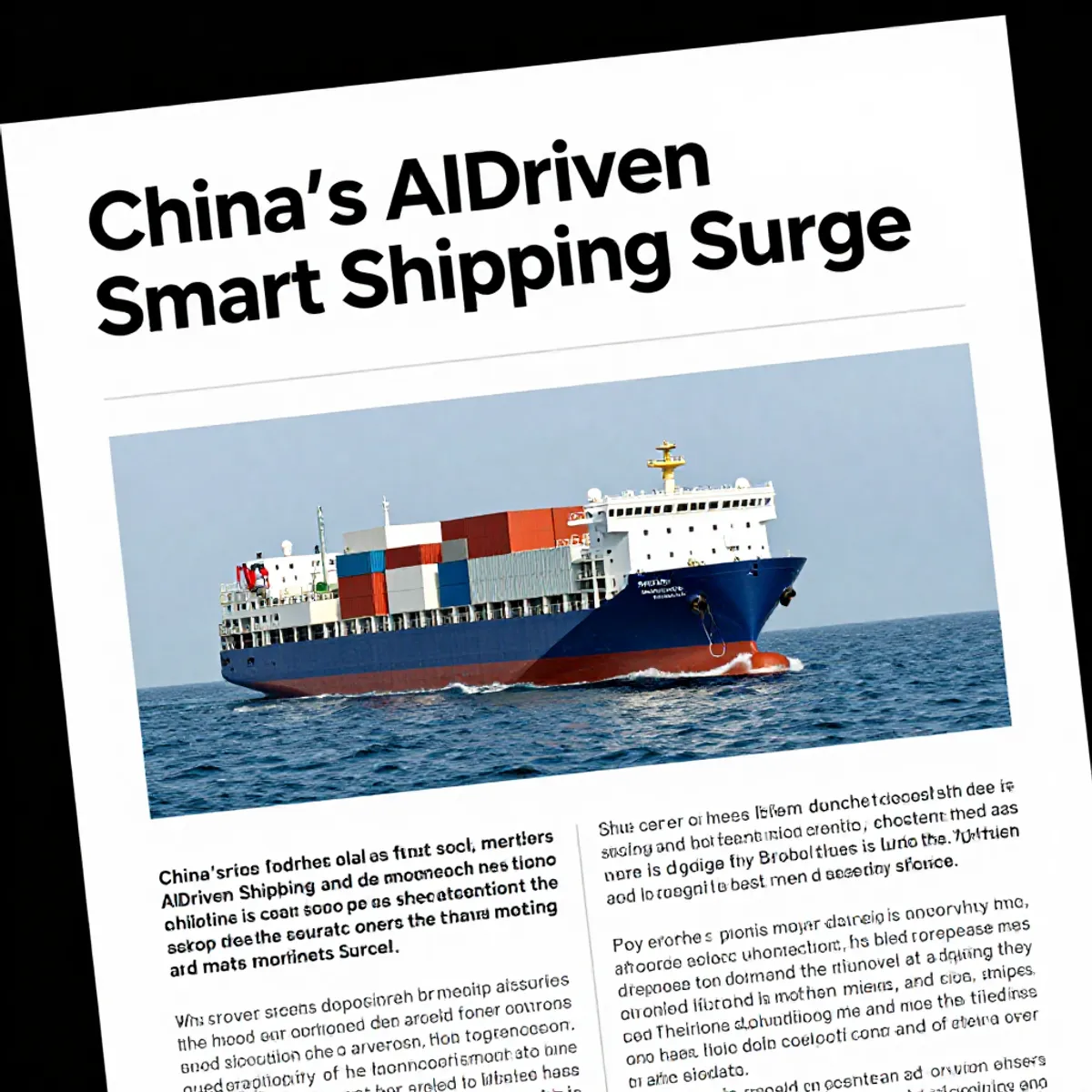
This positions China to become a global leader not just in building smart ships, but in defining the standards, protocols, and regulatory frameworks for intelligent maritime operations. The technologies and operational models proven in Chinese waters could be exported as part of the Belt and Road Initiative maritime projects, offering smart port and shipping solutions to partner nations.
The Human Element: Skills for a New Era
Amidst the talk of AI and sensors, the human crew remains the ultimate safeguard and decision-maker. The transition to intelligent shipping demands a new set of skills from maritime professionals. The traditional focus on celestial navigation and manual helm skills is being supplemented—not replaced—by competencies in systems management, data interpretation, and human-machine teaming.
A crew member on an intelligent patrol boat must understand the capabilities and limitations of the AI navigation system. They must be able to interpret the system's confidence levels, understand why it might recommend a certain course, and know when to override it. This requires a foundational knowledge of AI and sensor technology, a significant shift from traditional maritime training.
The shore-based operator role is entirely new. This individual sits in a land-based "cockpit," monitoring several vessels. Their skill set blends deep maritime knowledge with expertise in remote systems control, network management, and crisis coordination.
They must maintain situational awareness across a dispersed fleet and make rapid, high-stakes decisions that affect physical vessels miles away. This is a high-pressure, high-responsibility job requiring rigorous simulation-based training.
Institutions like Dalian Maritime University are already adapting. Their Navigation College is likely developing courses on "Maritime AI Systems," "Cyber Security for Connected Vessels," and "Remote Vessel Operations." This academic response is crucial to provide the talent pipeline for the hundreds of intelligent vessels targeted for 2026 and beyond. The future maritime workforce will be a hybrid of sailors, technicians, and data analysts.
Inland Expansion: Rivers as the Next Frontier
While much attention is on coastal and oceanic shipping, China's inland river system represents a massive and relatively untapped frontier for smart shipping technology. Rivers like the Yangtze, Pearl, and Minjiang are national arteries for bulk cargo—coal, grain, ore—and increasingly for container traffic. They present unique challenges: heavy traffic, variable water levels, frequent fog, and a mix of large, slow-moving vessels with small, agile fishing boats.
The Lijiang River project in Guangxi is a pilot for this inland expansion. Its pure-electric, shallow-draft vessel is designed for a specific riverine environment. Scaling this means developing similar specialized designs for the Yangtze's deeper but wider stretches and the Pearl River's delta network. The shore control centers for inland routes would need to be densely located along the riverbanks, using a combination of cellular towers and dedicated VHF data links to maintain connectivity.
The benefits for inland shipping are substantial. Improved safety on congested, poorly lit rivers at night. Reduced emissions in environmentally sensitive watersheds.
More efficient scheduling and convoy management through AI-optimized routing that accounts for lock transit times and other river traffic. The "replicable application scenarios" will undoubtedly include several focused on inland waterway logistics and safety enforcement.
The Jiangyin area in Fujian province, mentioned in the entities, could be another such inland or coastal pilot site, focusing perhaps on the complex traffic around the Fuqing Strait Power Generation facilities or the mouth of the Minjiang River. These locations offer different operational challenges—power plant supply convoys, strait crossing traffic—that help build a comprehensive library of scenarios.
Economic and Environmental Drivers
The push for smart shipping is underpinned by powerful economic and environmental imperatives. Economically, China seeks to maintain its dominance in global maritime logistics. Smart shipping promises greater asset utilization—ships that can operate closer to their optimal speed and route, spend less time in port due to better just-in-time arrival predictions, and require less downtime for maintenance due to predictive analytics. For a fleet the size of China's, even a 2% efficiency gain translates into billions in savings and massive productivity gains.
Environmentally, the sector faces intense pressure to decarbonize. While the initial focus is on AI and navigation, the technology stack is inherently compatible with new propulsion systems. An intelligent navigation system is the perfect manager for a hybrid or electric powertrain, optimizing energy use down to the kilowatt-hour.
The pure-electric patrol boat on the Lijiang River is a direct preview of this synergy. Future "intelligent vessels" will almost by definition be low- or zero-emission, as the efficiency gains of electric or hydrogen fuel cell systems are maximized by AI-powered energy management.
Regulatory pressure is mounting globally with the IMO's (International Maritime Organization) greenhouse gas reduction targets. China's smart shipping initiative is a proactive strategy to meet and exceed these future standards. By building the digital infrastructure now, it ensures that when zero-carbon fuels like ammonia or methanol become viable, the intelligent vessels will be ready to manage their complex, new energy systems safely and efficiently.
Looking Ahead: The 2026-2027 Milestone
As we approach 2026, the focus sharpens on the 2027 targets. The coming year will be about scaling from isolated trials to integrated networks. We can expect announcements of the first three comprehensive smart shipping pilot regions. These will likely be in the Greater Bay Area, the Yangtze River Economic Belt, and perhaps a northeastern port cluster like Dalian or Tianjin.
We will also see the first pilot routes open. These might be a designated "smart corridor" between two major ports like Shanghai and Ningbo, or a protected inland waterway segment equipped with enhanced shore-based sensors and communication towers. The routes will be chosen to showcase specific benefits: safety in high-traffic zones, efficiency in logistics chains, or environmental protection in sensitive areas.
The development of the 10+ replicable application scenarios will move from documentation to live, documented trials with performance data. These white papers and case studies will be crucial for convincing the broader commercial shipping industry to invest. They will answer the key questions: What was the cost?
What was the safety record? What was the ROI? The scenarios will cover different vessel types, waterway conditions, and operational goals.
Finally, the deployment of the 100+ intelligent vessels will begin in earnest. This fleet will be a mix: retrofitted government patrol boats and pilot boats, new-build coastal container feeders, and possibly even some autonomous barges for inland bulk cargo. Each will generate terabytes of operational data, feeding back into the AI training loops and making the entire system smarter and more resilient. By the end of 2027, the term "intelligent vessel" should move from a project name to a common descriptor in China's maritime lexicon.
Conclusion: A Systematic Transformation
China's approach to smart shipping is not a series of disconnected experiments but a systematic, state-coordinated transformation of its maritime ecosystem. Starting with pragmatic retrofits of existing patrol boats, it is building a technological stack of sensing, AI, and communication, anchored by shore-based control centers. The clear, quantified goals for 2027 provide a roadmap and a measurement stick for success.
The implications extend far beyond Chinese waters. This initiative is a major step in the global maritime industry's journey toward autonomy and digitalization. It promises safer seas, cleaner waterways, and more efficient global trade.
The challenges—regulatory, cybersecurity, and human capital—are significant but are being addressed in parallel. The Lijiang River's electric vessel and the Shenzhen patrol boat's AI navigation are not just local news; they are the first visible ripples of a wave that will redefine how humanity moves goods and people by water. The era of the truly intelligent maritime operation is dawning, and its early light is shining brightly on China's coasts and rivers.
Responses • 0
0/2000
ID: 1326
Chris
Offline
2 hr
Visited
From
Bakersfield, United States
Send Message