China's AI Embrace: Public Sentiment and National Vision
AI Learn Chinese
5 hr • 0 read
Explore Chinese public attitudes toward AI, government tech strategy, societal adaptation, and future workforce plans through 2026.
Introduction: A Nation in Technological Transition
The image of China over the past two decades has been one of unprecedented urban transformation, a landscape where ancient hutongs sit beside soaring skyscrapers and digital payment QR codes adorn everything from street food stalls to luxury boutiques. This physical metamorphosis is mirrored by a digital and technological revolution that has touched nearly every aspect of life for over a billion people. The question of how the Chinese population within its borders perceives this wave of artificial intelligence and technological integration is not merely an academic curiosity; it is a window into the social contract of a modern state pursuing a unique path to superpower status. The narrative often projected from abroad paints a picture of a populace either enthusiastically compliant or quietly resigned to a top-down tech agenda. The reality, as is often the case, is far more nuanced, a tapestry woven from threads of pragmatic benefit, generational divide, patriotic aspiration, and underlying anxiety about the pace of change. This article delves into the complex sentiment within China regarding AI and technology, dissects the government's long-term strategic view for its people, and examines the societal mechanisms of adaptation and the faint, but present, chords of resistance.
The context is critical. China's tech ascent has been state-directed yet market-fueled, creating a ecosystem where giants like Alibaba, Tencent, and ByteDance are household names, and concepts like "social credit" and "smart cities" are not dystopian fiction but lived policy experiments. The drive is encapsulated in national plans like "Made in China 2025" and the "New Generation Artificial Intelligence Development Plan," which set explicit goals for global leadership in key sectors by 2030. This creates a powerful national narrative: technology is the vehicle for national rejuvenation, for shedding the "century of humiliation" and claiming a rightful place at the center of the global order. For the individual, this macro-vision translates into a daily environment of immense convenience—ordering meals via app in 15 minutes, receiving medical consultations via video link, and navigating cities with facial recognition. The foundational query is whether this convenience is accompanied by consent, concern, or a calculated trade-off.
Public Sentiment: A Spectrum from Enthusiasm to Apprehension
To generalize "the Chinese view" is a fallacy. The response to AI and pervasive technology is stratified by geography, age, socioeconomic status, and personal experience. The sentiment is not monolithic but exists on a broad spectrum, with the median leaning toward pragmatic acceptance rather than either uncritical euphoria or outright rebellion.
The Urban, Educated, and Young: Digital Natives and Strategic Users
For the demographic that forms the backbone of China's consumer tech economy—urban residents under 40 with a university education—technology is an inextricable and largely positive layer of existence. This group, often called the "post-80s" and "post-90s" generations, are digital natives who grew up alongside the internet's commercialization. Their interaction with AI is often through curated, user-friendly interfaces: recommendation algorithms on Douyin (TikTok's Chinese sibling) that feel eerily accurate, customer service chatbots that resolve issues in seconds, and smart home devices that control lighting and temperature. The sentiment here is one of sophisticated expectation. They are aware of data collection but often rationalize it as a fair exchange for hyper-personalized services. A 2026 survey by a major Chinese university's social research center found that over 70% of respondents in Tier 1 cities (Beijing, Shanghai, Guangzhou, Shenzhen) believed "technology has made daily life significantly more efficient," with only 15% expressing strong concerns about personal data privacy. Their concern is less about the presence of AI and more about its quality—does the algorithm have bias? Is the facial recognition system accurate for all ethnic features? Is the social scoring mechanism fair? These are questions of refinement, not rejection.
This group also views technological prowess through a lens of national pride. The success of homegrown tech firms in competing with, and in some areas surpassing, their Western counterparts is a source of quiet satisfaction. The narrative of "Chinese innovation" replacing "Chinese manufacturing" is powerful. When a Chinese AI model wins an international competition or a domestic electric vehicle brand outsells foreign imports, it is celebrated in social media circles as a collective win. The US-China tech rivalry is palpable; there is a strong undercurrent of wanting to see China self-sufficient in core technologies like semiconductors, a sentiment amplified by export controls. For many, supporting domestic tech is a form of patriotism.
The Middle-Aged and Elderly: Adoption, Utility, and the Digital Divide
For those over 50, particularly outside the megacities, the relationship with technology is more utilitarian and often mediated by younger family members. The smartphone is a tool, not an extension of self. The adoption of apps like WeChat Pay is driven by necessity—everyone else uses it, and cash is becoming rare. But, the complexity of newer AI-driven services can be a barrier. A 2026 report on "digital inclusion" highlighted that while over 90% of Chinese citizens use mobile payments, only about 40% of those over 60 regularly use ride-hailing or food delivery apps independently. The sentiment is one of appreciation for the convenience these tools bring (video calls with grandchildren, easy access to government services online) mixed with frustration at the learning curve and a palpable anxiety about being left behind. This demographic is less concerned with abstract AI ethics and more with concrete issues: "Why does this health code app need my location all the time?" or "How do I stop this news feed from showing me scams?"
This group also experiences the state's technological reach more directly through the social credit system pilots and extensive surveillance networks in public spaces. While many appreciate increased safety and order—lower petty crime rates in monitored areas are frequently cited—there is a sense of vulnerability. The lack of transparent, actionable appeal processes for algorithmic decisions (e.g., a blacklist affecting travel) breeds a passive unease. The sentiment is not necessarily "resistance" but a desire for clarity and human oversight. The government's framing of these systems as tools for "trustworthiness" and "social harmony" finds more receptive ears here than in the tech-savvy youth, who may joke about "gaming" the system or express cynicism about its true purpose.
The Rural Population: Connectivity as a Lifeline, Not a Luxury
In rural China, the technological revolution has been a story of leapfrogging. Instead of laying copper phone lines, China built 4G and 5G towers. For farmers, a smartphone is a marketplace, a weather station, a banking terminal, and an entertainment center. E-commerce platforms like Pinduoduo have connected millions directly to urban consumers, altering agricultural economics. The sentiment is overwhelmingly positive toward the access technology provides. The AI and big data behind these platforms are invisible abstractions; the tangible result is a higher income for a better crop yield.
But, the rural sentiment also contains a sharp awareness of inequality. The "digital divide" is not just about access but about capability. While a farmer can sell produce online, they cannot easily leverage AI for precision agriculture without significant investment and training, which are often concentrated in state-backed pilot projects in wealthy regions. There is a quiet resentment that the "smart society" being built seems designed for urban efficiency, sometimes overlooking rural realities. The government is aware of this and has made "rural revitalization" a key policy, explicitly linking 5G coverage and agricultural tech adoption to its targets. The public sentiment here is conditional support: technology is good if it brings tangible, equitable prosperity.
Communities of Concern: Privacy, Mental Health, and the "Lying Flat" Phenomena
Within the broader acceptance, identifiable sub-communities express specific, deepening concerns. The discourse around data privacy has intensified following high-profile data breaches and the unregulated data harvesting practices of some apps. Tech-savvy netizens actively discuss using virtual private networks (VPNs), seeking out "privacy-focused" alternative apps, and meticulously managing app permissions. This is not a mass movement but a growing practice among the informed.
More pervasive is the concern about technology's impact on mental health, particularly among the young. The "involution" (内卷) phenomenon—the feeling of endlessly competing for diminishing returns—is amplified by the constant comparison and curated perfection on social platforms. The "big tech" work culture, modeled after the 996 schedule (9 am to 9 pm, 6 days a week), has sparked widespread debate about burnout. This has dovetailed with the "lying flat" (躺平) movement, a form of quiet resignation where young people opt out of the hyper-competitive race, rejecting the consumption and productivity cycles that tech platforms so effectively monetize. While not a rejection of technology itself, it is a rejection of the life trajectory that the current tech-enabled economic model often demands. The sentiment is one of weary defiance, using the very tools of connectivity to spread a message of disconnection.
Organized, collective resistance to technology on ideological grounds is minimal and operates in tightly controlled spaces. Some online forums and WeChat groups discuss the social credit system in critical terms, but public protests against specific tech deployments are rare and swiftly managed. The space for dissent is largely confined to academic papers (with cautious language), niche自媒体 (self-media) commentary that uses satire and allegory, and private conversations. The state's narrative of technological progress as synonymous with national strength leaves little room for legitimate public opposition to the core direction. The resistance, therefore, is more cultural and individual—opting out of certain apps, questioning algorithmic feeds, advocating for "digital detox"—than political.
The Government's View: A Long-Term Blueprint for Technological Supremacy and Social Management
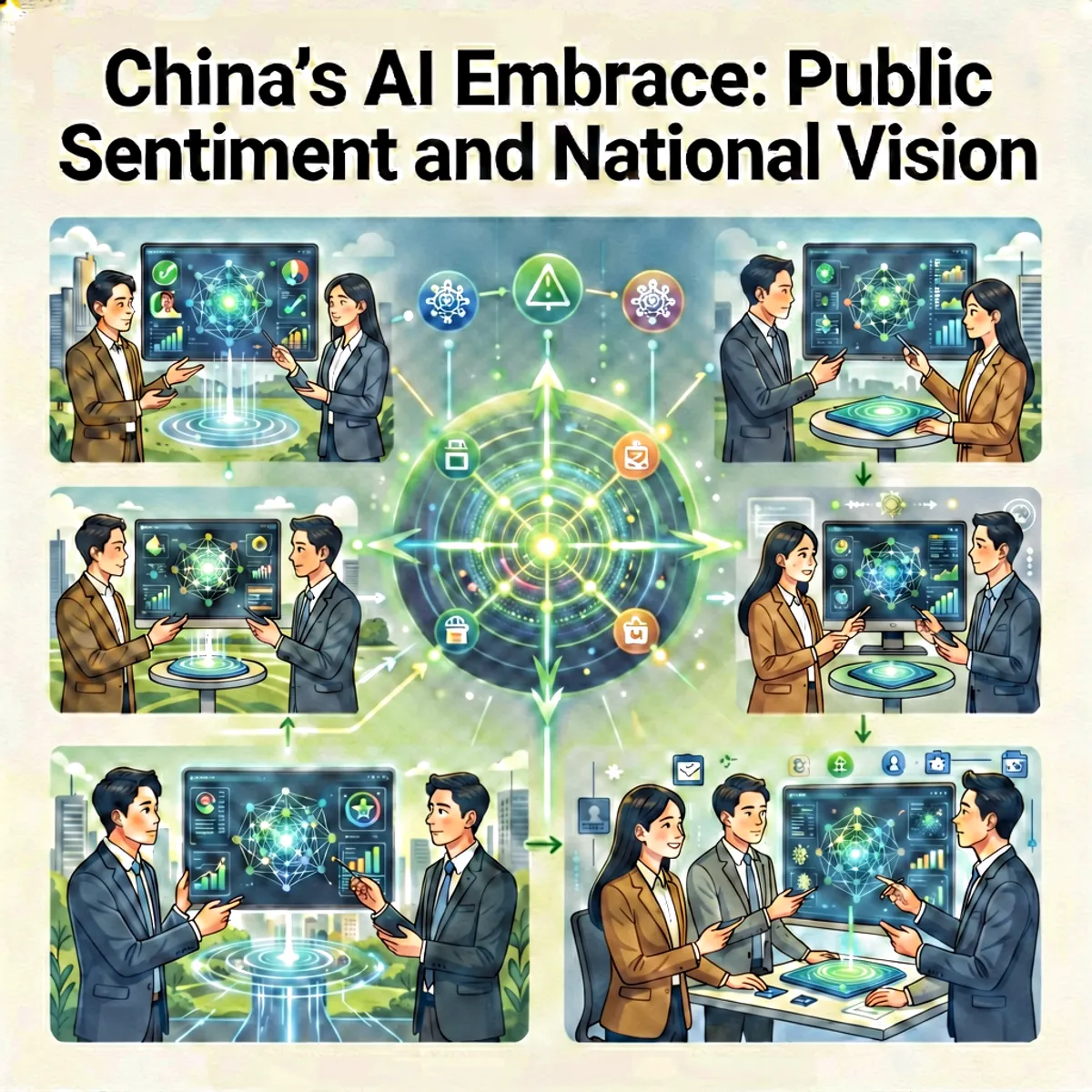
The Chinese government's perspective on AI and technology is unambiguous, comprehensive, and long-term. It views this domain not as a sector but as the central theater of 21st-century great power competition. The goal is not just economic growth but national security, social stability, and ideological influence. The view for "the coming decades" is one of deliberate, state-capitalist engineering to secure a dominant position.
The Strategic Framework: From "Made in China 2025" to "Dual Circulation"
The foundational document is the "New Generation Artificial Intelligence Development Plan," issued by the State Council in 2017. It sets a three-step goal: by 2025, China's AI theory and technology should achieve "world-leading" status in some fields; by 2030, it should be the "world's premier" AI innovation center. This is not a vague aspiration but a target backed by massive state funding for R&D, the establishment of national AI open innovation platforms, and the creation of pilot zones in cities like Beijing, Shanghai, and Shenzhen. The plan explicitly links AI to economic transformation, national defense, and social governance.
This sits within the broader "Made in China 2025" initiative, which targets ten key sectors, including next-generation IT, high-end numerical control machinery, and new materials—all heavily reliant on AI and robotics. The strategy is to move up the global value chain from "world's factory" to "world's innovator." The more recent "Dual Circulation" strategy, emphasizing internal consumption and domestic innovation, further cements technology's role. The government's view is that technological self-sufficiency, especially in core areas like semiconductors (chips), is a paramount national security issue. The US sanctions have only hardened this resolve, turning a commercial ambition into a patriotic mandate. The state's investment in the semiconductor ecosystem through the "Big Fund" is colossal, aiming to close the gap with Taiwan, South Korea, and the US by 2026-2030.
Technology as a Tool for Social Governance and Stability
Beyond economics, the government sees AI as an indispensable tool for governing a population of 1.4 billion with complex local conditions. The "Social Credit System," while often misrepresented in Western media as a single, monolithic score, is in reality a patchwork of local pilots and blacklist systems managed by various state bodies. Its stated purpose is to "build trust in society" by rewarding compliance with laws and regulations (e.g., paying bills on time, obeying traffic rules) and penalizing violations (e.g., fare evasion, manufacturing substandard goods). The government's view is that this data-driven governance increases efficiency, reduces administrative burdens, and deters misconduct. The sentiment among officials is that a "trustworthy society" is a more stable and low-cost society.
Similarly, the "Sharp Eyes" (雪亮工程) surveillance program, which integrates public and private camera feeds with AI-powered facial recognition, is framed as a crime-fighting and public safety tool. Government reports highlight drops in pickpocketing and faster resolution of missing person cases in areas with dense camera coverage. The official view is that law-abiding citizens have nothing to fear from such systems; they are a shield, not a sword. This perspective assumes a social contract where individual privacy is secondary to collective security—a trade-off that has historical and cultural resonances in China different from Western liberal traditions. The government anticipates that as these systems mature, public acceptance will grow alongside the perceived benefits of safety and order.
The Vision for the Workforce: "Human-Machine Collaboration" and Massive Reskilling
The government is acutely aware of the employment disruption AI will cause. Its public messaging does not shy from this. The vision is one of "human-machine collaboration" (人机协同), where AI handles repetitive, dangerous, or data-intensive tasks, freeing humans for creative, managerial, and care-oriented work. The policy response is centered on massive, state-directed reskilling. The "National Vocational Education Reform Implementation Plan" emphasizes STEM (Science, Technology, Engineering, Mathematics) and digital skills from secondary school onward. Universities are under pressure to expand AI-related majors and programs. For the existing workforce, the government partners with tech giants like Alibaba and Huawei to run "digital skills" training programs, often subsidized or free.
The long-term view is that China's large population is not a liability but an asset in the AI age. The goal is to create a workforce that is not just consumers of AI but active participants in its development, deployment, and maintenance. There is a strong emphasis on "application" and "engineering" innovation—taking basic research and scaling it into commercial products and industrial solutions at a speed and scale unmatched elsewhere. The state's narrative is that it can manage the transition better than market-driven Western societies because of its ability to direct resources, control social narratives, and implement policies without electoral cycles. The concern is not mass unemployment but a "structural mismatch" that the state is duty-bound to correct through education and policy guidance. The view is that the government will be the primary architect and mitigator of the workforce's transformation.
Societal Adaptation: The Practical Integration of AI into Daily Life
The adaptation to an AI-augmented society in China is less a conscious choice and more a relentless, ground-level reality. The integration happens through three primary vectors: consumer convenience, public service efficiency, and workplace transformation.
Consumer Convenience as the Trojan Horse
The most visible adaptation is in the consumer sphere. Super-apps like WeChat and Alipay are not just payment tools but platforms for mini-programs that offer a universe of services: booking doctor appointments, filing tax returns, paying utilities, accessing government documents. Underneath, AI optimizes everything. The recommendation engines on e-commerce sites like Taobao and JD.com learn preferences with stunning accuracy, shaping consumption patterns. The short-video platform Douyin's algorithm is a masterclass in engagement, creating a new form of entertainment and advertising. Food delivery riders are dispatched and routed by AI, creating an on-demand logistics network that delivers meals in under 30 minutes in major cities. The public has adapted by becoming avid users. The trade-off of data for convenience is largely accepted, partly because the alternatives (cash, physical forms, slower services) are disappearing. The adaptation is behavioral: people have internalized the speed and personalization as the new normal.
Public Services: Efficiency Gains and Opaque Algorithms
In public services, adaptation is driven by top-down mandates. The "Internet + Government Services" (互联网+政务服务) initiative has moved countless bureaucratic processes online. Applying for a driver's license, registering a business, or querying one's social insurance can now be done via a smartphone app, often with AI chatbots handling initial inquiries. The benefit is immense: reduced wait times, 24/7 availability, and less corruption in face-to-face interactions. The adaptation here is one of relief. But, the algorithms that prioritize cases or flag discrepancies for review are opaque. If an application is delayed or rejected by an automated system, the path to human review is often unclear. Citizens adapt by learning to "speak the algorithm's language"—filling forms with precise, keyword-rich language, ensuring all documents are perfectly scanned and uploaded. There is a growing, informal knowledge base on how to successfully navigate these automated systems.
The Workplace: AI as Colleague and Taskmaster
In factories, AI and robotics are being integrated under the "Intelligent Manufacturing" banner. Kuka robots on assembly lines, AI-powered visual inspection systems for quality control, and predictive maintenance algorithms are becoming standard in advanced plants. The adaptation for production workers is a shift from manual labor to machine tending and basic programming. The government's retraining programs aim to facilitate this. In white-collar jobs, tools like iFlytek's AI meeting assistants (which transcribe and summarize) and Alibaba's AI writing aids are changing workflows. The sentiment in corporate China is a mix of optimism about productivity gains and anxiety about job displacement, particularly in roles like customer service, data entry, and basic analysis. Companies are adapting by creating new hybrid roles—"AI trainers," "prompt engineers," "algorithmic auditors"—though these require higher skills. The adaptation is uneven, favoring those with higher education and digital literacy. The government's role is seen as crucial in providing the safety net and training to smooth this transition.
The Dimensions of Concern and Faint Resistance
Despite the widespread adaptation and official optimism, significant concerns simmer beneath the surface. They coalesce around three pillars: data privacy and security, algorithmic bias and control, and the psychological and social cost of hyper-connectivity.
The Erosion of Privacy and Data Security Fears
The Chinese public is not unaware of data privacy issues. Scandals involving the leakage of personal information from apps, the sale of user data by third-party SDKs (software development kits), and the mandatory data sharing requirements for tech companies under the Cybersecurity Law and Data Security Law have created a palpable unease. The sentiment is that data is a precious commodity, and once shared, it is out of the individual's control. There is a deep-seated fear of "data-enabled social engineering"—scams that use leaked personal details to appear legitimate—and of state overreach. While many accept surveillance in public spaces for safety, the aggregation of data from all aspects of life—purchases, movements, social connections, health records—into a single, potentially accessible profile is a source of dread. The resistance here is passive but widespread: meticulous management of app permissions, use of pseudonyms on non-essential platforms, and a general wariness of any service that asks for "excessive" data. But, there is a resigned understanding that in the current ecosystem, refusing to share data often means opting out of essential services, a choice not feasible for most.
Algorithmic Bias, Black Boxes, and the Lack of Recourse
The opacity of AI decision-making is a growing technical and social concern. If a facial recognition system fails to identify a person of a certain ethnicity, leading to denial of service, what recourse exists? If a credit-scoring algorithm denies a loan based on opaque factors, how can it be challenged? The Chinese legal system is slowly developing frameworks for "algorithmic transparency" and the "right to explanation," but implementation lags. The public sentiment is frustration mixed with a sense of powerlessness. Online, tech-savvy users share stories of "being trapped by the algorithm"—where a recommendation feed creates a filter bubble so complete it distorts worldview, or where a ride-hailing app's pricing surges during rain seem arbitrary and punitive. The resistance is cultural: memes mocking algorithmic stupidity, guides on how to "break" recommendation loops by deliberately searching for diverse content. It's a form of digital folk wisdom, a grassroots attempt to retain agency against an unseen system.
Mental Health, Social Fragmentation, and the "Lying Flat" Response
Perhaps the most profound societal adaptation is the internal, psychological one. The constant connectivity, the pressure to perform and consume amplified by social media, and the anxiety of an ever-changing job market have taken a toll. The government's own surveys acknowledge rising levels of anxiety among young adults. The "lying flat" movement, while not directly about AI, is a symptom of burnout from a system where technology enables and expects relentless optimization of one's life—career, appearance, social network. The sentiment is a quiet refusal to play the game. This is a form of resistance that is individual and existential, not political. It rejects the premise that one must constantly upgrade, network, and hustle to be valuable. It finds expression in online communities where members share minimalist lifestyles, reject consumerist pressures, and critique the "involution" that tech platforms exacerbate. The government views this with concern, seeing it as a threat to productivity and social dynamism, and has begun promoting "mental health" initiatives and criticizing "involution" in state media, attempting to co-opt the discourse.
The Government's Decadal Vision: Managed Transition and Controlled Openness
Returning to the core side question: with the insane technological growth, what is the government's view on what its people will do in the coming decades? The vision is one of managed, state-capitalist transition towards a "moderately prosperous society" (小康) that is also a "digital civilization" (数字文明). The government anticipates and plans for a society where:
1. Work is Re-defined: The government projects that while AI will eliminate many routine jobs, it will create new ones in tech maintenance, data curation, AI ethics oversight (within state guidelines), and the care economy (aging population). The state's role is to steer this transition through education policy, immigration rules for top tech talent, and social welfare reforms. The expectation is that citizens will be lifelong learners, constantly reskilling through government and corporate programs. The "hukou" (household registration) system is slowly being reformed to allow rural migrants better access to urban social services, partly to ensure a stable, mobile workforce for the tech-driven economy.
2. Social Governance is Algorithmic but "Human-Centered": The official line is that technology will make governance more precise, efficient, and responsive. The "social credit" and surveillance systems will evolve to be less punitive and more "preventive" and "service-oriented." For instance, instead of just blacklisting, the system might alert a citizen about an impending utility bill default and offer a payment plan. The government's view is that by 2026-2030, these systems will be so embedded that they will be seen as a neutral, beneficial infrastructure, like roads or electricity. The people will adapt by internalizing the rules of these systems, learning to maintain a "good digital record" as part of good citizenship.
3. Nationalism and Tech Sovereignty are Inextricable: The coming decades will see a continued, and possibly heightened, emphasis on tech self-reliance. The government anticipates a bifurcated global tech landscape—a Chinese ecosystem and a Western one. It will encourage its people to "use domestic products, support domestic innovation" as a patriotic duty. This means a continued, managed decoupling in certain tech sectors. The view is that the Chinese population will accept, and even embrace, this technological "independence" as a price for national dignity and security. The narrative will frame any Western technological dominance as a threat to be overcome.
4. Controlled Openness and Digital Sovereignty: The government does not envision a freewheeling, Silicon Valley-style internet. Its vision is of a "cyber sovereignty" where the Great Firewall remains, but within it, a vibrant, innovative, and commercially dynamic digital economy thrives. The people will have access to world-class domestic equivalents of global platforms (Weibo vs. Twitter, Baidu vs. Google, etc.). The government anticipates that this controlled environment, combined with aggressive crackdowns on "disinformation" and "harmful" content, will maintain social stability while allowing economic innovation. The public's adaptation will be to have a bifurcated digital life: using VPNs for specific academic or business needs to access the global internet, but conducting daily life entirely within the domestic ecosystem.
Conclusion: The Unfolding Experiment
The Chinese public's view on AI and technology is a complex calculus of tangible benefit, national pride, pragmatic concern, and resigned adaptation. There is no widespread, organized movement against the technological project itself because for most, the benefits—convenience, connectivity, economic opportunity—are too immediate and substantial to reject. The resistance that exists is fragmented, focusing on specific pain points: data privacy, algorithmic fairness, and mental well-being. It manifests as personal optimization strategies, ironic online commentary, and quiet lifestyle choices like "lying flat," rather than as a coherent political opposition.
The government's view for the coming decades is one of confident, deliberate engineering. It sees AI as the ultimate tool for achieving its core objectives: economic strength, social stability, and national rejuvenation. It anticipates managing the social disruptions through a combination of massive retraining, social policy adjustments, and narrative control, framing all technological advancement as part of the national cause. The state believes it can guide the transition better than liberal democracies because it can set the direction, control the information environment, and mobilize resources without the friction of partisan politics or strong civil society pushback.
The experiment is colossal. It is a test of whether a state-directed, surveillance-capable, consumer-driven model of technological integration can deliver sustained prosperity and social harmony without eroding individual agency or sparking systemic backlash. The Chinese people are not passive recipients but active participants in this experiment, adapting, complaining, innovating around the edges, and largely getting on with their lives within the new digital paradigm. The outcome of this decades-long wager will shape not only China's future but the global debate on the very meaning of progress, governance, and humanity in the age of AI. The world is watching this unfolding story, understanding that the "Chinese view" on technology is, in the end, the view of a billion individuals navigating a reality being built around them, for them, and sometimes, despite them.
Responses • 0
0/2000
ID: 1326
Chris
Offline
45 min
Visited
From
Bakersfield, United States
Send Message