China Move: ESIM and SIM Guide
AI Learn Chinese
2 hr • 0 read
Navigate ESIM and SIM options for moving to China. Understand Chinese Telecom bundles, prearrival setup, and carrier choices for 2026.
The Connectivity Challenge When Moving to China
Relocating to a new country is an exciting adventure, but few things cause more immediate stress than arriving without a working phone. Your ability to navigate, communicate with your new employer, find your apartment, and access essential services hinges on connectivity. The situation you describe—a building that exclusively permits Chinese Telecom infrastructure—is a common and critical detail for newcomers to Guangzhou (GZ).
This isn't just about choosing a phone plan; it's about understanding a regulated market where physical infrastructure and carrier agreements can dictate your options. The bundle offered through your job coordinator is a potential lifeline, but its true value depends on what it actually includes and whether it aligns with your needs. Your core question about arranging service from abroad touches on the evolving, and often complicated, world of ESIM technology within China's unique telecom landscape.
This guide will break down these layers, from the technical differences between SIM card types to the practical steps of securing service before your plane lands.
Your specific scenario highlights a fundamental tension in modern relocation: the global push for digital convenience versus local regulatory and infrastructural realities. Chinese Telecom is one of the three state-backed major carriers in China, often favored for fixed-line broadband in newer residential compounds due to existing wiring contracts. This means your home internet might be a foregone conclusion, but your mobile service is a separate, equally important puzzle.
The bundle offer could be a convenient, all-in-one solution, or it might be a basic package that requires significant topping up. Arriving with a functional phone number is non-negotiable for tasks like using ride-hailing apps, mapping services, and initial banking. So, a proactive approach is required, one that starts with understanding the tools at your disposal.
Why Physical SIMs Still Dominate the Chinese Market
Despite the global rise of ESIM (embedded SIM) technology, which allows for digital carrier profile switching without a physical card, its adoption in mainland China has been slower. The primary reason is real-name registration. Chinese law mandates that every mobile number be tied to a verified, government-issued ID.
For foreign nationals, this means your passport and valid Chinese visa must be presented and recorded in person at a carrier's physical store. This legal framework creates a significant hurdle for purely remote ESIM activation. While the technology exists in many modern phones, the regulatory process effectively requires a physical interaction for long-term service.
You cannot simply download a carrier profile from a website abroad and be fully compliant. This is the first, most important rule to internalize: for a primary, long-term number in China, you will almost certainly need to visit a store.
This isn't to say ESIM is useless for your move. Its value lies in providing immediate, temporary connectivity. a number of international carriers and some third-party travel ESIM providers offer data plans that work in China.
You can purchase and install one on your compatible phone before you depart. This gives you data access the moment you land, which is crucial for ordering a taxi, checking your new address on a map, or messaging your coordinator. But, these are typically data-only plans.
They do not provide a Chinese phone number for local calls, SMS verification for apps like WeChat Pay or Alipay, or the ability to top up easily with local methods. They are a bridge, not a destination. Understanding this distinction between temporary data and permanent local service is key to managing your expectations.
The Three Major Carriers and Their Landscapes
China's mobile market is effectively a tripoly controlled by three giant, state-influenced carriers: China Mobile, China Unicom, and China Telecom. Each has its own network strengths, retail presence, and partnership agreements. China Telecom is particularly strong in southern China, including Guangzhou, and is often the mandated provider for fiber broadband in new buildings, as you've experienced.
This gives them a "home field advantage" in your specific situation. Your job coordinator's bundle is likely a corporate agreement with Chinese Telecom for both mobile and fixed-line services. The advantage of such a bundle is convenience—one bill, potentially a discount, and simplified setup.
The risk is a lack of choice; you may be locked into their mobile plans, which can be less competitive for data-heavy users compared to other carriers.
China Mobile boasts the largest subscriber base and the most extensive 4G/5G coverage, especially in rural and suburban areas. Their retail stores are ubiquitous. China Unicom is often seen as having more flexible and innovative data packages, frequently partnering with tech companies for content bundles.
For a foreigner, the practical differences often come down to store proximity, the specific plan a store clerk recommends for your visa type, and the ease of future top-ups. All three require in-person registration. Your building's Chinese Telecom internet requirement does not legally bind you to their mobile service, but it does mean you'll be interacting with their ecosystem regardless.
If your coordinator's bundle is with Chinese Telecom, it might be the path of least resistance, even if you later discover a better mobile-only deal with Unicom.
Decoding the Job Coordinator's Bundle Offer
What's Typically Included in a Corporate Bundle
A bundle package offered through your employer or relocation coordinator is a pre-negotiated agreement between the company and a carrier, usually Chinese Telecom in your case. It is designed for convenience and administrative simplicity. Typically, it will combine two core services: home broadband (the mandatory wifi) and a mobile phone plan.
The mobile component is the part you need to scrutinize. It will likely be a post-paid plan, meaning you receive a monthly bill, rather than a prepaid "pay-as-you-go" SIM card. The plan will specify a monthly fee, a certain amount of data (e.g., 40GB per month), a number of domestic call minutes, and possibly some international calling credit.
Sometimes, it includes a handset subsidy, tying you to a new phone contract. You must ask for the exact plan name or number and its detailed terms.
The value proposition is clear: one point of contact, potential cost savings compared to retail rates, and a setup process where someone else handles the initial coordination. The coordinator will likely gather your passport information, visa details, and perhaps a deposit, then arrange for a Chinese Telecom technician to install the broadband and a store to prepare your SIM card. You might simply be asked to visit a designated store at a specific time to collect the card and complete the formal ID verification.
This is where your due diligence is critical. You must confirm: Is the mobile plan month-to-month, or are you locked into a 12- or 24-month contract? What are the penalties for early termination?
Does the data roll over? Is there a fair use policy that throttles speed after a certain limit? What happens if you leave the company?
These are standard questions for any contract, but the language barrier can make them daunting.
Potential Pitfalls and Questions to Ask
The main pitfall of such a bundle is complacency. Because it's "arranged for you," it's easy to accept it without comparison. You should mentally treat this as a default option, not necessarily the best option.
First, clarify if the bundle is mandatory. Some companies have exclusive deals; others simply offer it as a convenience. If it's optional, you have leverage to compare.
Second, understand the SIM card type. It will almost certainly be a physical SIM. Ask if the plan supports ESIM for future flexibility (most post-paid plans from the big carriers now do, but you must activate it in-store).
Third, probe the international aspects. Do you need to call home? How much does it cost per minute to your home country?
Is there a better option using a VoIP app like WeChat over data? Finally, get the total cost in writing, including the broadband fee, the mobile monthly fee, any installation charges, and the handset cost if applicable. Compare this sum to what you might pay for a standalone prepaid mobile plan and a separately arranged broadband line.
It is also wise to ask the coordinator about their experience. Have other expats used this bundle? What were the common complaints?
Was customer service responsive? This is qualitative intelligence that can save you future headaches. Remember, your coordinator's primary goal is efficient onboarding for many employees, not optimizing your personal telecom spend.
You must advocate for your own needs. If the bundle seems expensive or restrictive, you can politely decline and state you wish to arrange your mobile service independently, while still accepting the building-mandated Chinese Telecom broadband (which you must have anyway). This separation of concerns is a strategic approach.
Setting Up Mobile Service Before Arrival: The ESIM Possibility
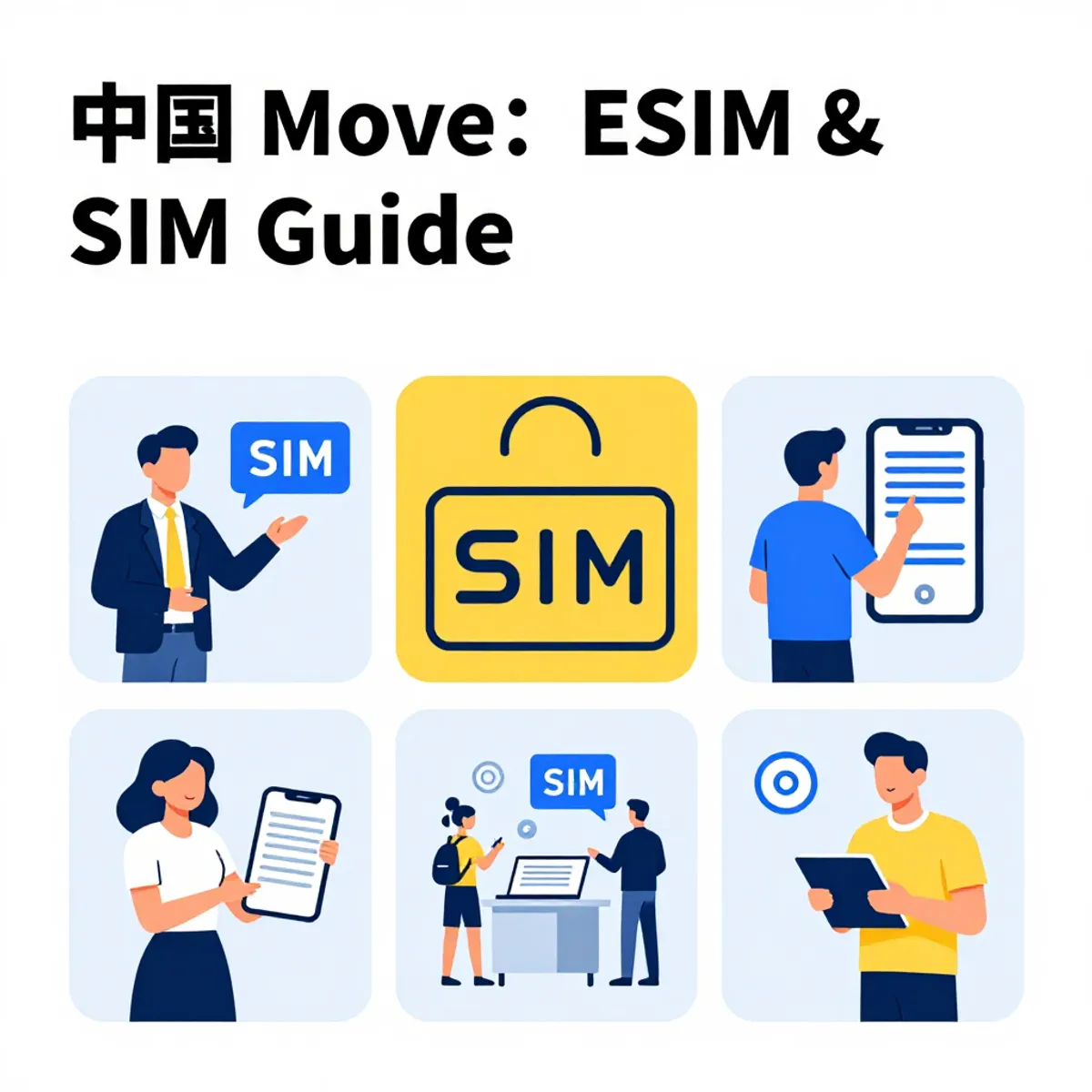
The Allure and Reality of Pre-Arrival ESIM Activation
The dream of landing in Guangzhou with a fully active Chinese phone number is powerful. You could use Didi (ride-hailing), Ele.me (food delivery), and register for apps immediately. ESIM technology suggests this should be possible.
But, as established, the real-name registration law is the gatekeeper. As of 2026, no major mainland Chinese carrier (China Mobile, Unicom, Telecom) offers a fully remote ESIM activation pathway for non-resident foreigners. Their official processes require you to present your original passport and visa at a physical store, where they scan the documents into their national verification system.
Some premium "international" plans targeted at frequent business travelers might offer a streamlined process, but these are rare, expensive, and still often require an initial in-store verification within a short period after arrival.
This means a purely pre-arrival setup for a permanent number is not feasible. You must plan for a "day one" store visit. This does not, however, make pre-arrival preparation worthless.
You can and should research the specific ESIM-compatible plans offered by each carrier. Visit their official international websites or their Chinese websites using a translation tool. Look for sections for "foreigners" or "international users." Identify the plan that best matches your expected usage.
Print or screenshot the plan details, its price in RMB, and the required documents. Having this information in hand will make the in-store conversation infinitely more efficient. You can show the clerk exactly what you want, reducing the chance of them upsell you to a more expensive, unsuitable plan.
Temporary Solutions: International Roaming and Travel ESIMs
While you cannot get a permanent Chinese number from abroad, you can secure temporary data connectivity. There are two main avenues. First, check with your home country's mobile carrier about their international roaming packages for China.
a number of offer daily or weekly data passes. Ensure your phone is unlocked and compatible with Chinese networks (most modern phones are). This is often the simplest but can be the most expensive option for extended use.
Second, purchase a travel ESIM from a third-party provider like Airalo, Holafly, or Nomad. These companies sell data-only ESIM profiles that work on China's networks. You buy it online, receive a QR code, and install it in your phone's settings before you travel.
Prices are generally more competitive than carrier roaming, and activation is instant. For your move, this is an excellent "day one" solution. You land, connect to this data ESIM, and can immediately use maps, messaging, and email to coordinate your first store visit to get your permanent SIM.
A crucial nuance: these travel ESIMs typically use the networks of the big three carriers (you often select which network you want to connect to), but you are not a registered customer of that carrier. You are a user of a reseller. This means you cannot top up the plan with local cash at a store, get a Chinese phone number, or use certain carrier-specific services.
It is purely a data pipe. Think of it as a stopgap for the first few days or weeks while you sort your permanent solution. Do not rely on it for more than a month, as performance and support can be variable.
The goal is to use this temporary access to research, locate the nearest Chinese Telecom or China Unicom store to your new apartment, and perhaps even call them in advance (using the travel ESIM) to confirm document requirements and plan availability.
Navigating the In-Person Registration Process
Required Documents and Store Etiquette
When you finally arrive and are ready for your permanent SIM, success depends on preparation. The non-negotiable documents are: your original passport with a valid Chinese visa (usually a work visa, Z-visa, or a resident permit if you've already obtained one), and your foreigner's permanent residence card if you have one (this simplifies some processes). Some stores may also ask for your employment certificate or a utility bill with your new Chinese address to confirm your residence.
Have digital and physical copies of everything. The process at a carrier store is standardized but can be slow. Go early in the day to avoid queues.
Be patient and polite; the clerks are processing many people and dealing with complex systems.
Upon entering a store (a China Telecom store is your most likely first stop due to the broadband mandate), clearly state your need: "I need to register for a mobile SIM card for a foreign passport." Use the phrase "waiguoren huzhao" (foreigner passport) if you can, or show them your passport. They will guide you to a counter. Present your documents.
They will input your information into their system and take a photo of you holding your passport open to your photo page. This is the real-name registration. Once verified, you will select a phone number from the available pool and choose your plan.
Here is where your pre-arrival research pays off. You can specify the plan you want by name or number. If you don't, they will present their default "recommended" plan for foreigners, which is often mid-tier in price and data.
often ask to see the plan details in writing before confirming. Clarify the billing cycle (calendar month or from activation day?), the data speed after any fair use limit, and the cost of exceeding your data.
Common Hurdles and How to Overcome Them
a few common issues can arise. First, your visa type. Some older store systems or less-experienced clerks may be unfamiliar with newer visa categories or residence permits.
If you encounter confusion, politely ask to speak to a manager or someone who handles "foreign clientele" (waiguoren kehu). Second, the phone number selection. The best, memorable numbers are often already taken or reserved for premium plans.
Don't stress too much; a random number is fine for functionality. Third, payment. You will need to pay an activation fee (usually a small amount) and the first month's fee.
Most large stores accept Alipay and WeChat Pay via QR code, which you can link to your international bank card (though this can be tricky). Having some cash in RMB is a reliable backup. Fourth, ESIM activation.
If you want ESIM on your permanent plan, you must request it during this registration. The clerk will generate an ESIM QR code on their screen for you to scan with your phone. You must do this immediately in the store.
If you forget or your phone isn't compatible, you'll get a physical SIM by default and would need to return later to convert it, which is a hassle.
After registration, your phone should connect to the network within minutes. Test it by making a local call (to the clerk's phone or your coordinator's number) and sending an SMS. Ensure mobile data is working.
Before you leave the store, get a receipt and a small card or paper with your plan details, customer service number, and the store's address. This is your proof of contract and your first point of reference for any issues. The entire process, from document presentation to a working SIM, can take 30 minutes to two hours depending on the store's busyness.
Factor this into your arrival schedule. You will likely need to do this alone, as your coordinator may not accompany you to the store.
Alternatives to the Coordinator's Bundle: Going Independent
Evaluating Standalone Mobile Plans
If you decide the job coordinator's Chinese Telecom bundle is not optimal for your mobile needs, you have the right to arrange your mobile service independently. You will still need to set up the Chinese Telecom broadband at your apartment, as mandated by the building. For mobile, you can choose any carrier.
The advantage is potential cost savings and plan customization. Prepaid (pay-as-you-go) SIM cards are widely available and offer maximum flexibility. You can buy a SIM with a data package that lasts 30, 60, or 90 days, and simply recharge it as needed via apps like Alipay or at convenience stores.
This is ideal if your long-term plans are uncertain or if you are a light data user. The downside is you must manage recharges manually and you don't get a bundled bill with your internet.
Post-paid plans, like the likely bundle, offer convenience and often better value for heavy, consistent users. You can walk into any China Mobile, China Unicom, or Chinese Telecom store and request their standard foreigner post-paid plan. These are publicly listed.
Compare the data allowances, the inclusion of apps like Douyin (TikTok) or Tencent Video in a "content bundle," and the price. China Unicom is often praised for having the most generous data packages for the price. China Mobile has the best rural coverage, but if you're staying in Guangzhou city, this is less critical.
Do not feel obligated to get a new phone with your plan. You can bring your own unlocked device. Simply have the IMEI number (found in your phone settings) ready to give to the clerk.
This avoids a two-year device contract lock-in.
The Hybrid Approach: Using Your Home Number for SMS
A clever strategy many expats use is to maintain their home country's mobile number on their phone, using a dual-SIM phone or an ESIM for the Chinese carrier. They keep their home SIM active for SMS verifications (for banking, two-factor authentication) and use the Chinese number for all local calls, data, and app registrations. This solves the problem of changing your number on critical accounts.
But, your home carrier's international roaming fees for receiving SMS are usually low or free, but making calls or using data on that line abroad can be costly. The key is to set your phone to use the Chinese SIM for data and primary calls, and manually switch to the home SIM only when you need to receive a verification code. This hybrid model provides a continuity bridge, especially if you plan to return home eventually.
It requires a phone that supports dual physical SIMs or one physical SIM plus an ESIM.
A Step-by-Step Timeline for Your Move
6-4 Weeks Before Departure: Research and Documentation
Your preparation phase starts now. Your primary tasks are informational. Using the keywords from this guide, search for: "China Mobile foreigner plan 2026," "China Unicom ESIM activation," "Chinese Telecom broadband contract for expats." Bookmark the official websites.
Identify the plan that looks best for you. Simultaneously, ensure your phone is unlocked. Contact your home carrier to confirm it is free to use on other networks.
Check your phone's model number online to confirm its compatibility with Chinese network bands (Bands 1, 3, 5, 8, 34, 38, 39, 40, 41 are common for 4G/5G in China; most recent iPhone and Samsung models are fine). Make physical and digital copies of your passport, visa, and employment contract. Purchase a travel ESIM from a reputable provider for immediate data upon arrival.
This is your connectivity safety net.
1-2 Weeks Before Departure: Finalize Plans and Tools
Download essential apps that you will need immediately. Get the Chinese versions of: Didi (ride-hailing), Amap or Baidu Maps (navigation), WeChat (messaging/pay), Alipay (payment). Create accounts where possible, but know that full verification often requires a Chinese phone number later.
Have a VPN service ready if you need access to Google services, YouTube, etc., from China. Note that while VPNs are commonly used, their legal status is a gray area; use reputable, paid services. Write down the address of your new apartment in Chinese characters, as you will need to show it to taxi drivers and store clerks.
Confirm with your job coordinator the exact date and time the Chinese Telecom technician will come to install the broadband. Schedule your own mobile SIM store visit for the day after you arrive, when you are less jet-lagged and have your documents in hand.
Arrival Day and Week: Execution and Adaptation
Land, clear customs, and activate your travel ESIM. Use it to call your coordinator or a taxi. Go directly to your apartment.
Be present for the broadband installation. The technician will set up the modem/router. Test the wifi.
Now, you have your guaranteed home internet. The next day, take a taxi (using Didi with your travel ESIM data) to the nearest large China Telecom or China Unicom retail store. Go through the registration process described above.
Get your permanent SIM. Once you have your Chinese number, register for WeChat and Alipay using that number. This is a critical step for digital life in China.
Link your international bank card to Alipay for easy payments. Use your new number to verify other apps. By the end of your first week, your digital infrastructure should be fully operational.
The initial stress will subside, replaced by the routine of topping up your plan or waiting for your first monthly bill.
Long-Term Considerations and Flexibility
Managing Your Plan and Understanding Costs
Once your service is active, understand your billing cycle and how to monitor usage. All carriers have official apps (e.g., "China Telecom" app, "Unicom" app) that you should download and login to with your new number. These apps are in Chinese, but with translation tools, you can check your remaining data, see your bill, and purchase data add-ons if you run out.
Be mindful of overage charges. If you exceed your monthly data limit, your speed may be throttled to a crawl (e.g., 128kbps) or you may be charged per MB. These charges can add up quickly.
Setting a data usage warning on your phone is a smart practice. Also, be aware of "international" add-ons. If you need to call home, a small monthly add-on for international minutes is cheaper than pay-per-use rates.
Evaluate this monthly based on your actual usage.
If your employment situation changes, understand your contract's termination clause. For post-paid plans, you usually need to give 30 days' notice and may have to pay a penalty if you are within a minimum contract period (often 12 or 24 months). For prepaid, you simply stop recharging.
Keep all your contract paperwork. If you leave China, you must cancel your service formally to avoid ongoing charges. Visit a store with your passport and SIM card to cancel.
Get a cancellation certificate. This is important for closing your Chinese bank accounts and ensuring no future debt.
The Evolving ESIM Landscape in China
While this guide emphasizes the current need for in-person registration, the situation is in flux. The Chinese government and carriers are gradually integrating ESIM more fully. By late 2026, it is possible that some carriers will allow initial remote ESIM activation for certain visa types, followed by in-person verification within 30 days.
This would be a major convenience. To stay updated, check carrier news sections or expat forums like "ShanghaiExpat" or "TheBeijinger" for the latest user reports. If you have a friend already in China, ask them to visit a store and inquire specifically about ESIM onboarding for foreigners.
The most reliable source is always the primary carrier store itself, as frontline staff are trained on the latest procedures.
Your takeaway should be this: plan for the worst-case (in-person only), but hope for the best (streamlined ESIM). The trajectory is toward more digital convenience, but regulatory inertia is strong. For your move in the near term, treat the physical SIM card as a necessary key to the kingdom.
The travel ESIM is your temporary bridge. The bundle offer is a convenient, if potentially non-optimal, default path. Your power lies in informed choice.
By understanding the "why" behind the rules—real-name registration, carrier monopolies on building infrastructure, and the prepaid vs. post-paid dichotomy—you can navigate the system with confidence, not frustration. Your mobile connectivity is the foundation of your new life in Guangzhou. Invest the time to get it right.
Responses • 0
0/2000
ID: 1326
Chris
Online
From
Bakersfield, United States
Send Message