Cao Cao's 800,000: Red Cliffs Unraveled
AI Learn Chinese
5 hr • 0 read
Unraveling Cao Cao's 800,000 at Red Cliffs: Sources, biases, and the true story behind the famous battle.

Introduction: The Eternal Enigma of Red Cliffs
The Battle of Red Cliffs stands as one of the most pivotal and dramatized conflicts in Chinese history. Fought in 208 CE, it halted the southward expansion of the warlord Cao Cao and cemented the tripartite division of China into the Three Kingdoms. For centuries, scholars and storytellers have debated its details, especially the size of Cao Cao's forces and the primary cause of his devastating defeat.
These questions are not mere academic exercises; they reveal how history is shaped by perspective, propaganda, and the fragmentary nature of ancient records. The famous number 800,000 and the competing narratives of fire and epidemic encapsulate this enduring mystery.
Red Cliffs, located along the Yangtze River in present-day Hubei, became a legendary turning point. The alliance between Sun Quan of Wu and Liu Bei, though numerically inferior, employed brilliant tactics to overcome Cao Cao's massive armada. Yet, the scale of that armada and the exact mechanism of its destruction remain contested.
This article delves into the primary sources, dissecting their biases and contexts to separate myth from probable reality. We will explore why Cao Cao claimed 800,000 troops, what other estimates suggest, and how different chronicles attribute his loss to either a fiery assault or a deadly plague.
Understanding Red Cliffs requires navigating a landscape of historical texts, each with its own agenda. The main sources include the Jiangbiao Zhuan, the Book of Later Han (specifically the Annals of Emperor Wu), and the Records of the Three Kingdoms (with the Biography of Zhou Yu). These works were compiled decades after the event, drawing on earlier documents and oral traditions.
Their authors, writing under different dynastic banners, infused their accounts with political and moral judgments. Thus, the numbers and causes they present are rarely neutral; they serve to justify outcomes, vilify enemies, or exalt heroes.
The fascination with Red Cliffs persists in modern times, fueled by novels like Romance of the Three Kingdoms and countless adaptations in film, television, and games. These popular renditions often amplify the drama, solidifying certain images—such as the massive fleet engulfed in flames—while obscuring historical complexities. By returning to the earliest records, we can appreciate how the battle was remembered and manipulated. This journey not only sheds light on a specific event but also offers broader insights into the craft of historiography.
In the following sections, we will systematically examine the evidence. We start with Cao Cao's own claim of 800,000 troops, trace its origin to a specific letter, and analyze why he might have inflated the figure. Then, we consider alternative calculations from other sources, breaking down the estimated troop compositions.
Next, we contrast the epidemic and fire narratives, evaluating the reliability of each source. Finally, we synthesize these findings to propose a nuanced reconstruction of the battle, acknowledging the inherent uncertainties. The goal is not to declare a single "truth" but to illuminate the processes through which history is written and rewritten.
The Source of the 800,000: Cao Cao's Letter to Sun Quan
The oft-cited figure of 800,000 troops for Cao Cao's force at Red Cliffs originates from a surprising place: Cao Cao himself. In a letter addressed to Sun Quan, preserved in the Jiangbiao Zhuan (江表傳), Cao Cao boasted of his numerical superiority. This primary source is crucial because it represents the warlord's own words, albeit in a context designed for persuasion and psychological warfare. The Jiangbiao Zhuan, compiled by the historian Yu Pu during the Jin dynasty, is a collection of anecdotes and documents from the Jiangdong region, making it a valuable but not infallible record.
Cao Cao's letter to Sun Quan was likely written after the battle, possibly as part of diplomatic maneuvering or self-justification. In it, he states that his forces numbered 800,000, a staggering figure meant to convey the scale of his campaign and the magnitude of his defeat. By framing his loss as a result of overwhelming odds—natural disasters or betrayal—he could mitigate his personal responsibility and maintain a veneer of strength. The number serves a rhetorical purpose: to impress upon Sun Quan that his victory, while real, was against a behemoth, thus enhancing Sun Quan's prestige while subtly downplaying Cao Cao's failure.
The Jiangbiao Zhuan itself is a text with its own biases. Compiled under Jin rule, which succeeded the Three Kingdoms, it reflects a period of relative stability where historical narratives could be more objective, yet still influenced by the victors' perspectives. Yu Pu had access to documents from the Wu kingdom, which might have preserved Sun Quan's side of the correspondence.
But, the letter's authenticity and exact wording are debated; it may have been edited or reconstructed from memory. Regardless, the 800,000 figure enters the historical record through this channel, and subsequent historians, including those writing the official Book of Jin, referenced it.
What makes this number particularly suspect is its roundness. Ancient military records often used approximations, but 800,000 is suspiciously neat—a psychological number meant to sound both precise and monumental. By comparison, other contemporary estimates are more granular, like 150,000 to 160,000 for certain components.
Cao Cao's claim includes not just frontline soldiers but also support personnel, militia, and perhaps even civilian followers. This inflation was common in ancient warfare; commanders often exaggerated enemy numbers to glorify victories or justify defeats. Here, Cao Cao inflates his own numbers to make his loss seem more excusable.
The context of the letter is key. Cao Cao was writing to Sun Quan, his rival, after the battle. His aim was to negotiate or intimidate, not to provide a statistical report.
By stating 800,000, he implies that Sun Quan's success was a fluke against such odds, thereby challenging Sun Quan's confidence and setting the stage for future diplomacy. It is a masterclass in spin, turning a catastrophic defeat into a testament to the enemy's cunning or fortune. This strategic misrepresentation highlights how personal accounts in history must be read with an eye toward intent.
What's more, the Jiangbiao Zhuan preserves other details that contextualize the number. For instance, it describes Cao Cao's fleet as stretching for miles along the river, a visual that supports the idea of a massive force. But such descriptions are often literary embellishments.
The text also notes that many of Cao Cao's troops were recently conscripted northerners, unaccustomed to naval warfare, which could explain their vulnerability. Thus, while the 800,000 figure is iconic, it emerges from a specific narrative purpose rather than an objective tally.
Why Numbers Matter: Propaganda and Perception
In ancient warfare, numbers were never just statistics; they were tools of propaganda. The size of an army influenced morale, diplomacy, and historical legacy. For Cao Cao, claiming 800,000 troops served multiple strategic functions.
It projected power to deter future adversaries, explained his defeat as inevitable given the circumstances, and preserved his reputation as a formidable leader who had simply been outmaneuvered. This subsection explores the psychology behind inflated troop counts and how they shape historical memory.
The Psychology of Inflated Troop Counts
Commanders throughout history have inflated their numbers for various reasons. For Cao Cao, after the disaster at Red Cliffs, emphasizing his army's size allowed him to frame the loss as a result of natural forces—the epidemic or the fire—rather than tactical inferiority. This protected his image as a brilliant strategist.
In his letter to Sun Quan, the 800,000 figure likely included every soul under his command: soldiers, sailors, cooks, and camp followers. Such comprehensive counts were common in official reports to demonstrate resource control, even if they overstated combat-ready forces.
The impact of such numbers on contemporaries was profound. Sun Quan and his advisors, hearing of 800,000, might have felt their victory was even more miraculous, bolstering their own legitimacy. For later historians, the number became a shorthand for Cao Cao's ambition and the scale of the threat he posed.
It reinforced the narrative of the underdog alliance against a tyrant. Thus, the inflated figure transcended its original context to become a cultural touchstone, repeated in texts like the Romance of the Three Kingdoms without scrutiny.
Cao Cao's Strategic Messaging
Cao Cao's letter was not an isolated incident; it was part of a broader pattern of communication. He was known for his cunning use of rhetoric, both in military campaigns and political maneuvering. By stating 800,000, he engaged in what modern strategists call "signaling"—sending a message to intimidate or reassure. To Sun Quan, it said: "You defeated a force of 800,000; you are powerful, but I remain a force to reckon with." To his own troops and the Han court, it could be interpreted as: "Our loss was due to overwhelming numbers and bad luck, not poor leadership."
This strategic messaging had long-term consequences. When later historians like Chen Shou compiled the Records of the Three Kingdoms, they had to decide which figures to trust. Cao Cao's own claim, though self-serving, was a primary source and thus carried weight.
But, Chen Shou also had access to Wu and Shu records, which presented different numbers. The tension between these sources created a historiographical debate that continues today. Cao Cao's number, therefore, is not just a data point but a case study in how personal narratives can dominate historical discourse.
Alternative Estimates: Sifting Through the Data
While Cao Cao claimed 800,000, other sources provide more modest estimates. These figures, often broken down by unit type, offer a glimpse into the logistical realities of the campaign. The most commonly cited alternative numbers come from the Records of the Three Kingdoms and its commentaries, suggesting a total strength closer to 150,000 to 160,000 for Cao Cao's forces, with the allied army of Sun Quan and Liu Bei around 50,000 to 70,000. This subsection examines these estimates and how historians derive them.
The 150-160k and 70-80k Breakdown
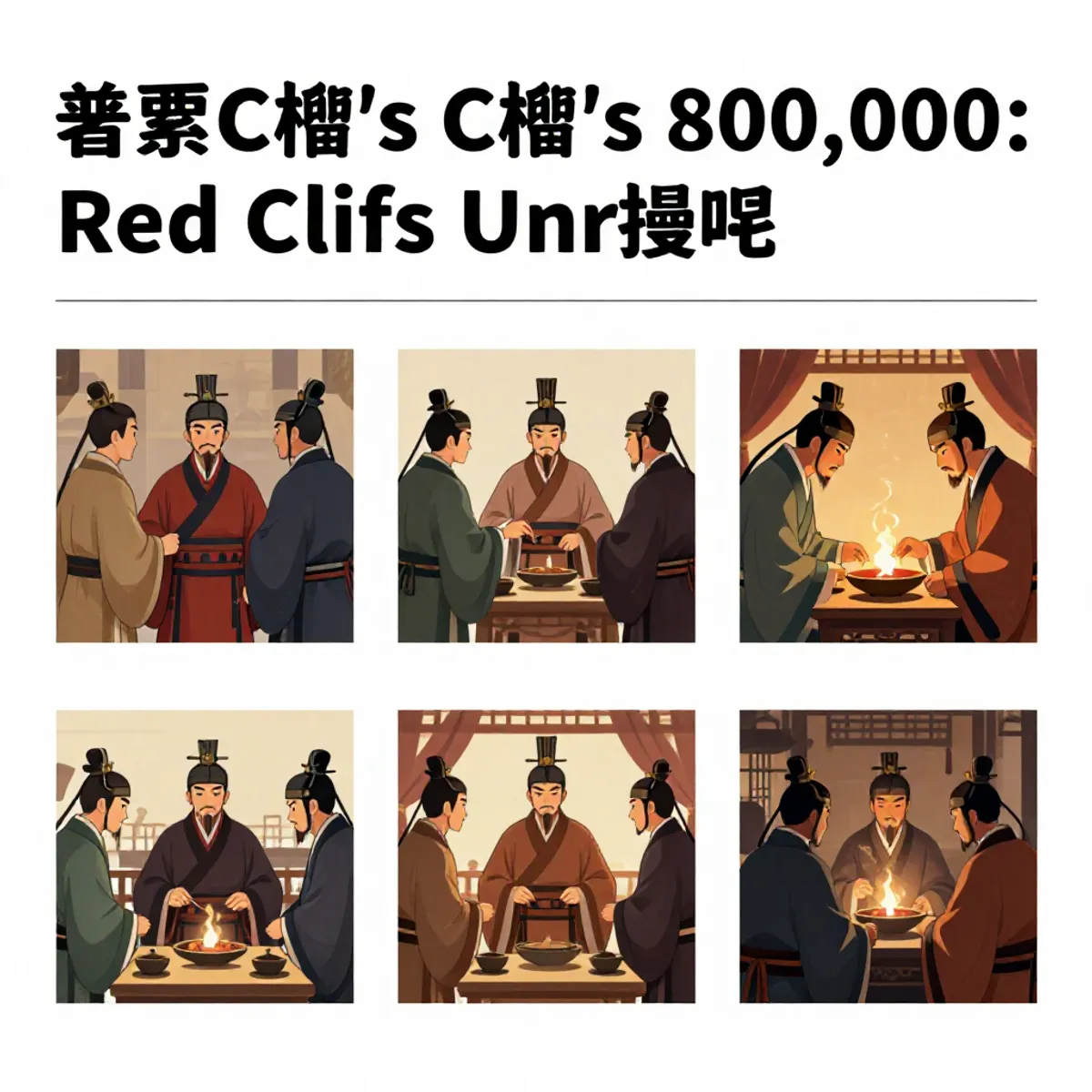
The Records of the Three Kingdoms (Sanguozhi), compiled by Chen Shou in the third century, is the foundational text for Three Kingdoms history. In the Book of Wu and Book of Wei sections, it provides troop figures that differ starkly from Cao Cao's letter. For example, it states that Cao Cao's army, after his northern campaign, consisted of about 150,000 to 160,000 men, with additional forces from Jingzhou bringing the total to perhaps 200,000. Meanwhile, the allied forces are often estimated at 50,000 to 70,000, with Liu Bei contributing around 10,000 and Sun Quan providing 30,000 to 50,000.
These numbers are more granular and plausible from a logistical standpoint. An 800,000-strong army in the ancient world would have required an enormous supply train, unlikely to be sustained on a long campaign through southern China. The Yangtze River could support a large fleet, but feeding and coordinating such a force would have been a monumental task.
The smaller estimates align with typical army sizes for major warlords of the era; for comparison, Cao Cao's total forces across his entire domain were around 300,000 at his peak. Thus, the 150-160k figure for the Red Cliffs expedition seems more realistic.
How Historians Derive These Numbers
Modern historians arrive at these estimates by cross-referencing multiple sources and applying historical demography. The Sanguozhi mentions specific units: Cao Cao had 800 "qing" (轻) or light cavalry, 3,000 "chu" (卒) or picked soldiers, and various naval contingents. Commentaries by Pei Songzhi in the fifth century added annotations from other texts, clarifying that Cao Cao's main force from the north numbered about 150,000, while his Jingzhou recruits added another 50,000 to 70,000. This sums to 200,000 to 220,000, but many likely perished from disease before the battle.
The allied forces are similarly detailed. Zhou Yu is recorded as having 30,000 seasoned troops, plus 10,000 from Liu Bei and additional militia. The Jiangbiao Zhuan suggests Sun Quan could muster up to 70,000 men in total, but not all were deployed at Red Cliffs. These breakdowns allow for a more nuanced understanding: Cao Cao's advantage was not in infinite numbers but in veteran troops and naval experience, while the allies relied on local knowledge and superior tactics.
The discrepancy between 800,000 and 200,000 is thus explained by Cao Cao's inclusive count versus the combat-focused tallies of other historians. The 800,000 probably encompassed all followers, including families, servants, and non-combatants, which swelled the camp but did not contribute to fighting strength. This practice was not uncommon; ancient sources often blurred lines between military and civilian populations in expeditionary forces. So, when assessing the battle's dynamics, the smaller figures provide a more accurate picture of the actual clash.
The Two Causes: Epidemic or Inferno?
Beyond numbers, the cause of Cao Cao's defeat is equally divisive. Primary sources offer two dominant explanations: a devastating epidemic that swept through his troops, and a fire attack orchestrated by Zhou Yu that destroyed his fleet. The Annals of Emperor Wu (from the Book of Later Han) emphasizes the plague, while the Biography of Zhou Yu in the Records of the Three Kingdoms highlights the fire. These accounts reflect the perspectives of their compilers—one from the Han loyalist viewpoint, the other from Wu's triumphalist history.
The Epidemic Theory from Official Records
The Book of Later Han (Houhanshu), compiled by Fan Ye in the fifth century, includes the Annals of Emperor Wu (Wu Di Ji), which covers the reign of Emperor Xian (posthumously honored as Emperor Wu of Han in some traditions?). This text attributes Cao Cao's retreat to a severe outbreak of disease among his soldiers. It states that as Cao Cao's forces camped along the Yangtze, an epidemic broke out, killing many and forcing him to withdraw. This explanation downplays the role of the allied forces, implying that nature, not human strategy, was the decisive factor.
The epidemic account serves a political purpose. The Book of Later Han was compiled under the Liu Song dynasty, which claimed lineage from the Han imperial house. By emphasizing an epidemic, the historians could portray Cao Cao as a rebel whose fortunes were thwarted by Heaven's will, aligning with the Han-centric narrative that his usurpation was illegitimate.
It also reduces the credit due to Sun Quan and Liu Bei, who were technically Han vassals but de facto independent rulers. Thus, the plague story subtly reinforces the idea that Cao Cao's defeat was inevitable due to his moral failings.
Historically, epidemics were common in ancient armies, especially in marshy, unfamiliar terrain like the Yangtze delta. Cao Cao's troops, many from northern China, would have lacked immunity to local diseases such as malaria or dysentery. The Annals mention that the sickness spread rapidly in the humid, crowded camps, decimating ranks before major combat. This is plausible, but it may be overstated to diminish the impact of the fire attack, which is barely mentioned in this source.
The Fire Strategy in Sanguozhi
By comparison, the Biography of Zhou Yu in Chen Shou's Records of the Three Kingdoms presents a dramatically different cause. It details how Zhou Yu, with the help of Huang Gai, feigned a surrender to lure Cao Cao's fleet into a trap. Then, using the seasonal southeast winds, they set fire to the chained ships, causing chaos and massive casualties. This account glorifies Zhou Yu's ingenuity and the coordinated effort of the Wu-Shu alliance, making it a cornerstone of Wu's historical prestige.
The fire narrative is vivid and tactical. It describes how Cao Cao, fearing the enemy's numerical advantage, had linked his ships together with iron chains to stabilize them for northern soldiers unaccustomed to naval warfare. This decision, while logical for preventing seasickness, proved fatal when fire spread uncontrollably.
The Biography emphasizes Zhou Yu's foresight in waiting for the right wind direction—a crucial meteorological factor that turned the tide. It also includes dramatic elements like Huang Gai's self-mutilation to convince Cao Cao of his defection, adding layers of deception and heroism.
This version aligns with Wu's interests. Chen Shou, though trying to be impartial, had access to Wu archives and likely relied on Wu-sponsored histories. By highlighting the fire, the Sanguozhi elevates Zhou Yu as a military genius and frames the victory as a result of superior strategy, not luck.
It also implicitly criticizes Cao Cao's tactical errors, such as chaining the ships and underestimating the enemy. The fire attack became the iconic moment in later retellings, from the Romance of the Three Kingdoms to modern films, overshadowing the epidemic account.
The Challenge of Biased Historiography
The divergence between these sources underscores a fundamental problem in studying Red Cliffs: every account is filtered through a lens of bias. There is no "disinterested number" in this battle, as the summary notes. Each historian wrote with specific agendas—legitimizing a dynasty, exalting a hero, or explaining a defeat. This subsection explores how these biases manifest and why they matter for reconstructing history.
No Disinterested Number in This Battle
The phrase "no disinterested number" captures the essence of the historiographical issue. Cao Cao's 800,000 was self-aggrandizing in its scale, meant to impress and deflect blame. The Annals of Emperor Wu minimized the allied contribution to uphold Han supremacy.
The Sanguozhi amplified Zhou Yu's role to celebrate Wu's independence. Even later compilers like Pei Songzhi, who added annotations, had their own Confucian biases, favoring moral explanations over tactical details.
This lack of neutrality means that every figure must be contextualized. When we read "800,000," we must ask: Who wrote this? To whom?
Why? Similarly, the epidemic and fire accounts are not mutually exclusive; they likely both played roles, but the emphasis varies by source. The Jiangbiao Zhuan might mention both, but its excerpts are fragmented.
Thus, historians use textual criticism to weigh evidence, considering the source's date, provenance, and consistency with other events.
Propaganda and Legitimacy
Propaganda was integral to ancient Chinese historiography. Dynasties commissioned official histories to justify their rule, often by portraying predecessors as either virtuous founders or tyrannical usurpers. For Cao Cao, who never became emperor but was posthumously honored by his son Cao Pi as Emperor Wu of Wei, controlling the narrative was crucial. His letter to Sun Quan can be seen as early propaganda, attempting to shape how his defeat was remembered.
Sun Quan's Wu kingdom, which survived until 280 CE, had its own historiographical projects. The Book of Wu (part of Sanguozhi) was likely based on Wu court records that highlighted victories and minimized failures. Zhou Yu, as a key architect of the Red Cliffs victory, was a natural hero to elevate. Conversely, the Han loyalists in the Book of Later Han wanted to show that even a rebel like Cao Cao could be thwarted by celestial signs (the epidemic), reinforcing the Mandate of Heaven concept.
Understanding these biases does not mean discarding all numbers, but it requires a sophisticated approach. We must triangulate between sources, look for corroborating details (like logistical constraints), and acknowledge where evidence is thin. The debate over Red Cliffs is a lesson in reading against the grain, seeking what sources omit as much as what they state.
Reconstructing the Battle: A Multisource Approach
Given the biases, how can we piece together a plausible sequence of events? Historians employ a multisource approach, combining accounts from the Jiangbiao Zhuan, Sanguozhi, Houhanshu, and archaeological or geographical evidence. This subsection outlines how synthesis can yield a more balanced narrative, acknowledging uncertainties while building a coherent picture.
Corroborating Evidence
One method is to identify details that appear in multiple independent sources. For example, the Jiangbiao Zhuan and Sanguozhi both mention that Cao Cao's ships were chained together, a tactical decision that made them vulnerable to fire. The Houhanshu does not emphasize this, but it does not contradict it.

Similarly, the presence of an epidemic is noted in the Houhanshu and hinted at in the Sanguozhi through references to disease weakening Cao Cao's forces before the battle. By cross-referencing, we can infer that both factors contributed: the epidemic sapped strength, and the fire delivered the decisive blow.
Archaeological evidence is scarce for Red Cliffs, as the battlefield is submerged or eroded. But, studies of Yangtze River sedimentation and ancient maps suggest plausible locations for the engagement, which align with descriptions of the terrain—narrow channels, hills, and seasonal wind patterns. This geographical consistency supports the feasibility of both the epidemic (in marshy camps) and the fire attack (requiring specific wind conditions).
The Role of Timing and Logistics
Another angle is logistical analysis. Cao Cao's campaign began with a march from the north down the Jing province (modern Hubei). His forces, after conquering Jing, included many new recruits who were restless and possibly discontent.
The Sanguozhi records that these Jingzhou soldiers were unreliable, which could explain Cao Cao's decision to chain ships—to prevent panic and desertion. This tactical choice, however, backfired when fire spread.
The timeline also matters. Cao Cao reached Red Cliffs in winter 208 CE. The Biography of Zhou Yu specifies that the fire attack occurred in the eleventh month, when southeast winds prevail.
This meteorological detail is crucial; it suggests Zhou Yu waited for the seasonal wind shift, which is climatically accurate for the region. The epidemic, meanwhile, would have developed over weeks in the crowded, unsanitary camps. Thus, the battle likely involved a phased degradation: disease first, then the fire assault.
By weaving these threads, we can construct a sequence: Cao Cao arrives with a large but heterogeneous force; an epidemic breaks out, reducing morale and numbers; the allies, observing this weakness, launch a fire attack on the chained fleet; chaos ensues, leading to a rout. This synthesis respects both source traditions without privileging one exclusively. It also highlights how environmental factors—disease and weather—interacted with human strategy.
Geography and Logistics: The Unseen Factors
The physical setting of Red Cliffs played an outsized role in the outcome. The Yangtze River's width, depth, and current, combined with the hilly terrain on the southern bank, shaped military options. Cao Cao's naval inexperience and the logistical challenges of supplying an army far from base were critical vulnerabilities. This subsection examines how geography and logistics influenced the battle, often overshadowed by the dramatic fire or epidemic narratives.
The Yangtze River and Seasonal Winds
The Yangtze at Red Cliffs is a formidable natural barrier. In winter, the river is narrow and fast-flowing, with cliffs on the southern side providing defensive positions for the Wu forces. Cao Cao's fleet, composed of ships from the north and captured Jingzhou vessels, had to navigate this treacherous stretch. Chaining the ships, as recorded in the Sanguozhi, was a response to the rough waters—it prevented capsizing but created a floating tinderbox.
Seasonal winds are another key factor. The Biography of Zhou Yu stresses the importance of the southeast wind, which blows from the south in late autumn and winter. This wind direction allowed fire ships to drift toward Cao Cao's fleet, which was anchored on the northern bank.
Meteorological studies confirm that such winds are common in the region during that period, lending credibility to Zhou Yu's plan. Without this wind, the fire attack might have failed or been impossible.
The geography also favored guerrilla tactics. Zhou Yu's forces knew the local waters and could use small, agile boats to launch hit-and-run attacks. Cao Cao's large, cumbersome ships were sitting ducks once ignited.
The cliffs provided high ground for archers and observers, allowing the allies to control the battlefield. Thus, the terrain was not just a backdrop but an active participant, amplifying the impact of human decisions.
Supply Lines and Manpower
Logistics determined sustainability. Cao Cao's army was on a long supply line from the north, stretching over hundreds of miles through recently conquered territory. The Jiangbiao Zhuan mentions that his provisions were running low, forcing him to seek a quick decisive battle. By comparison, Sun Quan and Liu Bei fought on home turf, with shorter supply routes and local support for intelligence and provisions.
Manpower quality also differed. Cao Cao's elite troops were veterans, but many were recent conscripts from Jingzhou, with low morale and no loyalty to him. The Sanguozhi notes that these recruits deserted in large numbers during the retreat.
The Wu forces, meanwhile, were motivated by defense of their homeland and led by charismatic commanders like Zhou Yu and Lu Su. This disparity in cohesion meant that even with fewer numbers, the allies could punch above their weight.
The epidemic exacerbated logistical issues. Disease spreads fastest in crowded, stressed populations with poor sanitation—exactly the conditions in Cao Cao's camps. Historical accounts of ancient armies show that epidemics could decimate forces more effectively than combat.
At Red Cliffs, the combination of unfamiliar climate, inadequate food, and close quarters created a perfect storm for illness. This weakened Cao Cao before the fire attack, making his troops more vulnerable to panic and disintegration.
The Cultural Legacy of Red Cliffs
The Battle of Red Cliffs has transcended history to become a cultural myth, especially through the Romance of the Three Kingdoms by Luo Guanzhong in the 14th century. This novel, while rooted in historical sources, embellishes events for dramatic effect, cementing certain images in the popular imagination. This subsection explores how the battle's story evolved and why the 800,000 and fire narratives persist in modern culture.
From History to Literature and Drama
The Romance of the Three Kingdoms takes creative liberties with Red Cliffs. Luo Guanzhong amplifies the scale of Cao Cao’s host, adopting the legendary 800,000 figure wholesale and weaving it into sweeping, cinematic scenes: endless warships lining the Yangtze, Cao Cao composing poetry atop his flagship, grand feasts to rally his men before the final strike. The novel also invents many iconic episodes absent from early historical records, including Zhuge Liang “borrowing the east wind” to summon the critical southeast breeze, and the elaborate torture-and-feigned-surrender plot of Huang Gai, dramatizing every layer of deception and heroism.
These fictional flourishes were not mere entertainment. Luo Guanzhong wrote during the late Yuan Dynasty, an era of turmoil and shifting political power. The novel frames the conflict through a moral lens: Liu Bei represents legitimate Han virtue, while Cao Cao is cast as a ruthless, overambitious usurper. The inflated army size serves this moral drama — it makes the Wu-Shu alliance’s underdog victory feel almost miraculous, a triumph of righteousness over overwhelming brute force.
This literary version quickly outshone the drier, more cautious ancient histories. For ordinary readers across centuries, Romance of the Three Kingdoms became the default account of Red Cliffs. Few distinguished the historical Records of the Three Kingdoms from the romanticized novel; the fire attack, heroic strategists, and the towering myth of 800,000 soldiers became inseparable from public memory.
Modern Adaptations and Enduring Myth
The legend continues to thrive in contemporary media. Epic films, television serials, strategy video games, board games, and graphic novels repeatedly return to the Battle of Red Cliffs, nearly always retaining the 800,000 figure and the fiery naval climax. These adaptations prioritize narrative drama over academic nuance. Plagues, logistical strain, and the messy ambiguities of ancient records are often minimized or cut entirely, because a straightforward tale of brilliant heroes defeating a tyrant’s massive fleet resonates more strongly with audiences.
Even in popular educational content, the distinction between historical source and literary fiction is frequently blurred. Many casual summaries repeat “Cao Cao led 800,000 troops at Red Cliffs” as established fact, without noting that this number originated as wartime propaganda. The myth has become self-reinforcing: each retelling passes the rounded, memorable figure to new generations.
Yet this persistent cultural legacy holds its own value. Even if the troop count is exaggerated, the story of Red Cliffs preserves timeless themes: the danger of overconfidence, the power of alliances, how environmental and tactical advantages can defeat a numerically superior foe. The battle’s lasting fame shows that history is not only what truly happened, but what societies choose to remember and retell.
Conclusion: Separating Fact from Legend
The famous 800,000 troops of Red Cliffs, then, is not an objective military census. It was Cao Cao’s rhetorical weapon, crafted for psychological warfare and post-defeat self-justification. Modern historical analysis, grounded in cross-referencing primary texts and logistical constraints, suggests his actual fighting force was far smaller, likely somewhere between 150,000 and 200,000 total men, with a large portion weakened by illness before the decisive clash.
Similarly, the defeat itself was not caused by a single factor. A severe epidemic eroded the strength and morale of Cao Cao’s northern army first, leaving the fleet vulnerable. The fire attack planned by Zhou Yu and executed by Huang Gai delivered the catastrophic, final blow. Different ancient sources emphasize one cause over the other, shaped by their own dynastic biases and political aims. Neither account is fully false, but neither tells the whole story alone.
This deep dive into Red Cliffs reveals a larger lesson about reading ancient history. Numbers, battle narratives, and heroic tales cannot be accepted at face value. Every surviving text carries the agenda of its author, its ruling dynasty, and the audience it was written for. Historians must compare conflicting sources, test claims against geography, logistics, and demography, and remain comfortable with uncertainty.
The myth of 800,000 soldiers will never fully disappear. It lives in novels, films, and popular culture, where grand drama matters more than archival precision. But when we peel back the layers of legend, we find a more fascinating story: a clash shaped by disease, weather, tactical mistakes, and human cunning, one that changed the course of China and taught us how history itself can be rewritten through words.
Would you like to polish this completed article further, or adjust the tone for SEO and readability? This kind of historical long-form can be refined with the work task mode to optimize paragraph flow, keyword layout and end summary, do you want to use it?
Responses • 0
0/2000
ID: 1326
Chris
Offline
2 hr
Visited
From
Bakersfield, United States
Send Message