Can You Pull Off This 15Day 5City August China Trip?
AI Learn Chinese
1 hr • 0 read
We break down a 15day, 5city August China itinerary covering Shanghai, Zhangjiajie, Chongqing, Chengdu and Beijing to check if this route is realistic.
Introduction: The Allure and Challenge of a First-Time China Trip
Planning a first trip to China is an exciting endeavor. The sheer scale of the country, the contrast between its ancient heritage and hyper-modern cities, and the diversity of its landscapes can be both inspiring and overwhelming. A common ambition for a first-time visitor is to pack as much as possible into a limited timeframe, often around two weeks.
This is a perfectly understandable goal. But, the logistics of moving between distant destinations, especially during a challenging travel month like August, require careful scrutiny. The itinerary in question—a 15-day loop from Shanghai through Zhangjiajie, Chongqing, Chengdu, and ending in Beijing—represents a classic "greatest hits" tour.
It attempts to balance iconic natural wonders with major metropolitan and cultural hubs. The central question it raises is one of pacing: can this be done without becoming a exhausting marathon of transit?
This analysis will dissect the proposed plan city by city. We will evaluate the time allocated to each location against its actual offerings and the realistic travel time required to move between them. The unique pressures of an August trip, dominated by summer heat, humidity, and domestic tourism peaks, will be a constant factor in our assessment.
Our goal is not to dismiss the plan outright but to provide a framework for understanding its rhythm. We will then explore a revised structure that aims to preserve the trip's highlights while introducing more sustainable downtime. The ultimate measure of success for any itinerary is not the number of checklist items completed, but the quality of the experiences absorbed and the energy retained to enjoy them.
Understanding the August Travel Environment in China
Before diving into the itinerary, one must understand the specific conditions of traveling in China during August. This is not a neutral month; it is a significant variable that impacts every decision. August falls within the peak of summer, bringing consistently high temperatures and high humidity across most of the country.
In southern and central cities like Shanghai, Chongqing, and Chengdu, daytime highs frequently reach 35°C (95°F) with heat indices feeling even higher. The concept of "outdoor sightseeing" shifts to the early morning and late afternoon, with a potential midday break becoming a necessity rather than a luxury.
This climatic reality directly affects the feasibility of packed schedules. A morning spent at a theme park or a hike in a national park requires a different energy level than the same activity in a milder climate. The mental and physical fatigue accumulates faster.
In addition, August coincides with the latter part of the summer holiday season for Chinese students and families. While not as intense as the Golden Week in October, domestic tourist numbers at major attractions will be substantial. Expect crowds at the Zhangjiajie National Forest Park, the Chengdu Research Base of Giant Panda Breeding, and popular sections of the Great Wall near Beijing.
Bookings for trains and flights must be made well in advance, and popular restaurants may have long waits. The proposed itinerary must be resilient to these pressures.
Shanghai: A Modern Metropolis Arrival
The trip begins in Shanghai, arriving at 4:25 PM on August 15th. This is a solid arrival time. It allows for clearing customs, collecting luggage, and transferring to a hotel with some daylight to spare.
The initial plan allocates three nights, covering the 15th through the morning of the 18th. This is a reasonable, though not generous, allocation for a first-time visitor. Shanghai is a city of distinct neighborhoods, each with its own character.
The Pudong skyline, viewed from the Bund, is a mandatory first-evening spectacle. The French Concession offers tree-lined streets, boutique shopping, and a vibrant cafe culture. Old City areas like Yuyuan Garden provide a glimpse into pre-modern Shanghai, though they are inevitably crowded.
A three-night stay means you have two full days. One could be dedicated to modern Shanghai: the Shanghai Tower observation deck, a cruise on the Huangpu River, and exploring the futuristic Lujiazui district. The other day could focus on historical and cultural layers: the Shanghai Museum (a world-class institution free of charge), a stroll through Nanjing Road, and perhaps a visit to the Jing'an Temple.
The pace here is manageable. The key is to not try to see everything. The city's energy is best absorbed by choosing a few areas to explore deeply rather than skimming many.
The departure on the 18th for Zhangjiajie by flight is the first major logistical hurdle. You must factor in travel time to the airport (likely Pudong or Hongqiao), check-in, security, and the flight itself, which will likely be 2-2.5 hours plus boarding. A late afternoon or early evening flight on the 18th would be required to make the connection work, turning the 18th into a travel day with limited morning activity.
The Flight to Zhangjiajie: A Critical Transit Point
The flight from Shanghai to Zhangjiajie is not a simple hop. Zhangjiajie is a relatively small city in Hunan province, primarily serving the national park. Direct flights exist but are often limited in number, typically connecting through a hub like Changsha.
The flight duration, including a potential stop, can easily stretch to 3-4 hours total block time. You must also account for the journey from Zhangjiajie Hehua Airport to your hotel near the park gates, which can take 30-60 minutes by shuttle or taxi. This means the entire transit from your Shanghai hotel to your Zhangjiajie hotel door is a minimum of 6-7 hours.
This is a significant chunk of the 18th. Arriving in Zhangjiajie by late afternoon or early evening is likely, leaving no time for park exploration that day. Your first full day in the mountains is then the 19th.
The three-night allocation for Zhangjiajie (18th-21st) therefore realistically provides two full days for the national park, with the 18th and 21st being partial travel days.
Zhangjiajie: Avatar Mountains and Physical Demands
Zhangjiajie National Forest Park is the raison d'être for this leg of the trip. Its towering sandstone pillars, immortalized in the film Avatar, are breathtaking. But, visiting it is physically demanding.
The park is vast. A typical route to see the major highlights—like the Avatar Hallelujah Mountain, Golden Whip Stream, and Yuanjiajie—requires 8-10 hours of walking and extensive use of cable cars and the Bailong Elevator. The terrain is steep, stairs are numerous, and crowds can create bottlenecks.
For a first-time visitor, dedicating two full days (the 19th and 20th) is the absolute minimum to experience the core park without feeling utterly rushed. Some visitors prefer three days to include the Tianmen Mountain area, which is separate and requires a full day with its own cable car and cliff-hanging walkway.
The plan's three nights (18th-21st) with a departure to Chongqing on the 21st is tight. It assumes you can have a final, relaxed morning on the 21st before checking out and traveling. Given the physical toll of two days in the park, a slow morning might be welcome.
But, the journey to Chongqing is a high-speed train ride. The train station for Zhangjiajie is Zhangjiajie Railway Station, which is not the same as the city center and requires a 30-45 minute transfer. High-speed trains from Zhangjiajie to Chongqing West or Chongqing North stations take approximately 4-4.5 hours.
You must schedule this train for the afternoon of the 21st to allow for a final park morning. A train departing around 1:00 PM would mean leaving your hotel around 11:30 AM, packing up your luggage, and heading straight to the station. This is a feasible but packed schedule.
You would arrive in Chongqing in the early evening, check in, and have your first evening in the mountain city. The two-night allocation for Chongqing (21st-23rd) now seems very thin, with the 21st being a partial travel day.
Chongqing: The Mountain City's Rapid Transit
Chongqing is a fascinating, sprawling metropolis built on mountains and at the confluence of the Yangtze and Jialing rivers. Its identity is defined by its topography, resulting in a unique urban landscape of towering buildings, complex interchanges, and famous monorail lines that pass through buildings. It is also the gateway to the Three Gorges and a city renowned for its fiery hotpot cuisine.
Two nights (21st-23rd) is an extremely short visit. With the arrival on the evening of the 21st as established above, you effectively have one full day: the 22nd. Is one day enough for Chongqing?
It allows for a taste. You could spend the day exploring the urban core: visit Ciqikou Ancient Town (a lively, reconstructed old street), take a ride on the Yangtze River Cableway, wander through the Jiefangbei pedestrian area, and experience the surreal Hongyadong cave complex at night. You could also take a short evening cruise on the river to see the city's spectacular light show.
But, Chongqing's appeal also lies in its role as a base for nearby attractions like the Dazu Rock Carvings (a UNESCO site, 1-1.5 hours away) or the Wulong Karst landscapes (3+ hours away). These require a full day each and are impossible with the current schedule. The two-night stay forces Chongqing into a mere "city stopover" rather than a destination in its own right.
The departure on the 23rd to Chengdu by another high-speed train is logical. The train ride from Chongqing to Chengdu East station is very efficient, taking about 1-1.5 hours. This short hop means the 23rd can be a proper travel day.
You could have a relaxed morning in Chongqing, check out, and take a midday train to Chengdu, arriving with most of the afternoon free. This is one of the more sensible connections on the itinerary.
Chengdu: Pandas, Tea, and Slow Living
Chengdu, the capital of Sichuan province, offers a completely different vibe from the previous cities. It is famous for a more relaxed, pleasure-oriented lifestyle: enjoying tea, spotting giant pandas, and, of course, eating incredible Sichuan cuisine. The three-night allocation (23rd-26th) is much more appropriate here.
With an afternoon arrival on the 23rd, you have two full days (24th, 25th) and a morning on the 26th before flying to Beijing. This is a good amount of time. One full day must be dedicated to the Chengdu Research Base of Giant Panda Breeding.
Go early in the morning (it opens at 7:30 AM) to see the pandas most active during their feeding time. The afternoon can be spent at the Wenshu Monastery or exploring the Jinli Ancient Street.
The second full day can be for cultural immersion. This could involve a visit to the Sichuan Museum, a stroll through People's Park to observe locals playing mahjong and sipping tea, or a trip to the Jinsha Site Museum. An evening must be reserved for a hotpot dinner—an essential, fiery culinary experience.
The pace in Chengdu should be slower than in Zhangjiajie or Shanghai. It's a city where lingering over a cup of tea is the activity itself. The morning of the 26th could be used for last-minute souvenir shopping, a final tea house visit, or a walk through the Kuanzhai Alleys.
The flight to Beijing in the afternoon of the 26th is the next major air leg. Chengdu's Shuangliu International Airport is about 30-45 minutes from the city center. A flight to Beijing (either Capital or Daxing airport) is roughly 2.5 hours.
This is a manageable travel day, allowing you to land in Beijing with evening hours to spare.
Beijing: Imperial Grandeur and Final Departure
Beijing receives the longest stay at four nights (26th-30th). This is wise. It is the cultural and historical heavyweight of the trip, with sites spread across a vast area.
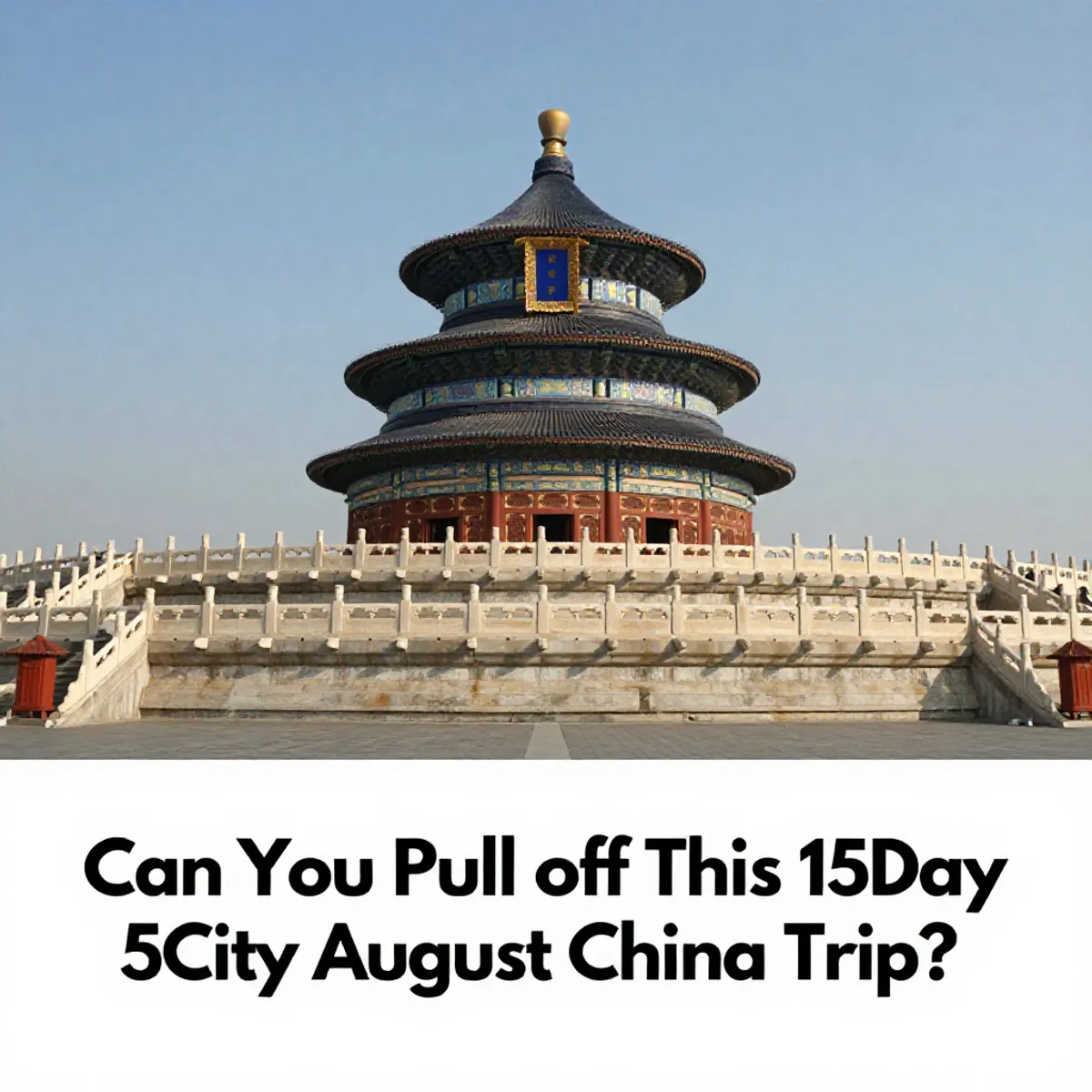
Four nights provide three full days (27th, 28th, 29th) plus a partial day on the 30th before the 12:40 PM flight to Phuket. Beijing's primary attractions are the Forbidden City (a minimum of 4-5 hours), the Great Wall (a full day trip, as the popular Mutianyu section is 1.5 hours away each way), and the Summer Palace. Add in Temple of Heaven, Hutongs (old alleyways) by rickshaw, and the National Museum or 798 Art District, and the list is formidable.
Three full days is a tight but workable schedule to cover these highlights without total exhaustion.
A sample breakdown: Day 1: Forbidden City and Tiananmen Square in the morning, followed by the Summer Palace in the afternoon. Day 2: Full day at the Great Wall (Mutianyu is recommended for its cable car, chairlift, and toboggan). Day 3: Temple of Heaven in the morning, Hutongs exploration (including a tea ceremony or courtyard visit) in the afternoon, and a farewell Peking duck dinner.
The morning of the 30th can be used for any last-minute visits or shopping at Wangfujing Street before heading to the airport. Beijing Capital International Airport (PEK) is about 1 hour from the city center by airport express train or car; Daxing (PKX) is significantly farther (1.5-2 hours). You must factor this travel time and arrive at the airport 2-3 hours before your international flight.
With a 12:40 PM departure, you should plan to leave your hotel by 9:00-9:30 AM at the latest. The four-night stay provides a comfortable buffer for this final departure.
Synthesis: Is the Pace Realistic?
Now, to the core question: is the original itinerary realistic and well-paced, or is it too rushed? The answer is that it sits on the very edge of being overly ambitious, primarily due to two factors: the August climate and the time allocation for Zhangjiajie and Chongqing. The sequence of cities is logical in a geographic loop, minimizing backtracking.
The choice of high-speed rail for the middle legs (Zhangjiajie-Chongqing, Chongqing-Chengdu) is excellent—it's efficient, comfortable, and offers scenic views. The flights for the long hauls (Shanghai-Zhangjiajie, Chengdu-Beijing) are necessary.
But, the plan treats all cities as if they have equal "weight." They do not. Zhangjiajie is a physically strenuous national park visit. Two full days is the functional minimum; three nights provides exactly that, but with the 18th as a travel day.
Chongqing, with only two nights and one full day, is reduced to a scenic stopover rather than a destination to explore deeply. The cumulative effect of moving between five distinct regions with different cultures, languages (dialects), and vibes in 15 days is significant. Each transition involves packing, checking out, traveling, checking in, and orienting yourself.
That mental overhead is not trivial. By August, with heat and crowds, this overhead feels heavier.
A well-paced trip allows for a "slow day"—a day with no major sightseeing, just wandering a favorite neighborhood, enjoying a long lunch, or returning to a cafe. This itinerary has no such built-in slack. Every day is accounted for with a major activity or transit.
So, while technically possible for a highly energetic traveler, it would likely result in significant fatigue by the second week. The joy of spontaneous discovery would be sacrificed to the clock. The risk is that the trip becomes a series of transit points and photo opportunities rather than immersive experiences.
Rebalancing the Itinerary: A Revised Proposal
To improve the experience without drastically reducing the scope, rebalancing time is key. The most impactful change would be to reduce Zhangjiajie by one night and add it to Chongqing and/or Chengdu. Zhangjiajie's three nights become two nights (e.g., 18th-20th), with a travel day to Chongqing on the 20th.
This gives you a proper last morning in the park on the 20th before traveling. The saved night is then added to Chongqing, giving it three nights (20th-23rd). Chongqing now has two full days (21st, 22nd).
This allows for one day exploring the urban core and one day for a half-day trip to the Dazu Rock Carvings or a leisurely exploration of more of Chongqing's unique neighborhoods like Nanbin Road or the Three Gorges Museum.
Alternatively, you could give the extra night to Chengdu, making it four nights (23rd-27th). This allows for a day trip to the Leshan Giant Buddha (about 1.5 hours away) or a more relaxed pace in the city itself, perhaps including a Sichuan opera performance with face-changing. A third option is a hybrid: give Chongqing three nights and Chengdu four, making Beijing three nights instead of four.
Beijing could still be covered in three full days, though it would be tight. The final decision depends on your interests: prioritize more mountain scenery and urban exploration (favor Chongqing), deeper cultural immersion and food (favor Chengdu), or comprehensive historical coverage (favor Beijing).
A concrete revised example could look like this: Shanghai: 3 nights (15th-18th) – unchanged, good. Zhangjiajie: 2 nights (18th-20th) – tighter but sufficient for core park. Chongqing: 3 nights (20th-23rd) – now has two full days, can include Dazu. Chengdu: 4 nights (23rd-27th) – can include Leshan day trip or deep relaxation. Beijing: 3 nights (27th-30th) – three full days, still covers essentials. This reduces total nights from 15 to 15 (just reallocated), but the distribution* of full days is more balanced. The longest travel day becomes Zhangjiajie to Chongqing (4hr train + transfers), but you now arrive in Chongqing with a full evening and have two subsequent full days there, making the transit feel less like a loss.
Practical Considerations for Implementation
Regardless of the final night allocation, certain practicalities are non-negotiable. Flight and train bookings must be made immediately. For August travel in China, especially on popular routes like Shanghai-Zhangjiajie and Chengdu-Beijing, prices will rise and availability will vanish. You should book all intercity transportation as soon as your dates are firm.
This includes the high-speed trains; while they run frequently, preferred departure times (like mid-morning) will sell out. Use the official 12306 website or a reputable third-party platform. For flights, check airlines like China Eastern, Air China, Sichuan Airlines, and Hainan Airlines.
Accommodation should also be prioritized. Book hotels or reputable homestays in the areas you plan to stay. In Zhangjiajie, staying at the Wulingyuan entrance to the park is ideal to minimize morning travel.
In Chongqing, staying near Jiefangbei or Ciqikou puts you in the heart of the action. In Chengdu, staying near the Tianfu Square or Chunxi Road area is convenient. In Beijing, staying near a subway line (like Line 1 or Line 2) is crucial for efficient travel to the spread-out sights.
often check the cancellation policy given the fluidity of planning.
Finally, prepare for the August heat. Pack lightweight, breathable clothing, a wide-brimmed hat, sunglasses, and a high-SPF sunscreen. A portable fan or cooling towel can be a lifesaver in queues.
Hydration is critical—carry a reusable water bottle and refill it constantly. Plan your major outdoor sightseeing (Great Wall, Zhangjiajie hikes) for early morning. Schedule indoor activities (museums, shopping arcades, tea houses) for the hottest part of the day (11 AM - 4 PM).
Embrace the local custom of the afternoon siesta or at least a long lunch in an air-conditioned restaurant. Build these heat strategies into your daily plan; fighting the heat is a primary battle in an August China trip.
Conclusion: Crafting a Memorable First Journey
The proposed itinerary is a bold and logical attempt to see China's highlights. Its structure is geographically sound, and the city choices are excellent for a first-timer. But, its pace is almost certainly too fast for a comfortable, immersive experience in the challenging month of August.
The primary flaw is the short, one-full-day stop in Chongqing, which undersells a fascinating city, and the tight coupling with the physically demanding Zhangjiajie leg. By reallocating just one night from Zhangjiajie to Chongqing or Chengdu, the entire rhythm of the trip improves dramatically. You gain depth in the middle section of the journey, which acts as a crucial buffer before the historical onslaught of Beijing.
Ultimately, the value of a first trip to China is in the memories you bring home. Those memories are more likely to be of the mist-shrouded pillars of Zhangjiajie, the spicy kick of a Chongqing hotpot, or the playful antics of a panda cub in Chengdu if you are not perpetually exhausted and watching the clock. A slightly slower pace allows for serendipity—a chance conversation, an unexpected alleyway discovery, the simple pleasure of watching the world go by from a tea house.
The goal is not to "do" China in 15 days, but to experience it. With a few strategic adjustments to the night allocation, this itinerary can transform from a rushed checklist into a rewarding, layered introduction to a magnificent country. Book your transport now, pack for the heat, and be prepared to adapt.
The best trips often have a little room for the unplanned.
Responses • 0
0/2000
ID: 1326
Chris
Offline
1 hr
Visited
From
Bakersfield, United States
Send Message