C919 Challenges Airbus on HighAltitude Routes
AI Learn Chinese
2 hr • 0 read
COMAC's C919600 begins testing, targeting Airbus' dominance on China's highaltitude commercial routes with Xizang Airlines' launch order.
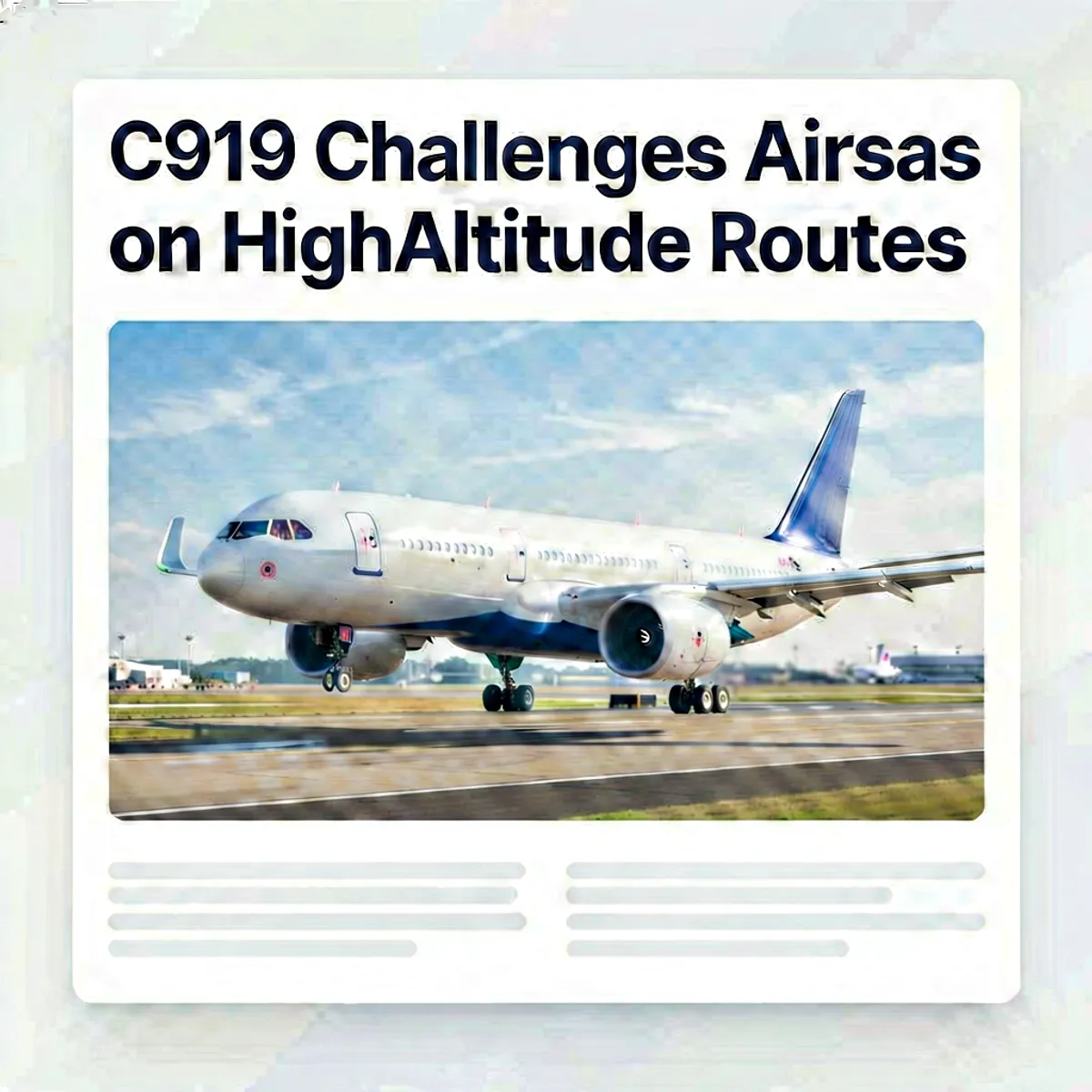
Introduction: A Direct Challenge to an Aviation Monopoly
On a crisp Wednesday in 2026, the C919-600 soared into the sky above Shanghai Pudong International Airport for a two-hour maiden flight. This isn't just another test; it's a direct challenge to Airbus's decades-long dominance on the world's most demanding commercial routes—the high-altitude plateaus of China. For aviation-industry observers, the significance lies less in the flight duration and more in the strategic statement it makes.
The aircraft represents the first credible, government-backed domestic challenger to Airbus's grip on China's strategically vital plateau route network. This challenge is not theoretical; it is backed by a firm 40-aircraft launch order from the airline with the deepest operational knowledge of these extreme routes.
The flight itself, a routine shakeout over eastern China, is a world away from the ultimate proving grounds. Those are the runways carved into the Tibetan Plateau, where air is thin and performance is everything. The C919-600 must now demonstrate it can meet the unique demands of these airports, where every percentage point of engine thrust and every kilogram of lift matters.
This article will explore the technical, economic, and strategic dimensions of this challenge. We will examine why these plateau routes are so critical, how Airbus built its monopoly, and what COMAC must overcome to displace it.
The Strategic Importance of Plateau Routes
Geographic Extremes Define the Network
China's plateau route network is defined by a series of airports that sit at elevations considered impossible for conventional commercial aviation elsewhere. Daocheng Yading Airport in Sichuan province stands as the world's highest commercial airport at 4,411 meters (14,472 feet) above sea level. It is not an outlier but the pinnacle of a network that includes several other extreme-altitude facilities.
Lhasa Gonggar Airport, the primary hub for operations into the Xizang Autonomous Region, sits at 3,570 meters (11,713 feet). Qamdo Bamda Airport, another critical node, reaches 4,334 meters (14,219 feet). These are not minor elevations; they represent environments where atmospheric pressure and density are a fraction of what aircraft experience at sea level.
The terrain surrounding these runways is as formidable as the altitude. Deep valleys, towering peaks, and volatile weather patterns create a complex operational mosaic. Approaches are often challenging, requiring precise navigation and significant performance margins from the aircraft.
An engine flame-out during a missed approach in these regions is not a trivial checklist item; it is a critical emergency with limited options for safe landing. This inherent danger and logistical complexity have historically limited the number of aircraft types certified to operate these routes.
The Physics of Thin Air
The core engineering challenge is the dramatic reduction in air density at altitude. At Lhasa Gonggar Airport, air density is roughly 75 percent of the sea-level value. At Qamdo Bamda Airport, it falls to approximately 65 percent.
This has a cascading effect on aircraft performance. An engine producing 130 kilonewtons (29,213 pounds-force) of thrust at sea level effectively generates 15 to 20 percent less useful thrust at plateau altitudes. This loss directly impacts takeoff distance, climb rate, and single-engine performance during critical phases of flight.
For a commercial jet, less dense air means the wings must travel faster to generate the same lift. This requires longer runways and more powerful engines. It also means the aircraft's flight envelope is compressed; the margin between normal operation and stall speed narrows significantly.
The certification standards for high-altitude operations are therefore exceptionally stringent. Aircraft must prove not only that they can take off and land safely but that they can do so with adequate performance reserves for engine failures and severe weather diversions. This high barrier to entry has been the cornerstone of Airbus's monopoly.
Economic Lifelines to Remote Regions
Beyond the technical spectacle, these routes are vital economic arteries. They connect the Tibetan Plateau and surrounding high-altitude regions with the rest of China, facilitating trade, tourism, and essential services. For communities in these remote areas, reliable air service is not a luxury but a necessity.
Ground transportation is often impossible for large parts of the year due to snow, landslides, or sheer distance. The airlines operating these routes, particularly Xizang Airlines, bear the responsibility of maintaining this lifeline.
The economics are uniquely challenging. The fuel burn penalty for operating at high altitude is significant. Aircraft must carry more fuel for the same distance, reducing payload or range.
Passenger yields can be lower due to smaller regional markets, though tourism to scenic areas like Daocheng Yading provides important revenue. The operational costs per seat kilometer are among the highest in the world. Only aircraft specifically optimized for this environment can operate profitably.
This has locked the market into a small number of approved airframes, creating a natural, technology-driven monopoly that Airbus has expertly exploited for decades.
Airbus's Decades-Long Dominance
The A319neo: A Perfect Fit for the Plateau
Airbus's monopoly on China's highest routes was not accidental; it was engineered through a combination of foresight, marketing, and technical excellence. The cornerstone of this dominance is the Airbus A319neo, specifically the A319-115 variant. This aircraft is a shortened version of the A320 family, which reduces empty weight—a critical advantage when operating at the edge of performance envelopes. Its engines, typically from the Pratt & Whitney PW1100G or CFM International LEAP families, were among the first to offer significant fuel efficiency gains and, crucially, high-altitude performance.
Airbus invested heavily in certifying the A319neo for operations at airports like Daocheng Yading and Qamdo Bamda. This involved extensive testing in these actual conditions, gathering data to prove compliance with stringent Chinese and international regulations. The aircraft's flight control software, engine control systems, and takeoff performance calculations were all fine-tuned for the thin air.
Airbus marketed the A319neo not just as an airliner but as a solution to a specific, high-value problem: reliable, efficient, and safe service to the roof of the world. This positioning made it the default, and often only, choice for Chinese airlines seeking to serve these routes.
Building an Unassailable Network Effect
Airbus's strategy extended beyond the aircraft itself. The company cultivated deep relationships with Chinese airlines and regulatory bodies. It provided comprehensive training for pilots and engineers on high-altitude operations.
Spare parts inventories and maintenance support were established at key hubs like Lhasa. This created a powerful ecosystem where the A319neo became the standard. Airlines knew that by choosing Airbus, they were choosing a proven, supported platform with a fleet of common type for easier crew scheduling and maintenance across their network.
The network effect became Airbus's strongest defense. Once an airline like China Southern or Sichuan Airlines built its plateau route schedule around the A319neo, switching costs became prohibitive. Retraining pilots, re-engineering maintenance procedures, and renegotiating airport support for a new aircraft type represented a massive operational and financial undertaking.
In addition, the established safety record of the A319neo on these demanding routes built immense trust with both operators and passengers. For years, the Airbus A319neo wasn't just the best option; it was the only option that made commercial and operational sense.
The Strategic Value of the Monopoly
For Airbus, controlling China's plateau route network was strategically invaluable. These routes, while niche in terms of total seat capacity, represented a high-margin, high-prestige segment of the market. Successfully operating where others cannot is a powerful marketing tool globally.
It demonstrated Airbus's technical leadership in a very public way. More importantly, it cemented Airbus's position as the indispensable partner for China's aviation expansion into its most challenging geography.
This monopoly also provided a steady stream of revenue in a market where overall growth is fiercely contested by COMAC's narrowbody offerings. While COMAC's ARJ21 regional jet and the newer C919 family compete directly with Airbus's A320 family on trunk routes, the A319neo's stronghold on the plateau acted as a protected fortress. It ensured Airbus retained a critical foothold in China's rapidly growing aviation market, one that was less vulnerable to government-driven "buy local" policies because it was technically justified. This fortress is now under its most serious threat.
COMAC's Strategic Countermove
The C919 Family: A Credible Domestic Alternative
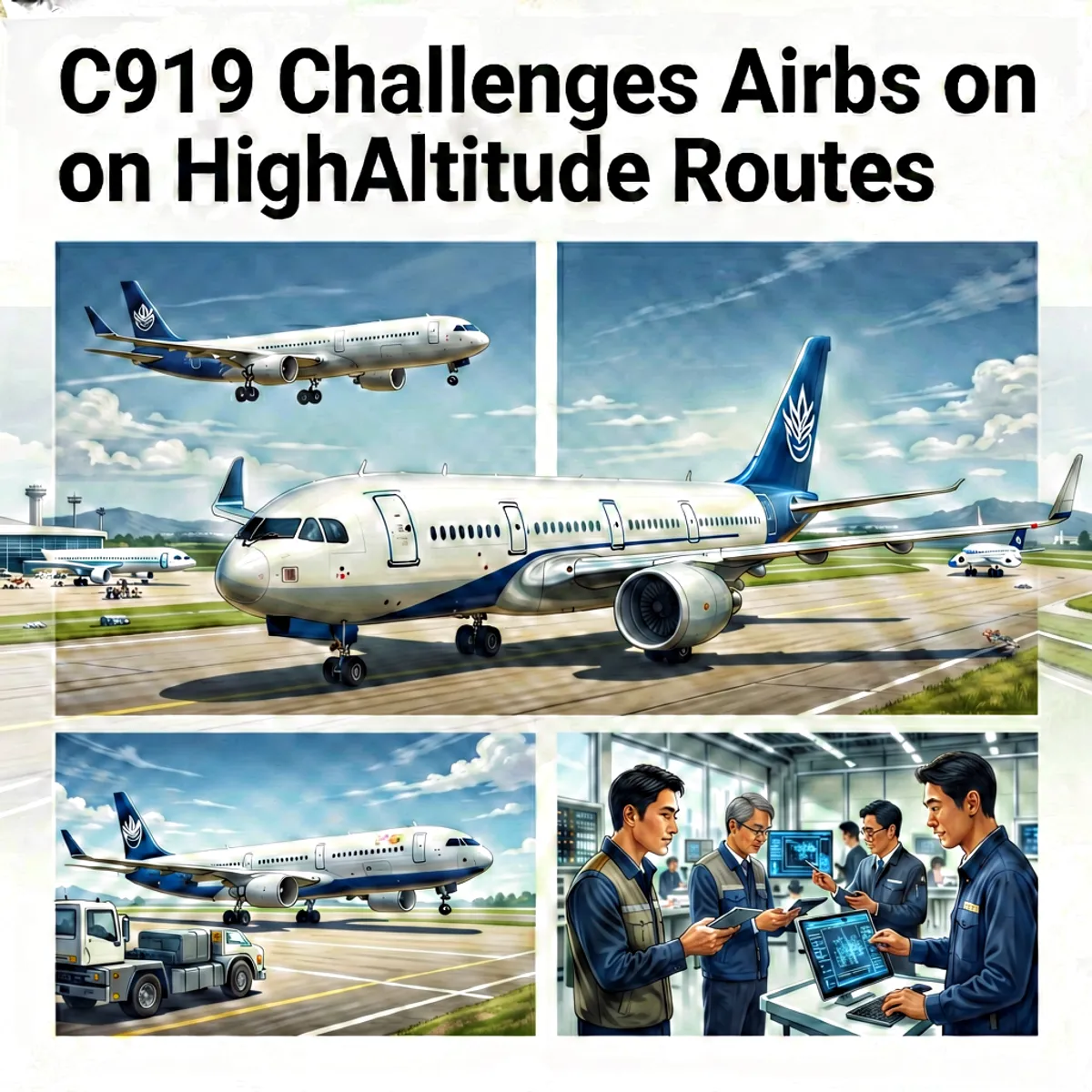
COMAC's response to this challenge is the C919 family, with the C919-600 being the stretched variant designed for longer, higher-capacity routes. The program represents China's most ambitious civil aviation project, aiming to create a true alternative to Airbus and Boeing for the mainstream narrowbody market. The C919-600's development has been closely watched, with its first flight in 2026 marking a major milestone. The aircraft incorporates modern aerodynamics, composite materials, and a choice of Western engines (currently the CFM International LEAP-1C), positioning it as a state-of-the-art product rather than a copy.
The significance of the C919-600 beginning flight testing is that it moves the program from prototype to a production-configured variant. The "600" suffix denotes increased maximum takeoff weight and fuel capacity, essential for the demanding performance requirements of high-altitude operations. This variant is being purpose-built to attack the very market segment where the A319neo has reigned supreme. It is not a coincidence; it is a deliberate strategic targeting by COMAC and its state backers of a high-value, technically prestigious market that has long been closed to Chinese industry.
Government Backing as a Force Multiplier
What distinguishes the C919 challenge from previous domestic attempts is the level of integrated government support. This is not merely a company project; it is a national strategic initiative. Support manifests in guaranteed launch orders from state-owned or state-influenced airlines, subsidized research and development, coordinated certification efforts with the CAAC (Civil Aviation Administration of China), and policies that favor domestic procurement for strategic routes.
The 40-aircraft launch order from Xizang Airlines is the most potent example of this. It transforms the C919-600 from a promising prototype into an aircraft with a guaranteed, high-profile customer whose needs perfectly align with its design goals.
This backing de-risks the program in a way no private company could achieve. It signals to the global supply chain and potential export customers that China is committed to this aircraft for the long term. It also allows COMAC to pursue an aggressive development and certification schedule, knowing that the initial domestic market is secured.
For Airbus, this changes the calculus entirely. The competition is no longer a commercial entity that can be outspent or outsold; it is a national champion with the full weight of the Chinese state behind it, targeting a market Airbus believed was secure.
Targeting the Plateau: A Calculated Entry Strategy
COMAC's strategy is not to attack the massive, competitive trunk route market first, where the A320neo and Boeing 737 MAX are entrenched. Instead, it is using the plateau route network as a beachhead. This is a brilliant tactical maneuver.
By focusing on a niche where Airbus's product, while dominant, is also uniquely vulnerable to a purpose-built challenger, COMAC can achieve a decisive victory with a smaller initial production run. Winning the plateau market provides a powerful proof of concept. Success on the world's highest runways would be an unparalleled marketing asset, silencing critics who question the C919's capabilities.
In addition, securing Xizang Airlines as the launch customer is a masterstroke. This airline's daily operations on these routes provide an invaluable real-world testing and feedback loop. Pilots and engineers who know every nuance of flying into Daocheng Yading and Qamdo Bamda will be the first to validate the C919-600's performance.
Their endorsement, once gained, will be more credible than any advertisement. This customer-centric, mission-specific approach contrasts with Airbus's earlier, more generalist entry into the market. COMAC is building the right tool for a specific, well-defined job and then selling it directly to the people who need it most.
The Technical Hurdle: Engineering for the Roof of the World
Engine Performance at the Edge
The single greatest technical challenge for any aircraft operating on the Tibetan Plateau is engine thrust lapse. As air density decreases, the mass of air entering the engine core per second drops. This directly reduces the thermodynamic and kinetic energy the engine can produce.
The 15 to 20 percent thrust loss at plateau altitudes is not a minor detail; it is the primary sizing driver for the aircraft's wing, its landing gear, and its entire takeoff performance profile. The C919-600 must be engineered from the ground up to manage this deficit.
This requires a holistic design approach. The wing must be efficient at high altitudes, often requiring a larger area or higher aspect ratio than a standard narrowbody. The landing gear must be robust enough to handle higher true airspeeds on the runway during takeoff and landing.
The flight control software must have sophisticated algorithms to calculate precise, real-time takeoff performance based on exact airport elevation, temperature, and aircraft weight. A error of a few hundred kilograms in weight calculation or a misreading of outside air temperature could mean the difference between a safe climb-out and a runway overrun.
Airframe Modifications and Certification
While the baseline C919 shares much with its Western counterparts, the -600 variant for high-altitude operations will likely see specific modifications. These could include enhanced anti-ice systems for the more severe weather encountered on the plateau, reinforced structural components to handle higher stress cycles from constant high-altitude operations, and specialized braking systems for the longer ground runs required on thinner air. The certification process for these modifications with the CAAC will be rigorous and likely involve dedicated flight tests at the target airports.
The benchmark is the Airbus A319neo's existing certification for Daocheng Yading and Qamdo Bamda. COMAC's engineers must not only match that performance but demonstrate clear advantages to persuade airlines to switch. This means the C919-600's published takeoff distances at maximum weight on a hot day at Daocheng Yading must be competitive or superior.
Its single-engine climb gradient must meet or exceed regulatory minima. Every performance chart in the aircraft's flight manual will be scrutinized by the pilots and dispatchers at Xizang Airlines. The technical hurdle is therefore not just about building an aircraft that can fly high; it's about building one that can do so more efficiently and reliably than the established incumbent.
The Runway as a Constraint
The runways themselves are a fixed, immutable constraint. Daocheng Yading Airport's runway is approximately 4,200 meters long, which is long by global standards but becomes a critical limitation when an aircraft is struggling for thrust in thin air. There is no room for error in performance calculations.
The runway's slope, surface condition, and surrounding terrain (which affects go-around procedures) are all baked into the aircraft's certified operating limitations. For COMAC, gaining intimate knowledge of these specific runway characteristics through joint testing with Xizang Airlines is a mandatory step.
This focus on the runway-interface highlights the aircraft's integrated nature. It is not enough for the engine to be powerful on a test stand. The thrust must be transmitted efficiently through the airframe, controlled by the flight computers, and managed by the pilots within the confines of a specific, challenging piece of concrete at 4,411 meters. The C919-600's success depends on this seamless integration, a systems engineering challenge that COMAC is tackling with the full weight of national resources behind it.
Xizang Airlines: The Key Customer and Validation Partner
An Airline Forged in the High Altitude
Xizang Airlines is not a typical launch customer. It is an airline whose entire identity and operational model is built around flying the Tibetan Plateau. Based in Lhasa, its fleet is tailored for high-altitude performance, and its pilots are among the world's most experienced in this specialized environment.
The airline operates the vast majority of its flights to and from airports above 3,000 meters. Its expertise is institutional, born from thousands of flights in conditions that would ground other carriers. This makes its endorsement of the C919-600 potentially more valuable than any marketing claim from COMAC itself.
The airline's decision to place a 40-aircraft order is a monumental vote of confidence. It signals that, after years of operating Airbus aircraft, Xizang Airlines sees a credible, superior alternative on the horizon. This order likely comes with significant concessions or support from COMAC and the Chinese government, but its symbolic weight is immense. It tells the global aviation industry that the C919-600 is not a political project for show; it is a practical tool that solves a real operational problem for a world-class airline.
From Operator to Development Partner
The relationship will likely evolve beyond a simple buyer-seller dynamic. Xizang Airlines's pilots and engineers will be deeply involved in the final phases of testing and certification. Their feedback on cockpit ergonomics at altitude, on engine behavior during hot-and-high takeoffs, and on maintenance procedures in remote bases will be critical.
They will be the ones writing the operational manuals and training the next generation of C919-600 pilots for the plateau. This turns the launch customer into a development partner, dramatically increasing the program's chances of success.
For Xizang Airlines, the partnership offers potential advantages beyond aircraft cost. It could mean greater influence over the final design specifications, priority in delivery schedules, and a closer technical support relationship with the manufacturer. In a market where aircraft availability is key, securing a dedicated supply of a purpose-built aircraft could provide a significant competitive edge.
This deep collaboration is a model often seen in military procurement but less common in commercial aviation. It underscores the strategic, rather than purely commercial, nature of the C919-600 program.
The Proof Will Be in the Flying
Ultimately, Xizang Airlines's fleet will be the ultimate proving ground. The first C919-600s delivered to the airline will begin commercial service on routes like Lhasa to Chengdu or Qamdo to Kunming. Every flight will be a live test.

The aircraft's dispatch reliability, fuel burn compared to the A319neo, and pilot satisfaction will be measured in real-time. Any teething problems will be highly visible. Success will be measured not in flight test hours over Shanghai, but in on-time departure rates from Gonggar Airport during the winter monsoon season.
The plateau leaves no room for hype; it rewards only proven performance. Xizang Airlines's operational experience will become the definitive benchmark for the C919-600's capabilities.
Market Implications and Competitive Dynamics
Shifting the Balance in China's Skies
A successful C919-600 entry into the plateau route network would fundamentally alter the competitive landscape for COMAC and Airbus in China. For COMAC, it establishes the C919 family as a true multi-role platform, capable of serving everything from standard domestic trunk routes to the most demanding high-altitude sectors. This dramatically expands its addressable market and strengthens its value proposition to other Chinese airlines. It moves the C919 from being seen as an "A320 competitor" to a specialized solution for specific network needs.
For Airbus, the loss of its plateau monopoly is a significant strategic blow. While the absolute number of aircraft needed for these routes is small compared to the total narrowbody fleet in China, the psychological and strategic value is enormous. It demonstrates that even in a market segment where Airbus had a technological lead and deep incumbency, a determined, state-backed challenger can compete.
This could encourage other Chinese airlines to consider the C919 for more standard routes, especially if government policy subtly favors domestic options. Airbus's fortress has a crack, and the company will be forced to respond, likely with aggressive pricing or enhanced support for its existing A319neo fleet.
Global Ripple Effects
The implications extend beyond China's borders. a few other countries, including Nepal, Bhutan, and Peru, operate commercial flights to high-altitude airports. These markets often use older Airbus A319s or Boeing 737 Classics because modern, fuel-efficient aircraft are not certified for the conditions.
A proven, modern C919-600 variant could become an attractive option for these nations, especially if offered with attractive financing from Chinese state banks. This represents a potential new export market for COMAC, one that directly leverages the experience gained in China.
In addition, the technical data and certification experience from the high-altitude program would be invaluable assets. It would prove COMAC's engineering rigor in a domain that is objectively difficult. This could make the broader C919 family more palatable to risk-averse international lessors and airlines.
The "plateau certification" could become a powerful marketing badge, analogous to how ETOPS certification became a key selling point for twinjets over the oceans. It transforms the C919 from a regional player into a globally credible aircraft.
Supply Chain and Industrial Policy
The C919-600 program is also a catalyst for China's domestic aerospace supply chain. While it currently uses Western engines (LEAP-1C) and systems, the long-term goal is to replace these with indigenous alternatives like the CJ-1000A engine. Success on the plateau routes, backed by a major airline order, provides the political and economic justification to accelerate this indigenization.
It strengthens the argument for investing in domestic avionics, landing gear, and flight control manufacturers. This could gradually erode the business of Western suppliers in the Chinese market, a slow but steady shift with major long-term consequences.
For global suppliers, the plateau route challenge presents a dilemma. The market is lucrative but comes with strings attached. Continued participation means technology transfer and potential competition from Chinese copycats down the line.
Withdrawing cedes the field to competitors and loses a major growth market. This tension will shape the supply chain for years to come. The C919-600's success on the plateau is a key data point in this calculation, showing that the Chinese program is not just a paper tiger but a viable, high-performance product.
The Road Ahead: Certification, Delivery, and Scaling
The Final Certification Gauntlet
The flight test program in Shanghai is merely the opening act. The true certification gauntlet will be run on the plateau itself. COMAC will need to conduct a series of flights from Daocheng Yading, Qamdo Bamda, and Lhasa Gonggar under varying seasonal conditions.
This includes hot summer days when density altitude is extreme, and frigid winter mornings with potential snow and ice. The CAAC will observe these tests with a fine-toothed comb, ensuring the aircraft meets all Chinese regulations, which are often more stringent for high-altitude operations than international standards.
This phase will be time-consuming and logistically complex. Transporting support equipment, engineering teams, and spare parts to these remote airports is a major undertaking. Weather windows for specific test points can be narrow.
Delays are common in such programs. The target for entry into service with Xizang Airlines is likely 2026, but this timeline depends on a flawless execution of the high-altitude flight test program. Any significant technical issue discovered during these tests could push certification back by months or even years.
Scaling Production for a Niche Market
Producing 40 aircraft for Xizang Airlines is a scaled challenge, but it is not the mass production needed for the broader C919 program. The assembly line will need to be validated for the -600 variant's specific components and configuration. Supply chain maturity for the specialized parts required for high-altitude operation—such as enhanced brakes or specific engine tuning—must be proven. The initial production run will be a careful, quality-focused process, not a sprint to high rates.
Once the plateau variant is certified and delivered, COMAC will face the next question: how to leverage this success? Will it develop an even longer-range, higher-performance variant for even more extreme airports? Or will it use the credibility gained to push the standard C919-600 into other Chinese airlines for mixed fleets? The scaling strategy will determine whether the plateau program remains a niche success or becomes the foundation for a broader C919 family dominance.
The Long-Term Vision: An Aviation Superpower
For China, the C919-600's plateau challenge is a key milestone in a decades-long vision to become a complete aviation superpower. This vision includes designing and building large commercial aircraft, developing domestic engines and avionics, and establishing a global support and sales network. Successfully capturing the high-altitude route network would be a powerful symbol of this achievement. It would demonstrate mastery over one of the most technically demanding segments of aviation.
The year 2026 is a target, but the journey continues beyond it. The ultimate goal is a fully independent, globally competitive civil aviation industry. The battle for the Tibetan Plateau is the first major test of that ambition.
It is a test where the stakes are high, the margins are thin, and the world is watching. For COMAC and its state backers, failure is not an option. For Airbus, defending this last stronghold is now a top priority.
The runway at Daocheng Yading has become the frontline in a quiet but profound industrial competition.
Conclusion: The Plateau as a Strategic Battlefield
The flight of the C919-600 over Shanghai is the first maneuver in a high-stakes contest for control of China's most challenging air routes. This is not a battle over seat capacity or fuel efficiency alone; it is a contest for technological prestige, strategic autonomy, and industrial dominance. The Tibetan Plateau, with its thin air and towering peaks, serves as the ultimate proving ground.
For decades, Airbus's A319neo has reigned supreme here, its performance a testament to Western aerospace engineering. That reign is now directly challenged by a state-backed Chinese program with a singular focus.
The outcome hinges on execution. COMAC must translate flight test data into flawless, reliable service for Xizang Airlines. It must scale production without compromising quality.
It must eventually wean itself from Western suppliers to achieve true independence. Airbus, in turn, must defend its fortress not just with better marketing, but by potentially accelerating upgrades to the A319neo or developing a new high-altitude variant to stay ahead. The 40-aircraft order from Xizang Airlines is the opening gambit; the real war will be won or lost in the maintenance hangars at Lhasa Gonggar and on the runways of Daocheng Yading.
This struggle for the plateau routes is a microcosm of a larger shift in global aviation. It shows how national strategic priorities can reshape even the most technically entrenched markets. The aircraft themselves—the Airbus A319neo and the COMAC C919-600—are more than metal and composites.
They are symbols of two different models of industrial development: one built on global supply chains and incremental innovation, the other on state-directed ambition and national self-reliance. The thin air of the Tibetan Plateau may seem an unlikely arena for such a profound contest, but in aviation, as in geopolitics, the most remote frontiers often become the most significant battlefields. The world's highest commercial runways are about to become a lot more crowded.
Responses • 0
0/2000
ID: 1326
Chris
Offline
2 hr
Visited
From
Bakersfield, United States
Send Message