Bridging the Taipei Speaking Gap
AI Learn Chinese
3 hr • 0 read
Stuck in Mandarin comprehension but not conversation? A 4.5month guide to effective speaking practice in Taipei without breaking the bank.
You are in Taipei. The air hums with the very language you are learning. You can follow a news headline, catch the gist of a café order, even understand the plot of a TV drama with the help of subtitles. Yet, when a local greets you with a warm "Nǐ hǎo ma?" your brain scrambles. The words you want are there, somewhere, but the path from understanding to producing feels like a blocked highway. This is the intermediate plateau, and you have exactly 4.5 months to build a bridge across it. Your current class, using Book 4-1, is laying a solid grammatical foundation, but you correctly identify the core issue: it is textbook-heavy. You need to speak. The good news is that Taipei itself is your ultimate classroom, and with a strategic, layered approach, you can transform those 4.5 months into a period of explosive conversational growth.
The Intermediate Plateau: Understanding Without Fluency
This stage is famously frustrating. You have moved beyond absolute beginner survival phrases. You possess a vocabulary that feels substantial on paper. You can dissect a sentence structure. But spoken Mandarin, especially unscripted, native-speed conversation, is a different beast. It is filled with slang, dropped particles, regional accents, and a rhythm that textbooks rarely capture. You find yourself in the scenario you described: catching key phrases, surmising meaning from context, and nodding along while your internal monologue screams, "I know this word! Why can’t I say it now?!" This gap between receptive knowledge (what you understand) and productive knowledge (what you can say) is normal. It is not a reflection of your intelligence or effort. It is a skills gap. Speaking is a motor skill; it requires not just knowing the vocabulary but wiring your mouth and your brain to retrieve and articulate it under pressure. Your goal—to hold more conversations where you understand more and communicate more effectively—is precisely about closing this gap.
The Taipei Ecosystem: Your Immersion Advantage
Living in Taipei for 4.5 months is a monumental advantage. You are not learning in a vacuum. You are immersed. Every interaction is a potential lesson. The challenge is converting passive immersion into active practice. You cannot rely on osmosis alone; osmosis is slow and inefficient. You must engineer opportunities for output. This means creating situations where you must speak, and where the feedback loop is tight. The city offers a spectrum of options, from low-cost, high-immersion community settings to structured, paid one-on-one guidance. The most effective plan will combine several of these, creating a weekly routine that forces you to produce language in different contexts.
The $30/Hour Question: Is 1-on-1 Tutoring Worth It?
At about $30 per hour, professional one-on-one tutoring in Taipei is a significant but potentially high-leverage investment. Let’s break down the math and the value. If you commit to 20 hours per month, that’s about $600 monthly. Over 4.5 months, that totals \$2,700. This is a serious sum. Is it justified? The value of a good tutor is not in lecturing you on grammar from a book. You already have a class for that. The value is in customized, corrective conversation. A skilled tutor acts as a speaking coach. They will:
- Force Output: For 60 minutes, you are the primary speaker. There is no hiding. - Provide Immediate Correction: They will catch your pronunciation errors, your incorrect tone placements, your awkward word order, and fix them in real-time. This is impossible in a group class or with a language partner who may not have the pedagogical training to explain why something is wrong. - Simulate Real Scenarios: You can role-play ordering food, complaining about a noisy neighbor, discussing current events, or negotiating a price at a market. You can work directly on the conversational situations you anticipate needing. - Build Confidence: The one-on-one environment is a safe space to make mistakes. A good tutor creates encouragement, turning errors into learning moments without judgment. - Target Your Specific Gaps: They will listen to your speaking patterns and specifically drill your weak points. Do you mix up "shì" and "sì"? Do you drop measure words? A tutor will design exercises just for you.
But, the quality varies wildly. A \$30/hour tutor might be a university student looking for extra cash or a seasoned professional. You must vet them. Your goal is conversational fluency, so seek a tutor whose profile emphasizes spoken practice, pronunciation correction, and daily life topics. Avoid those who simply want to go through textbook dialogues with you. Use the first trial lesson to assess: do they talk 30% of the time and you 70%? Do they interrupt gently to correct? Do they bring relevant materials (news articles, discussion prompts) or just open your book? If the answer is yes to the first two, they are likely worth the investment. This tutoring should be the backbone of your speaking practice, providing structured, corrective output.
The Free(er) Alternative: Strategic Language Exchange
This is the complementary force to tutoring. A language exchange (Tandem, HelloTalk, local Facebook groups) pairs you with a native Mandarin speaker learning English. The model is typically 50/50 split: 30 minutes English, 30 minutes Mandarin. The cost is your time and your willingness to help them with English. The value is authentic, unscripted conversation with a peer. This is different from a tutor. There is no formal correction. You learn through negotiation of meaning. You learn to paraphrase when you don’t know a word. You learn the real way people talk, the filler words ("nàme...", "jiùshì..."), the interjections ("wǒ kàn..."). You build social connections that can organically lead to more casual meetups—coffee, a walk in Daan Forest Park, trying a new restaurant. This is the "soft" immersion. It builds fluency, confidence, and cultural understanding in a way a tutor never can.
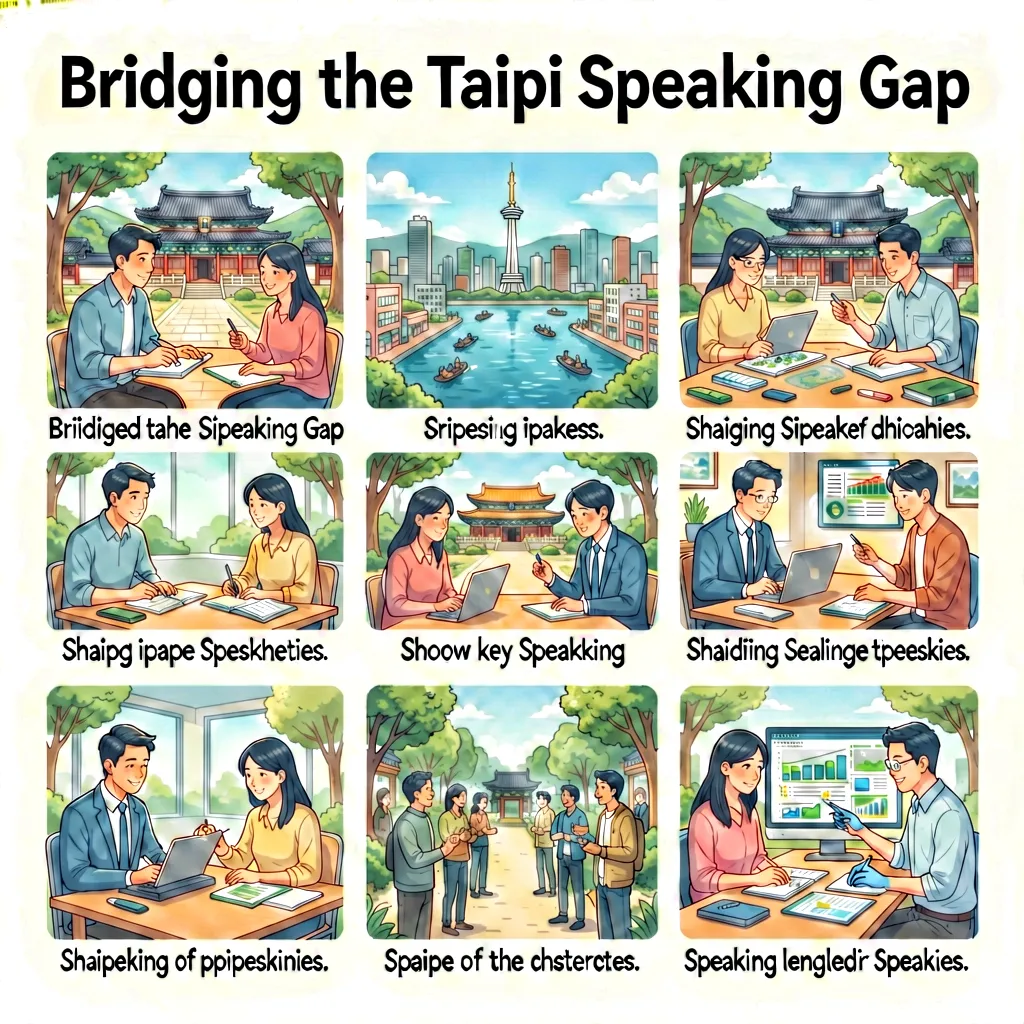
The pitfall is inefficiency. Without a trained guide, you might spend 30 minutes talking about the weather with simple sentences, reinforcing basic patterns but not stretching your ability. Your job in the exchange is to push your own boundaries. Come prepared with a topic. "Today, I want to talk about the pros and cons of remote work." "Let's discuss this news article I read." "Tell me about your favorite childhood memory in Taipei." Bring a notepad. When you don't know a word, ask. When they use a phrase you like, ask them to write it down. This is your chance to practice comprehension under pressure and improvisation. Aim for at least 3-4 language exchange sessions per week, each 1-1.5 hours. This adds up to 12-18 hours of low-cost, high-context speaking practice monthly.
The Daily Grind: Weaving Practice into Your Life
Your formal tutoring and language exchanges are your weekly "deep practice" sessions. But fluency is built on a mountain of tiny, daily interactions. This is where you leverage your Taipei environment. You must actively seek out micro-opportunities to speak.
- The Order-Up Drill: rarely just point and grunt. At any food stall, convenience store, or bubble tea shop, use full sentences. "Wǒ yào yī bēi nǎichá, shēng bīng, xiē xiē." (I want a cup of milk tea, less ice, a little sweet.) If they ask a follow-up question ("dà bēi hái shì zhōng bēi?"), engage. This is 30 seconds of real, high-stakes speaking. Do this 5 times a day, and you have 2.5 minutes of forced production. - The Taxi/UBer Chat: Drivers are often talkative. Ask about their favorite night market, how long they’ve been driving, what they think of the weather. They are a captive audience and usually appreciate the effort. - The Question Everywhere: Instead of using your phone to look up a restaurant review, ask the person next to you in line. "Nǐ juéde zhè jiā diàn hǎo chī ma?" (Do you think this restaurant is good?) The worst they can do is give a short answer. The best is a 5-minute chat. - Join a Hobby Group: Find a group that does something you already like—hiking, board games, photography, yoga—conducted in Mandarin. Platforms like Meetup.com or local Facebook hobby groups are goldmines. Here, the conversation is tied to a shared activity, reducing pressure. You talk about the hike, the game, the photo. This creates natural, topic-based vocabulary.
These daily interactions train your brain to switch on Mandarin spontaneously. They desensitize you to the fear of making mistakes. They expose you to accents and speeds you won’t hear in a classroom.
Structuring Your 4.5-Month Ascension
With these tools, you need a plan. Let’s map a hypothetical, balanced weekly schedule for the next 4.5 months, assuming a moderate budget.
Weeks 1-6: Foundation & Frequency
- 1-on-1 Tutoring: 2 sessions/week (2 hours). Focus: core pronunciation correction, basic conversational frameworks (past/present/future, expressing opinions). Use your Book 4-1 as a reference, but tell your tutor to treat it as a grammar reference, not a script. Practice making your own sentences with those structures. - Language Exchange: 3 sessions/week (1.5 hours). Focus: simple daily topics, introducing yourself, hobbies. Your goal is just to talk continuously for your half-hour. Don’t worry about perfection. - Daily Micro-Interactions: 5+ as described above. - Self-Study: 30 mins/day. Listen to a slow Mandarin podcast (如 "Slow Chinese") or watch a kids' show. Shadowing ( repeating immediately after the speaker) is excellent for rhythm and pronunciation.
Weeks 7-12: Expansion & Complexity
- 1-on-1 Tutoring: 2 sessions/week. Shift focus. Now, bring in articles from the Taipei Times or a blog you like. Discuss them. Work on more complex sentence structures and nuanced vocabulary. Role-play specific, challenging scenarios you anticipate (e.g., giving directions, handling a service complaint). - Language Exchange: 3-4 sessions/week. Increase topic complexity. Discuss news, cultural differences, plans for the weekend. Start asking "why" and "how" questions. - Hobby Group: Join 1 group that meets weekly (e.g., a hiking group). This is pure, unstructured social immersion. - Daily Micro-Interactions: Continue, but push slightly. Try to have a 2-3 minute chat instead of a 30-second exchange.
Weeks 13-18 (Final Stretch): Integration & Nuance
- 1-on-1 Tutoring: 1-2 sessions/week (maintain, don’t drop). Now, use it for polishing. Have your tutor simulate a "job interview" in Mandarin or a deeper conversation about your future plans. Get feedback on your more subtle errors. - Language Exchange: 2-3 sessions/week. You should be carrying more of the conversation now. Your English time should feel like a genuine break for your partner, not a struggle. - Hobby Group & Social Circle: Actively try to arrange casual meetups with 1-2 people you’ve met through exchanges or hobby groups. Go for coffee. This is the ultimate test—social bonding in Mandarin. - Consumption: Shift your listening to native-level content aimed at adults—TV dramas without subtitles (or Chinese subtitles only), popular podcasts. Focus on understanding without translating.
The Critical Mindset Shift: From "Correct" to "Communicative"
This is the most important psychological adjustment. For 4.5 months, your primary metric for success is not grammatical perfection. Your metric is effective communication. Did you get your point across? Did you understand the gist of what they said, even if you missed words? Did the conversation flow? If yes, you succeeded. A mispronounced tone that still leads to the correct restaurant is a win. A sentence with a missing particle that your friend understands is a win. You are training for fluency, which is a highway with construction zones, not a pristine, empty autobahn. Your tutor is there to gradually smooth out the biggest potholes (the errors that cause real miscommunication). Your language partners and daily interactions are there to get you comfortable driving on the bumpy road. Stop apologizing for your Chinese. Start celebrating the moments of connection. The person on the other end is usually thrilled you are trying.
Financial Reality Check: Optimizing the $600/Month
If the \$600/month for 20 hours of tutoring is steep, adjust. You could do:
- 10 hours of tutoring + 10 hours of language exchange: \$300/month. This is a powerful combo. The tutor fixes your foundational errors; the exchange provides volume. - 5 hours of tutoring + 15 hours of structured conversation meetups: Some organizations like TIA (mentioned in your entities) or local university clubs offer cheap, topic-based conversation sessions (often \$100-200 NTD per session, so very affordable). This gives you some structure without the full tutor cost. - The "Tutor-Lite" Model: Hire a tutor not for general chat, but for a specific, intensive purpose. For example, two weeks before a trip to a specific region of Taiwan, hire a tutor for 4 hours to drill all the vocabulary and phrases you’ll need for that context. This is surgical, high-impact spending.
The core principle is this: Spend money on corrective feedback. Spend time on volume. Your budget should reflect that split.
Measuring Progress Beyond the Textbook
How do you know you’re improving over 4.5 months? The textbook tests won’t tell you. You need new metrics:
1. The "Comprehension Threshold": At the start, you might understand 40% of a casual conversation between natives. In 3 months, is it 60%? Are you catching more of the "glue" words ( conjunctions, adverbs) that signal relationships between ideas? 2. The "Response Latency": How long does it take you to form a simple response? From hearing a question to opening your mouth, is it 5 seconds of panicked silence, or 2? Decreasing latency is huge. 3. The "Circumlocution Success Rate": When you don’t know a word, do you freeze, or can you describe it ("the thing you use to cut paper" for "scissors") and get your point across? This is a sign of true communicative competence. 4. Social Invitations: Are you starting to get invited to things in Mandarin? "Wǒmen qù chīfàn ba!" (Let’s go eat!) This is the ultimate field test. People invite you when they enjoy talking to you, not when you are a grammar project.
Conclusion: The Bridge is Built One Conversation at a Time
Your 4.5 months in Taipei is a finite, precious resource. Do not waste it solely inside a classroom, no matter how "good" the level. The bridge from understanding to speaking is not built with more textbooks. It is built with the \$30/hour tutor who stops you from fossilizing bad habits. It is built with the language exchange partner who laughs with you when you mix up "hot" and "cold." It is built with the auntie at the market who chats with you because you made the effort. It is built in the 30-second interactions that, multiplied by thousands, rewire your brain. Combine the structured correction of paid guidance with the high-volume, authentic practice of the free Taipei ecosystem. Be kind to yourself. Measure progress in connections made, not errors avoided. By the time your 4.5 months are up, the goal is not perfection—it is the quiet confidence that when someone speaks to you in Mandarin, you will not just understand some of it. You will know, without a doubt, that you can respond. You will have built that bridge, plank by conversational plank, right there in the heart of Taipei.
Responses • 0
0/2000
ID: 1326
Chris
Online
From
Bakersfield, United States
Send Message