Breaking the Chinese Learning Plateau
Learn Chinese
2 hr • 0 read
Stuck in your Chinese studies? Discover why plateaus happen and practical, actionable strategies to reignite your progress and move beyond HSK4-5 fluency barriers.

You know the feeling. It’s that quiet, frustrating moment when you realize your dedicated study routine has hit a wall. For months, you’ve been consistent—showing up every day, grinding through flashcards, attending your lessons, consuming content. You’ve built a solid vocabulary, you can navigate familiar conversations, and you feel like you’re almost there. Then, one day, you wake up and nothing changes. The progress you once felt in your bones has evaporated. You’re moving, but you’re not going anywhere. This is the plateau. It’s a universal rite of passage in language acquisition, and if you’re studying Chinese, it can feel particularly isolating and steep. This article is not about quick fixes or magical shortcuts. It’s a deep dive into the mechanics of the plateau, why your current, otherwise excellent, routine might be reinforcing it, and a comprehensive toolkit of strategies to systematically dismantle it and resume your ascent.
The Illusion of Linear Progress and the Reality of the Plateau
From our first language-learning successes as children, we’re conditioned to expect a straight line upward. Learn a word, know a word. Practice a phrase, master a phrase. This model works spectacularly well for the first few hundred words and basic sentence structures. It’s the “low-hanging fruit” phase, where every study session yields tangible, measurable results. You can feel yourself getting smarter. But language is not a checklist; it’s a complex, adaptive system. True fluency—the ability to think, joke, argue, and dream in another language—requires a fundamental restructuring of your cognitive processes. This deeper work doesn’t happen in neat, weekly increments. It happens in spurts, often triggered by cumulative exposure that suddenly clicks, followed by periods of integration where your brain is furiously processing and cataloging everything you’ve thrown at it. During these integration phases, it feels like nothing is happening. You’re studying, but your subjective feeling of ability is stagnant. This is the plateau. It is not a sign of failure or wasted effort. It is a necessary, albeit maddening, phase of consolidation.
Your current routine—daily flashcards, three weekly lessons with a teacher, a DuChinese story daily, and some comprehensible input—is objectively excellent. It covers the core bases: structured learning (flashcards, lessons), extensive reading (DuChinese), and listening immersion (comprehensible input). For someone at the HSK4-5 vocabulary and character stage, this is a robust regimen. So why the plateau? The most common reason is that the routine has become too efficiently comfortable. Your brain knows exactly what to expect. The flashcards review words it already vaguely recognizes. The lessons follow a predictable pattern. The DuChinese stories are at a level you can mostly decipher with effort, but not one that forces true, uncomfortable grappling. You are operating in what psychologists call the “comfort zone of competence.” You are using your existing skills to complete the tasks, rather than being forced to build new neural pathways to complete them. The system is working, but it’s not being stressed enough to adapt and grow.
Diagnosing Your Specific Plateau: Beyond “I Feel Stuck”
To break a plateau, you must first diagnose its specific type. “I feel stuck” is a symptom, not a diagnosis. Is your listening comprehension hitting a wall? Do you understand native podcasts at 80% but can’t push past that frustrating gap? Is your speaking fluent on practiced topics but crumbling on spontaneous discussion? Is your reading speed painfully slow, or do you simply feel bored by the content available at your level? Is your writing stuck using simple, correct but painfully basic sentences? The strategies differ for each.
Given your toolkit—a teacher, DuChinese, flashcards—let’s map potential bottlenecks. Your flashcards are likely focused on isolated vocabulary and perhaps character components. This builds a recognition database but does little for active recall or contextual usage. Your teacher lessons, if not carefully directed, can become a space for performing what you already know rather than producing new, complex language under pressure. DuChinese is graded reading, which is fantastic for building reading stamina and reinforcing known grammar/vocab in context. But if you’re always choosing stories at your “comfortable” level (say, 95% comprehension with some guessing), you’re not getting the rich, challenging input that drives the next leap. The “comprehensible input” you consume—what is it? Is it teacher-speech slowed down for learners (still useful), or is it authentic, native-level content like vlogs, dramas, or podcasts? If it’s the former, you’re still in a learner bubble. The plateau often lies at the border between learner materials and the chaotic, messy, rapid-fire world of authentic communication.
Strategic Shifts: How to Restructure Your Routine for Growth
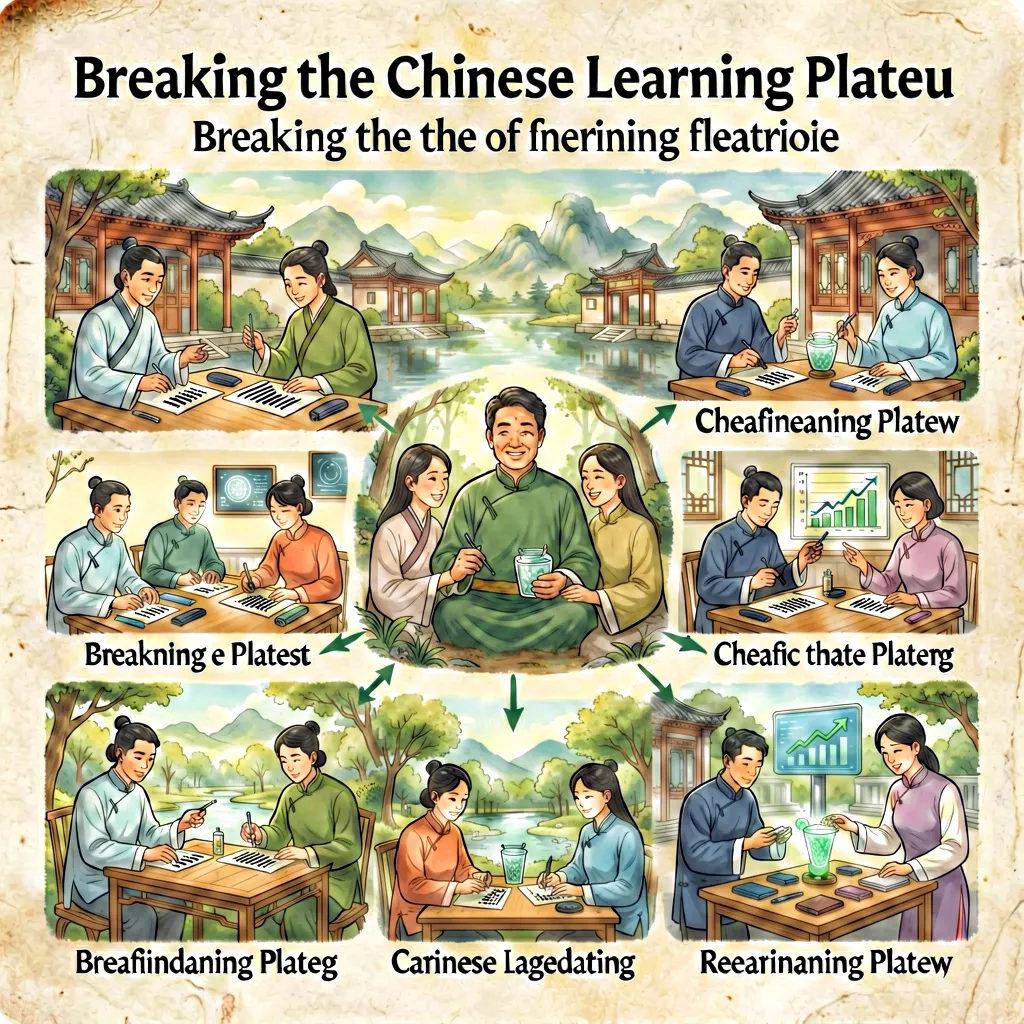
The solution is not necessarily to do more, but to do different and to do some things worse (in the short term). Growth requires a state of “desirable difficulty.”
1. Radicalize Your Input. This is the single most powerful lever. You must flood your system with language that is slightly beyond your current comfortable processing ability. For reading, this means deliberately selecting DuChinese (or other graded readers) at a level where you understand only 70-80% of the text without looking up words. The struggle is the point. You are training your brain to infer meaning from context, to tolerate ambiguity, and to recognize patterns in denser text. Stop looking up every unknown word. Look up only those that prevent you from following the narrative thread. For listening, you must seek out authentic, unscripted content. Find Chinese vloggers discussing topics you genuinely care about (gaming, cooking, tech reviews). Watch Chinese dramas or variety shows without Chinese subtitles. Use Chinese subtitles only. The initial experience will be one of near-total incomprehension. That’s the point. Your goal is not to understand everything, but to absorb the rhythm, intonation, common filler words, and the “shape” of sentences. Do this for 20 minutes a day. Your comprehension will hover around 20-30%. Over weeks and months, that number will creep up without you noticing, until one day you realize you caught a whole sentence. This is called “acquisition through exposure,” and it’s non-negotiable for breaking the intermediate plateau.
2. Transform Your Flashcard System. Ditch the simple word-to-definition model. Implement “cloze deletion” and “sentence mining.” When you encounter a new, useful phrase in your reading or listening—a phrase you wish you could say—create a flashcard with the entire sentence, but blank out the key word or phrase you want to learn. For example, from a story: “他 finally \_\_\_ (理解) 了老师的苦心。” (He finally \_\_\_ the teacher’s good intentions). Your job is to recall the verb 理解 in the context of that specific sentence structure. This links vocabulary directly to syntax and usage. In addition, your flashcard reviews should force production. Use an app that requires you to type or speak the answer, not just recognize it. The act of production is a much higher cognitive load and exposes gaps in your active knowledge that passive recognition hides.
3. Re-engineer Your Teacher Time. Your 30-minute weekly lesson is a precious resource. It must be a laboratory for production, not a review session. Have a strict pre-lesson rule: you will bring one specific, complex question or topic you want to discuss. It could be “I want to debate the pros and cons of remote work in China” or “I read this news headline and don’t understand the nuance of this particular word.” Your teacher’s role is to push you, to correct you ruthlessly, to introduce more natural alternatives to your sentences, and to force you to think on your feet. Implement a “no English” rule for the last 10 minutes of every lesson, even if it means long, painful silences. That silence is your brain working. If your lesson feels easy and affirming, you are wasting it. It should feel like a workout where you’re slightly out of breath.
4. The “Boredom” is a Feature, Not a Bug. You mentioned feeling bored. In language learning, boredom at the intermediate stage is often the feeling of your brain resisting the hard work of reorganization. The initial thrill of recognizing characters is gone. The newness has worn off. What remains is the grind. You must reframe this boredom. When you sit down to read a challenging article and your mind wanders after two paragraphs, that’s the signal. That’s the moment you need to lean in, not walk away. The boredom is the friction of building new mental pathways. Acknowledge it. Sit with it. Tell yourself, “This feeling means I am doing the right work.” The activities that feel easiest and most entertaining (like breezing through a DuChinese story you already mostly know) are probably providing the least growth. Seek out the content that feels slightly annoying, too fast, or mildly confusing. That’s your growth zone.
The Critical Role of the “Why”: Connecting to Real-World Chinese
A major plateau catalyst is a loss of connection to a tangible, emotional “why.” If your study is an abstract goal of “HSK6” or “fluency,” the motivation will erode when the going gets tough—which is exactly what a plateau is. You must anchor your learning to a living, breathing use case for Chinese in your life as it exists in 2026.
What does this look like? It’s not just “I want to travel to China.” It’s specific. “I want to have a 30-minute conversation with my colleague in Shanghai about the implementation of their new CRM system, without switching to English.” “I want to understand the nuances in the social media commentary around the latest sci-fi blockbuster released in Beijing.” “I want to read the original serialization of that web novel everyone is talking about, not a translation.” “I want to follow the cooking instructions of my favorite Chengdu food blogger without subtitles.” These are concrete, emotionally charged, and time-bound goals. They require a specific type of language—business jargon, internet slang, narrative prose, culinary terms—that your generic HSK-centered routine will never provide. Use these goals to curate your input. If your goal is professional, start reading Caixin or reading transcripts of Chinese tech entrepreneur interviews. If your goal is pop culture, dive deep into Bilibili comment sections and Weibo trending topics. This shifts your learning from an academic exercise to a tool for accessing a world you care about, providing a powerful motivational engine to push through the plateau.
Embracing Productive Struggle and the “Silent” Phase
Here is a crucial psychological truth: you will get worse before you get better. When you switch to authentic, fast, messy input, your comprehension will plummet. When you force yourself to speak only in Chinese about complex topics, your output will be slow, broken, and full of mistakes. This is a necessary regression. Your brain is shedding the crutches of learner material and attempting to operate in real-time. This phase feels like losing ground. It is not. It is the demolition of old, fragile structures to build stronger ones. You must trust the process.
This leads to what I call the “silent phase.” After weeks or months of this intensified, struggle-focused practice, you may not feel more confident. You might still fumble words. The change will first be evident in your comprehension. One day, while watching a vlog, you’ll realize you didn’t need to mentally translate a sentence; you just understood it. You’ll catch a subtle joke. You’ll read a news headline and grasp the implication immediately. These are the signals. The feeling of fluency often lags months behind the actual functional improvement. Do not wait to feel fluent to act fluent. Start speaking and writing at the edge of your ability now, even if it feels terrible. The feeling will catch up.
A Sample Restructured Week: From Theory to Practice
How does this all come together? Let’s build a sample week for someone at your stage, designed to attack plateaus from multiple angles.
- Morning (20 mins): Cloze deletion flashcards (using a spaced repetition system like Anki). The cards are sourced from sentences you mined the previous day from authentic reading/listening. Focus on production. - Lunch Break (15 mins): Authentic Listening Sprint. Find a 5-minute clip of a Chinese YouTuber discussing a topic you love. Watch it once with Chinese subtitles. Watch it again without. Don’t stress about understanding everything. Your goal is auditory immersion and pattern recognition. - Evening (30 mins): Radical Reading. Read one article from a native-source site (e.g., a technology blog, a culture piece on 163.com) or a chapter of a native-level web novel. Your rule: read for 15 minutes without looking up any words. Then, go back and look up only the 3-5 words that were critical to the main point. Summarize the article’s core argument in one sentence, in Chinese, in your notebook. - Teacher Lesson (3x/week): Come with a specific goal. “Today I want to practice describing a process (like how to make coffee) using sequential language.” Or “I want to discuss this short opinion piece I read and express my agreement/disagreement.” The lesson is for output practice and correction. Record it (with permission) and listen back to identify recurring errors. - Weekend Project (60 mins): Consume and Create. Watch a full episode of a Chinese talk show or documentary. Then, write a 200-character reflection or summary in Chinese. Post it on LangCorrect or HelloTalk for native feedback. This forces synthesis of listening and writing.
This routine is harder. It’s more frustrating. It will feel less “productive” in the short term because you won’t be checking off “learned 20 new words.” You’ll be struggling to understand a 5-minute video. But this is the work that breaks plateaus.
The Long View: Plateaus as Milestones, Not Stop Signs
The journey from HSK4-5 to genuine, comfortable intermediate fluency (what some might call HSK6+ in practical skill) is often the longest and most psychologically challenging leg of the journey. The vocabulary growth slows; the grammar is mostly familiar; the easy dopamine hits of beginner progress are gone. What remains is the deep, slow work of integration, automatization, and nuance. Every great Chinese speaker you admire has navigated not one, but several of these plateaus. They are not detours; they are the terrain. The feeling of boredom or stagnation is your brain’s signal that it’s time to change the stimulus. Your current routine served you brilliantly to get you to this point. Its job is done. Now you must build a new one, one that embraces struggle, seeks authentic chaos, and connects your learning to a living, breathing reason to use the language. Stop waiting to feel motivated. Start designing your environment to force growth. The plateau is not a wall. It is a platform. From here, with a new strategy, your next view will be wider than you can currently imagine. The work is hard, but the view from the next level—where you finally understand the joke, catch the subtle insult, or express a complex idea with grace—is worth every moment of the struggle. Start today. Pick one strategy from this article and implement it ruthlessly for the next month. Then, reassess. The path upward is there. It just requires a different kind of climb.
Responses • 0
0/2000
ID: 1326
Chris
Offline
2 hr
Visited
From
Bakersfield, United States
Send Message