AIPowered Mandarin Readers
AI Learn Chinese
4 hr • 0 read
Filling the graded reader gap with AIgenerated stories for intermediate Mandarin learners.

The Graded Reader Dilemma
For any serious student of Mandarin, the value of a graded reader cannot be overstated. These books are carefully crafted to use a limited, high-frequency vocabulary, allowing learners to absorb new words within a familiar, repetitive context. This method, rooted in the theory of comprehensible input, makes reading a powerful engine for vocabulary acquisition.
You are not just memorizing lists; you are seeing words live and function. The experience is transformative, turning abstract characters into meaningful concepts.
But, a stark reality soon confronts every dedicated reader: the shelf is frustratingly short. While resources have grown, the number of truly sequential, professionally produced graded readers at any specific level remains limited. A learner might devour an entire series only to find the next logical step simply does not exist.
This creates a bottleneck, a valley between beginner confidence and advanced fluency where self-study momentum can stall. The search for the next suitable book becomes a chore, not a joy.
This was precisely the situation I faced. My journey with graded readers had been defined by one exceptional series: the Mandarin Companion. These books are a masterclass in pedagogical design.
Vocabulary is introduced at a glacial, deliberate pace. Key phrases and sentence structures reappear with comforting regularity, reinforcing memory through sheer exposure. The stories themselves are engaging adaptations of Western classics, providing cultural familiarity that aids comprehension.
They were, for a time, the perfect solution.
Yet, there are only twelve books in the core Mandarin Companion series. After completing the final volume, I found myself at a loss. The natural progression was a cliff, not a slope.
I needed more content at that specific, intermediate sweet spot where I could read with minimal dictionary use but still be consistently challenged. Flashcard apps felt sterile and decontextualized. I craved more narrative, more reading.
The trouble was, my Mandarin vocabulary wasn't massive enough to tackle native materials comfortably. The graded reader gap was a real problem.
The Experiment: AI as a Creative Partner
About six months ago, I decided to experiment. I had been following the rise of large language models and their potential for language learning. The idea was simple: what if I could use an AI to generate stories that adhered to the strict vocabulary constraints of a graded reader?
I chose Claude AI as my partner for this experiment, drawn by its strong performance with nuanced instructions and longer context windows. The goal was not to replace the meticulous work of professional authors and linguists but to create a stopgap, a personalized bridge across the vocabulary chasm.
The first step was preparation. I selected a specific Mandarin Companion book that represented my current reading level—the vocabulary list was my gold standard. I meticulously extracted the list of words used, compiling it into a master reference.
This list was non-negotiable; any story generated had to be built exclusively from these words, plus perhaps a handful of ultra-high-frequency function words. The constraint was the entire point. I then crafted a detailed, multi-part prompt for Claude.
This prompt was the blueprint.
The prompt had several critical components. First, I specified the exact vocabulary list to be used, pasting it in. Second, I defined the story parameters: length (roughly equivalent to a 50-page graded reader), genre (something familiar like a mystery or adventure), and character count (simple, with 2-3 main characters).
Third, I gave explicit stylistic instructions: use short sentences, repeat key vocabulary and grammatical patterns, avoid complex clauses, and maintain a clear, linear plot. I emphasized that readability and repetition were more important than literary flair. Finally, I included an example paragraph from an actual Mandarin Companion book to set the tone and structure.
The initial results were a mix of fascination and frustration. Claude could, with frightening ease, generate coherent Chinese text that used the target vocabulary. But, the stories often felt mechanical.
The repetition was sometimes forced, inserted like a required exercise rather than flowing naturally from the plot. The narrative logic could be shaky, with characters making odd decisions simply to incorporate a specific target word. The first few outputs were technically correct but pedagogically weak.
They lacked the organic feel of the professionally written series.
This revealed the core challenge: a graded reader’s magic lies in the artful constraint. Professional authors weave a compelling tale within the vocabulary box, making the repetition feel effortless because the story demands it. An AI, guided by a list, sees the box as a barrier to overcome, often leading to clunky integration.
The AI’s vast knowledge of language and story structure worked against the simplicity required. My prompt needed to be smarter, guiding the AI to embrace the constraint as a creative engine, not a limitation.
I iterated. I refined the prompt to explicitly forbid certain complex grammatical constructions. I added commands like, "If you cannot use a target word naturally in the current scene, save it for the next scene and use a simpler synonym you already know." I instructed the AI to create a scene-by-scene outline first, mapping which target words would be introduced and reinforced in each section.
This structural planning step, which the AI handled well, dramatically improved the flow. The stories became less stop-start. They were still not as smooth as the Mandarin Companion originals, but they were now usable.
They provided the extended reading practice I desperately needed.
The Vocabulary Chasm: AI Stories vs. Professional Series
A critical, unavoidable difference emerged between the AI-generated stories and the Mandarin Companion series: the vocabulary introduction curve. The professional series is a marvel of slow, patient scaffolding. A new word might appear once in a chapter, then three times in the next, then be a background character in several subsequent chapters before finally becoming part of the active cast.
The repetition is calculated and cumulative. You learn because you cannot avoid it, and the avoidance is pleasant because the story is engaging.
The AI stories, by contrast, presented a wider range of the target vocabulary more evenly across the narrative. This was a direct result of my prompt’s instruction to "use all target words." There was less strategic holding back. Consequently, the reading experience was more "stop-start." I would encounter a new word, see it once, and then not again for pages, while five other new words appeared in between.
The consolidation period was shorter or non-existent. It felt more like a vocabulary checklist being ticked off than a natural language immersion.
This is the fundamental trade-off. The AI provides volume and variety of context at a given level. You get to see your 300-word list deployed in ten different story scenarios—a market scene, a police investigation, a family dinner.
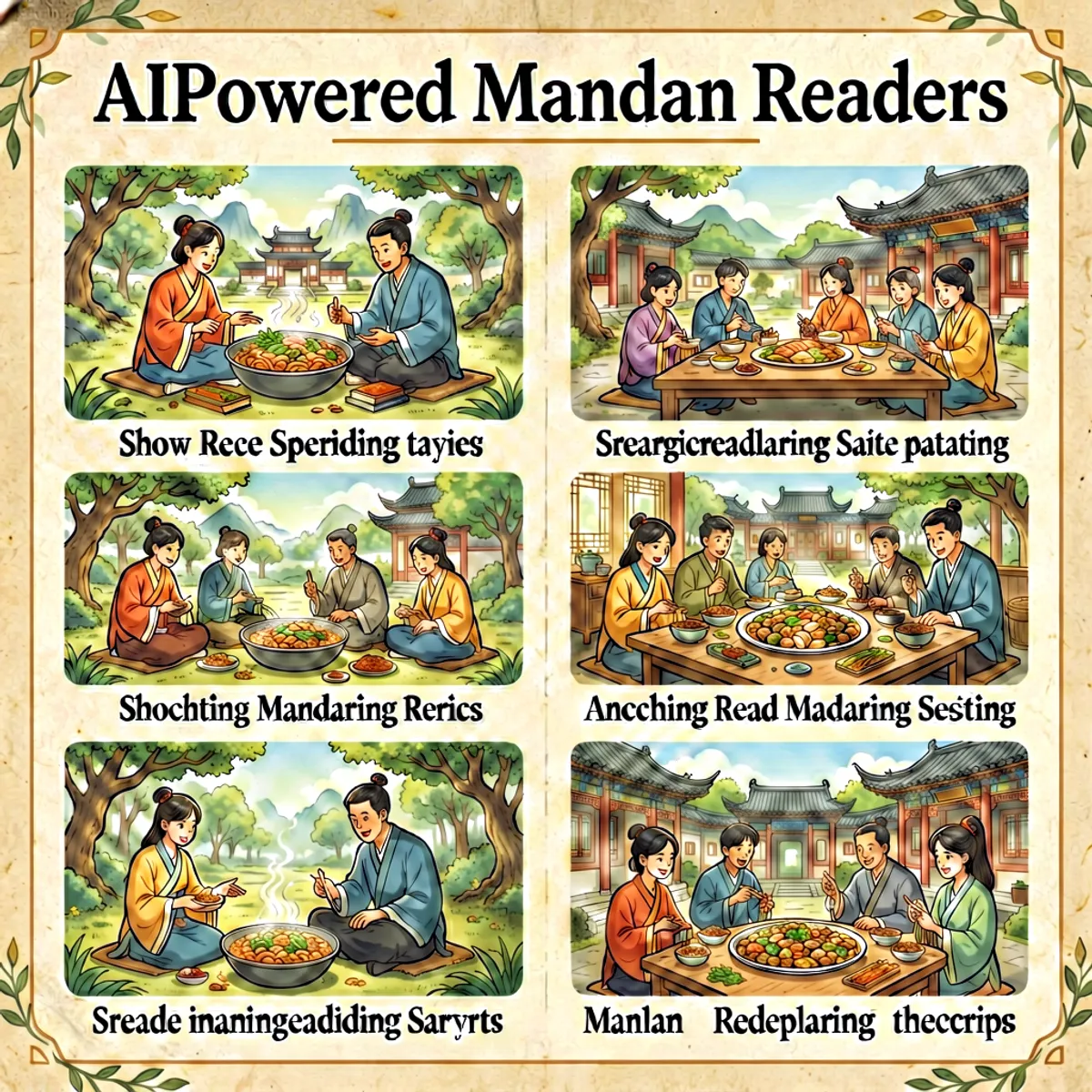
This breadth is invaluable for seeing the semantic range of a word. But, you lose the depth of repetition that cements a word into long-term memory. The professional series gives you depth; the AI gives you breadth.
For a learner, the ideal is a blend, which is why my next step was necessary.
To combat the stop-start effect and force the consolidation that the AI stories lacked, I needed a system. Reading the story once was not enough. I needed to engage with the vocabulary actively, repeatedly, outside the narrative context.
The natural tool for this is Anki, the spaced repetition flashcard program. The solution was clear: I would have Claude generate a custom Anki deck for every story it created. This deck would be the bridge between the breadth of the AI story and the depth required for acquisition.
Building the Custom Anki Deck: A Dual-Purpose Tool
The instruction to Claude was precise: "For every story you generate, also generate a complete Anki deck in CSV format. For each unique word in the story that is part of the target vocabulary list, create one card. The card must have: 1) The Chinese word (simplified), 2) Its Pinyin with tone marks, 3) One example sentence from the story where the word is used, 4) The English translation of that example sentence."
This instruction transformed the project. The Anki deck was not an afterthought; it was an integral part of the learning product. Its purpose was twofold.
First, it served as a pre-reading study aid. Before diving into a new AI-generated story, I could review the deck. This pre-exposure to the upcoming vocabulary—seeing the word, its pronunciation, and a sample sentence—significantly reduced the friction of the first read-through.
The "stop-start" moments were softened because I had already met the word in a focused, low-context setting.
Second, and more importantly, the deck became the engine for the spaced repetition the story itself lacked. After reading the story, I would study the deck. Each card’s example sentence was from the story I had just read.
This created a powerful feedback loop. The context was fresh in my mind. When I saw the card for the word "调查" (diàochá, to investigate), I didn't just see a sterile example; I instantly recalled the scene in the story where the detective asked the question.
The emotional and narrative context of the story tagged along with the vocabulary item, making the memory infinitely stronger than a random example sentence.
The process of generating the deck also forced a final quality check on the story. If Claude struggled to create a coherent example sentence for a particular word within the story’s context, it was a sign that the word’s usage in the narrative might have been forced or awkward. I could then request a rewrite of that specific story segment.
This created a virtuous cycle: the deck demanded narrative integrity, and the narrative provided perfect deck content. The two outputs—story and deck—were symbiotic, each improving the other.
The technical implementation was straightforward. Claude could output a properly formatted CSV file that Anki imports effortlessly. I would name the deck after the story (e.g., "AI_Story_04_The_Missing_Heirloom").
The cards used a basic note type: Chinese on the front, Pinyin + Example Sentence + English on the back. I added a tag for the story number to keep everything organized. This system turned each AI-generated story from a simple reading exercise into a complete, multi-modal learning module.
The Human Touch: Prompt Engineering as Pedagogy
This entire endeavor hinged on one skill: prompt engineering. The quality of the AI’s output was directly proportional to the clarity and pedagogical foresight in my instructions. I was not just a user; I was a curriculum designer, a editor, and a teacher. My prompts evolved from simple requests ("write a story using these words") to complex pedagogical blueprints.
A key insight was to treat the AI not as an author, but as a compliant apprentice. I had to provide the structure it lacked. I began generating detailed outlines myself and feeding them to Claude.
"Scene 1: Introduce protagonist, Li Wei, at the train station. Use words: station, wait, train, late, anxious. Scene 2: Li Wei meets a stranger who has lost a bag.
Use words: lost, help, find, thank..." By dictating the scene and the target words for it, I ensured the vocabulary distribution was under my control, mimicking the strategic rollout of a professional series.
I also learned to specify non-targets. "Do not use characters or words not on the provided list, except for the following very common words: 的, 了, 和, 在, 是..." This closed loopholes where the AI might "cheat" by introducing a slightly more complex synonym that was actually outside the prescribed lexicon. The constraint had to be absolute to maintain the graded reader integrity.
Another powerful technique was few-shot prompting. Within my prompt, I would write: "Here is an example of the desired style and structure from a real graded reader:" and paste a short, relevant excerpt. I would then follow with: "Now, write a new, original story in this exact style, using the following vocabulary list..." This gave the AI a concrete model to emulate, far more effective than abstract descriptions. It was teaching by example, the most human way to instruct.
The human role did not end with the prompt. Every story required a manual review. I would read through each generated chapter, checking for unnatural phrasing, logical jumps, or forced word usage.
I would then issue follow-up prompts: "Rewrite the conversation in Scene 3. The word 'suspicious' (怀疑) feels forced. Have the character express suspicion through action and simpler words like 'why' and 'strange' instead." This iterative, editorial process was essential.
The AI was a powerful first-draft generator, but the final pedagogical product required a human expert’s eye for natural language and learning progression.
The Completed Learning Module: A New Methodology
The final product for each unit was a package: one original story PDF, formatted simply, and one corresponding Anki deck. The workflow became ritualized. First, I would study the Anki deck for the upcoming story, familiarizing myself with the new words in isolation.
Second, I would read the story from start to finish, noting how the words were used. The first read was for gist, not perfection. Third, I would read the story again, this time more slowly, consulting the deck for any word I forgot.
Fourth, I would spend a few days reviewing the Anki deck, where the story’s context reinforced each card.
This method effectively synthesized the strengths of both worlds. The story provided the narrative context and the joy of reading a complete tale. The Anki deck provided the spaced repetition system and active recall necessary for long-term retention.
The AI provided the volume of content at my exact, frustratingly narrow level. My own effort provided the pedagogical design and quality control. It was a hybrid model, a personal publishing house for one.
The results were tangible. My reading fluency at that intermediate plateau improved steadily. I was no longer stuck waiting for the next official book.
I could generate content on demand, tailored to my precise vocabulary set. If I felt weak on words related to "crime," I could request a detective story. If I wanted more "daily life" contexts, I could ask for a family drama.
The content was relevant to my interests and my immediate learning needs.
This approach also democratizes the creation of graded content. The barrier to entry is not publishing contracts or academic linguistics expertise, but rather a clear understanding of one’s own vocabulary level and the skill to craft effective prompts. Any learner with access to a capable AI model and a defined word list could, in theory, replicate this process. It turns the learner from a passive consumer into an active producer of their own curriculum.
Limitations and Cautions: The AI’s Blind Spots
Despite its utility, this method has significant limitations that must be acknowledged. The most profound is the lack of true cultural and idiomatic depth. The Mandarin Companion series, by adapting classic stories, embeds cultural narratives and idioms that are themselves learning tools.
The AI, trained on a vast but generic corpus, produces stories that are culturally neutral or accidentally awkward. It might use a word correctly but in a situation a native would never describe that way. The "Chinese-ness" of the prose is thin.
It is language without the full soul of the culture.
There is also the risk of fossilizing errors. If the AI generates a grammatically questionable but comprehensible sentence using a target word, and I then put that sentence into my Anki deck, I risk internalizing a non-standard pattern. The AI is a statistical parrot, not a authority on grammatical purity.
Constant vigilance is required. I often cross-checked generated sentences with native speaker forums or grammar resources before accepting them into my study deck. The AI’s output is a draft, not a final textbook.
The emotional resonance is another gap. Professional stories are crafted to evoke laughter, suspense, or empathy. The AI stories, while logically coherent, often feel emotionally flat.
The characters are plot devices, not people. This doesn’t ruin the vocabulary utility, but it does diminish the motivation to read. Reading a beautifully sad or thrilling story is its own reward, making the language learning incidental.
With AI stories, the learning is the primary, sometimes laborious, goal. The joy is more intellectual than emotional.
Finally, there is the ethical and practical question of scale. This method works for a dedicated individual managing their own study. It does not scale to produce thousands of books for a mass market.
The human time investment in prompt crafting, review, and deck generation is substantial. It is a personalized solution, not a commercial one. It fills a gap for the self-driven learner at a specific moment of need, but it does not replace the need for a broader ecosystem of professionally produced, high-quality graded material.
The Bigger Picture: Reshaping the Language Learning Landscape
This experiment points toward a larger shift in autonomous language learning. The bottleneck is no longer necessarily access to content, but curation and personalization. AI can generate infinite text, but the learner’s skill lies in filtering, structuring, and integrating that text into a coherent study plan. The future may see learners using AI not just for stories, but for generating practice dialogues, summarizing news at their level, or creating personalized grammar drills—all tied back to a central vocabulary management system like Anki.
The role of the teacher or content creator evolves. Instead of being the sole source of graded material, they become curators and coaches. They teach learners how to use these tools effectively: how to assess their vocabulary level accurately, how to craft a prompt that yields pedagogical sound material, how to critically evaluate AI output for accuracy and naturalness. The skill set expands from pure language knowledge to include AI literacy and self-directed curriculum design.
It also highlights the enduring value of human-created content. The Mandarin Companion series remains, in my view, superior in its seamless integration of learning and storytelling. AI-generated content is a supplement, a bridge, a source of high-volume practice.
But the artistry, the cultural embedding, the emotional punch—these remain firmly in the human domain. The ideal ecosystem is a hybrid: foundational, beautifully crafted series for deep, enjoyable immersion, augmented by AI-generated material for targeted practice, vocabulary expansion, and bridging specific level gaps.
For the intermediate learner feeling stuck, this method offers a tangible path forward. It requires curiosity, a bit of technical tinkering, and honest self-assessment. It turns the problem of "there are no more books at my level" into a project: "I will build my own next book." The tools are available.
The vocabulary list is your syllabus. Claude or a similar model is your drafting assistant. Anki is your memory system.
You are the architect of your own reading curriculum.
Conclusion: A Personalized Path Forward
The journey from the frustration of a short bookshelf to a personalized library of graded stories has been illuminating. It confirmed that the core principles of language acquisition—comprehensible input, spaced repetition, and contextual learning—remain unchanged. What has changed is our ability to generate and curate the input itself. Using Claude AI as a tool, guided by a rigorous prompt and coupled with the proven system of Anki, I built a functional, if imperfect, substitute for the missing professional graded reader.
This is not a declaration that AI will replace authors. It is a testament to the resourcefulness of the modern language learner. When the established path ends, we can now, with some effort, pave our own.
The stories created are not masterpieces, but they are adequate. They are sufficient. They provide the essential service of extending the period of comfortable, independent reading, which is the golden period for vocabulary growth.
They keep the momentum going when the commercial options run dry.
The key takeaway is empowerment. The vocabulary list is your map. The AI is your tireless, if sometimes literal-minded, scribe.
The Anki deck is your retention engine. You, the learner, are the director, editor, and final authority. This triad—list, AI, SRS—forms a new, powerful loop for self-directed study.
It turns the passive act of waiting for the next book into the active act of creating it.
For those at the intermediate plateau, I encourage you to try it. Start with your last graded reader’s word list. Craft a careful prompt.
Generate a short story. Build the deck. Experience the cycle.
You may find, as I did, that the act of building your own learning material deepens your engagement with the language in a way that simply reading alone never could. You move from consumer to creator, and in doing so, you claim ownership of your learning journey in a very tangible way. The graded reader gap need not be a wall.
With the right tools and approach, it can become a doorway to a more personalized, proactive, and ultimately more effective study method. The future of your Mandarin reading is not just in the books you buy, but in the stories you, with a little help from AI, decide to write.
Responses • 0
0/2000
ID: 1326
Chris
Offline
56 min
Visited
From
Bakersfield, United States
Send Message