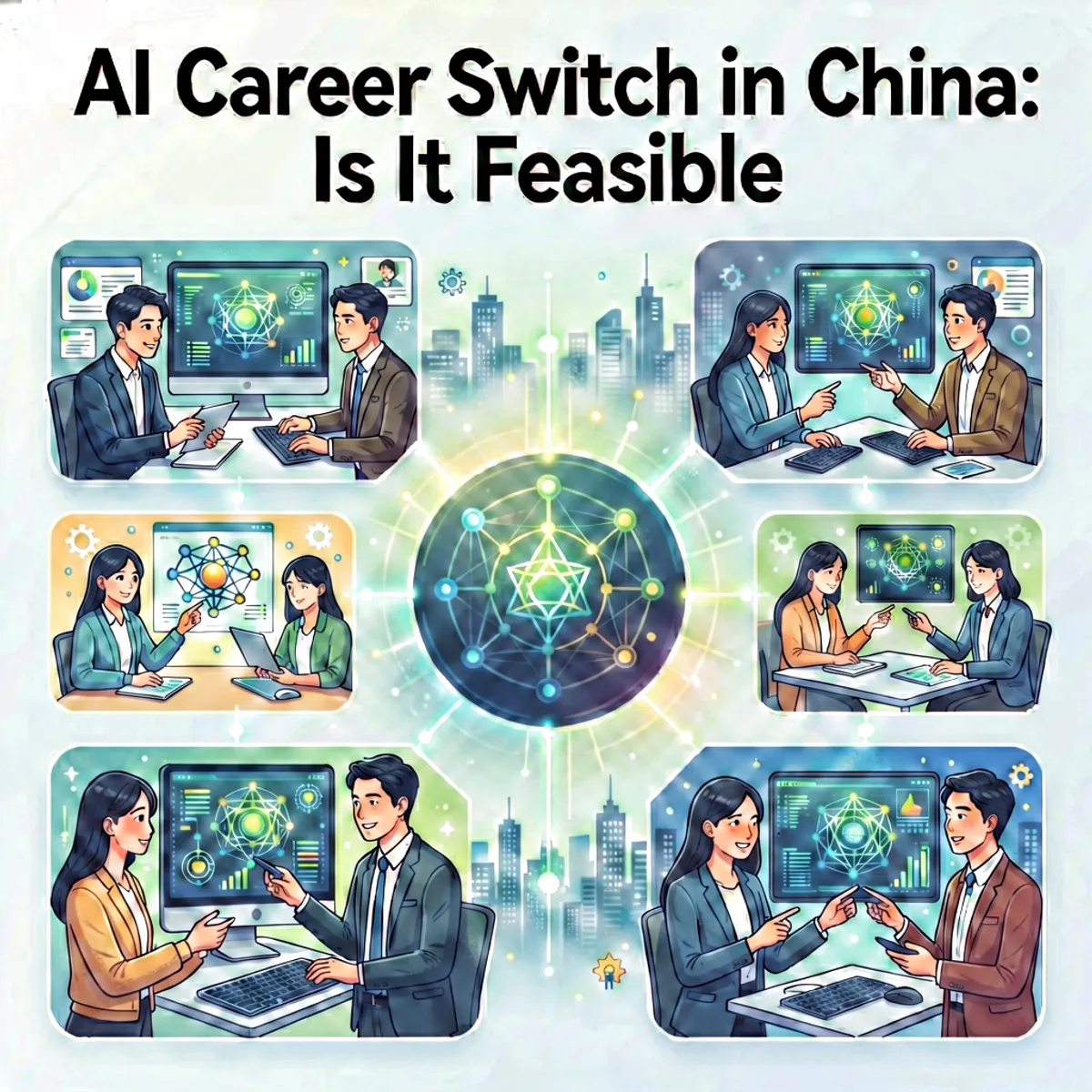
AI Career Switch in China: Is It Feasible?
AI Learn Chinese
2 hr • 0 read
Assess the viability of transitioning from English teaching to AI roles in China by 2026. Covers hiring trends, skill building, and relocation strategy.

Introduction: The Allure and Skepticism of an AI Transition
a number of expatriates and local professionals in China have built stable careers teaching English. For some, the initial excitement fades, replaced by a desire to pivot into the dynamic field of artificial intelligence. The question is not just about changing jobs, but about entering a fundamentally different industry with its own gatekeepers and expectations.
Is moving to China to transition from English education into AI a realistic career path? This article explores that question with a clear-eyed view of China's tech landscape in 2026. We will examine hiring practices, the necessity of specific technical skills, and the optimal timing for such a major life change.
The goal is to provide actionable, realistic advice for those serious about making this shift.
The sentiment around career changers in tech is mixed globally, and China is no exception. On one hand, the country's AI boom has created a seemingly insatiable demand for talent. On the other, traditional educational credentials often hold significant weight in the Chinese hiring ecosystem.
For an English educator, the path forward is not simply about learning to code; it involves strategic portfolio development, cultural and linguistic preparation, and a nuanced understanding of regional tech hubs. This article is structured to move from the macro environment of China's AI sector down to the individual steps one can take today. We will avoid generic motivational platitudes and focus on concrete considerations for a successful transition by 2026.
The Current State of China's AI Ecosystem in 2026
China's artificial intelligence sector has matured beyond the initial hype cycle of the early 2020s. The government's "Next Generation Artificial Intelligence Development Plan" set ambitious goals, and while the pace has moderated, investment and application deployment remain robust. The ecosystem is now characterized by a few dominant tech giants, a vibrant startup scene, and increasing integration of AI into traditional industries like manufacturing, finance, and retail.
This creates a diverse range of roles, from core algorithm research to AI product management and data engineering. Understanding this landscape is the first step for any career changer.
The demand is not uniform. Core research positions at places like Baidu's AI lab or DeepMind's Beijing office still heavily favor PhDs from top-tier universities, both domestic and international. But, the application layer—building and deploying AI solutions for specific business problems—has a higher tolerance for non-traditional backgrounds.
A company developing an AI-powered customer service chatbot may value a candidate who understands user experience and communication (a strength for former educators) as much as pure algorithmic knowledge. The key is to target the right segment of the market.
Government Policy and Industrial Focus
State policy continues to steer AI development toward "strategic frontiers" like intelligent manufacturing and healthcare diagnostics. This means companies aligned with these national priorities often receive subsidies and face less regulatory friction. For a job seeker, this translates to a higher concentration of opportunities in cities with strong industrial bases, such as Shenzhen (hardware and IoT integration) or Hefei (emerging as a hub for AI in automotive). The "AI Champions" program, which designated Baidu, Alibaba, Tencent, iFlytek, and SenseTime as national leaders, still influences the sector's structure, creating both competition and partnership networks.
The Talent Gap: Myth and Reality
Reports consistently cite a talent gap in China's AI sector, but the nature of that gap is often misunderstood. There is no shortage of graduates with computer science degrees. The deficit lies in senior engineers with 5+ years of hands-on experience in deploying scalable AI systems and cross-disciplinary professionals who can bridge AI and business domains.
This is where career changers can find an opening. A former English teacher who has spent two years mastering Python, contributing to open-source NLP projects, and can articulate how AI can improve language learning platforms possesses a unique, valuable profile. The gap is for applied, contextualized skills, not just theoretical knowledge.
Hiring Realities: Degrees Versus Demonstrable Skills
The classic debate in tech hiring—paper credentials versus proven ability—plays out uniquely in China. For large state-backed enterprises or traditional corporations venturing into AI, a formal degree in computer science or a related field from a recognized university (especially a 985 or 211 project school) remains a common filter in initial resume screenings. This is partly due to HR practices that rely on pedigree as a proxy for quality and partly due to cultural respect for formal academic achievement.
But, in the bustling startup ecosystems of Beijing's Zhongguancun or Shanghai's Zhangjiang, the attitude is often more pragmatic. Here, founders and engineering leads are desperate to find people who can ship products. They are increasingly open to candidates with unconventional paths if those candidates can demonstrably build and deploy.
"We hired a history major who taught himself TensorFlow and built a impressive recommendation engine prototype," shared a CTO at a mid-sized e-commerce AI firm in Hangzhou. "His degree was irrelevant. His GitHub repository and his ability to explain his project were everything." This is not the universal rule, but it is a growing and significant trend, particularly in applied AI roles.
The "Portfolio Over Diploma" Shift in Practice
This shift is most evident in roles like AI Product Manager, Machine Learning Engineer (for applied problems), and Data Analyst with a focus on predictive modeling. Companies in these areas are beginning to structure interviews around take-home assignments and practical case studies. The question "What have you built?" is slowly gaining equal or greater weight than "Where did you study?" For an English educator, this is crucial.
Your background in curriculum design, user engagement, and communication is a potential asset for AI in education (EdTech), human-computer interaction, or natural language processing applications. The challenge is to reframe your past experience as a complementary strength, not a liability.
Where Traditional Paths Still Dominate
It would be negligent to claim the door is wide open. Core research scientist roles, positions in state-owned enterprises, and jobs at the most conservative tech giants often still require, or at least strongly prefer, a CS or math PhD. In addition, for foreign nationals, the visa process (the Z-visa for professionals) typically requires a documented offer for a role that "matches your professional qualifications." A lack of a formal degree in a related field can complicate the paperwork, even if a company wants to hire you. So, while the industry is evolving, understanding where the rigid walls remain is essential for realistic planning.
Building a Competitive AI Portfolio: The Non-Negotiable First Step
Regardless of when you plan to move, the single most important activity for the next 12-24 months is building a public, substantive portfolio. This is your new resume. For a career changer, it must answer two questions: "Can you code?" and "Can you solve real problems with AI?" The portfolio is proof. It moves the conversation from your past as an English teacher to your future as an AI practitioner.
Start with the fundamentals. Python is the absolute lingua franca of AI/ML. You must achieve fluency—not just tutorial completion, but the ability to structure a project, debug errors, and write clean, documented code.
Follow this immediately with core libraries: NumPy and Pandas for data manipulation, Scikit-learn for traditional machine learning, and then TensorFlow or PyTorch for deep learning. Online platforms like Coursera, edX, and Udacity offer structured specializations (from universities like Stanford or companies like Google), but treat them as guided syllabi, not the end goal. Your certificate is less important than the projects you build using those tools.
Project Philosophy: Depth Over Breadth
A common mistake is to list dozens of tiny, tutorial-style projects. Quality and narrative are key. Aim for 3-5 significant projects that tell a story of progressing skill and interest.
Project 1: A complete data analysis and prediction model on a public dataset (e.g., predicting housing prices). Project 2: An end-to-end Natural Language Processing application. Given your background, this is a natural fit.
Build a sentiment analysis tool for movie reviews, a simple chatbot, or a text summarizer. Deploy it as a simple web app using Flask or Streamlit and host it on a platform like Heroku or a Chinese equivalent like Tencent Cloud. Project 3: Something more ambitious that combines your prior knowledge with AI.
For example, an AI tool that analyzes English learner essays for common grammatical errors or generates practice questions. This demonstrates your unique value proposition.
Your GitHub repository for each project must be pristine. Include a clear README with problem statement, methodology, results, and instructions to run the code. Write clean, commented code.
This is your digital handshake with future employers. They will look at your commit history, your problem-solving approach, and your documentation skills—all areas where a former educator may actually have an advantage.
Engaging with the Open-Source and Competition Community
Beyond personal projects, active participation in the wider ecosystem is a powerful signal. Contribute bug fixes or small features to relevant open-source libraries. This shows you can work in a collaborative, distributed environment.
Compete in Kaggle competitions or similar Chinese platforms like Tianchi. Even a top 50% finish in a relevant competition is a strong credential. It proves you can work with messy, real-world data and iterate on models under constraints.
Document your competition entries with detailed blog posts explaining your thought process and learnings. This turns a competition result into a learning narrative that hiring managers can follow.
Timing the Move: Before or After Relocation?
This is a pivotal strategic question with no one-size-fits-all answer. The two primary strategies are: (1) Build your portfolio and secure an offer while still living abroad, then relocate for the job. (2) Move to China first on a different visa (e.g., a business visa for exploration, or a language student visa), immerse yourself in the ecosystem, build a local network, and then search for a job on the ground. Each path has distinct risks and rewards.
Strategy 1: Secure the Offer First. The primary advantage is security. You arrive with a signed contract, a work visa (Z-visa) in process, and a salary. This mitigates the immense financial and psychological pressure of job hunting in a new country with no income.
It also forces you to build a portfolio strong enough to attract remote interest. The major drawback is the "outsider" problem. Without being in China, your network is limited to online connections.
You may misunderstand the nuances of local company culture, the specific tools in demand (some companies use domestic frameworks like PaddlePaddle instead of TensorFlow), or the true nature of the role from a job description. You might accept an offer based on incomplete information.
Strategy 2: Relocate First to Explore and Network. This path leverages the power of guanxi (relationships) and local immersion. Being in Beijing or Shanghai allows you to attend tech meetups (many are listed on platforms like Meetup.com or local apps like "Dianping" for events), visit company offices, and have informal coffee chats with people in the industry. You can take short-term intensive courses or bootcamps in China to learn local tools and practices.
Your understanding of the market becomes visceral, not theoretical. But, this is the high-wire act. You are using a visa that does not permit work (like a tourist visa, though note that working on one is illegal) or a student visa, which is expensive and has time limits.
You have a ticking clock and dwindling savings. The pressure to find a job quickly can lead to accepting a poor-fit or even fraudulent offer. It requires significant financial runway and resilience.
A Hybrid "Exploratory Visit" Model
For many, a third, more balanced approach is optimal. Spend 6-12 months building a solid foundation and portfolio at home. Then, use a multiple-entry tourist visa (or a business visa if you have a contact) to make one or two focused, 1-2 month trips to your target city (e.g., Shenzhen for hardware-AI integration, Beijing for NLP research).
The explicit goal of these trips is not to job-hunt full-time, but to: (1) Network intensively with a pre-planned schedule of meetups and informational interviews. (2) Get a feel for different neighborhoods, commute times, and cost of living. (3) Possibly do a short freelance project or internship to gain local experience.
(4) Interview for a few targeted roles you are genuinely qualified for. You return home with real insights, stronger connections, and perhaps even an offer. This model reduces risk while maximizing the benefits of local immersion.
By 2026, with post-pandemic travel norms stable, this hybrid approach is highly feasible and recommended.
Language and Cultural Adaptation: Beyond Survival Mandarin
Fluency in Mandarin is not merely a lifestyle convenience; it is a career accelerator in China's tech industry. While many leading tech companies have English-speaking international teams, the majority of internal communication, documentation, and cross-departmental meetings occur in Mandarin. Your ability to understand technical discussions, write clear comments in code, and build rapport with colleagues is fundamentally tied to language proficiency.
At the HSK 4 level (upper-intermediate), you can navigate most work scenarios. At HSK 5, you can discuss abstract concepts and nuance, which is critical for roles in product management or user research.
For an AI engineer, the need for high-level Mandarin might be slightly less than for a business development manager, but it is still a major differentiator. Imagine being in a sprint planning meeting where requirements are debated quickly in Mandarin. Missing these nuances leads to building the wrong thing.
In addition, many of the most valuable resources—Chinese-language technical blogs on platforms like CSDN or Jianshu, local forum discussions on Zhihu, or documentation for domestic tools—are not available in English. Proactive language learning is an investment in your technical growth.
Cultural Nuances in the Tech Workplace
Chinese workplace culture, even in startups, often places a higher premium on hierarchy, group harmony, and indirect communication than the stereotypical flat Silicon Valley model. "Face" is a real concept. Publicly contradicting a senior colleague, even if you are technically correct, can be detrimental.
Understanding how to present dissent or alternative ideas respectfully is a crucial soft skill. The concept of "chi fan" (literally "eating rice," meaning informal networking over meals) is a primary venue for building trust and discussing ideas outside formal meeting rooms. Accepting an invitation to a team dinner is not optional; it is part of the job.
Decision-making can sometimes be top-down. While engineering teams may have autonomy, the final product direction often rests with founders or senior executives who may not have a deep technical background. As an AI professional, your role includes being an effective translator of complex technical trade-offs into business risks and opportunities for these decision-makers.
This is where your background in communication and education becomes a superpower. You are already practiced in breaking down complex ideas for learners.
Navigating China's Regional Tech Hubs
China's AI ecosystem is not monolithic. It is concentrated in specific cities, each with a distinct flavor, cost structure, and network. Choosing where to land is as important as the job itself.
Beijing is the undisputed king for core AI research and development. It hosts the headquarters and major AI labs of Baidu, ByteDance, and Meituan, along with top universities like Tsinghua and Peking University driving basic research. The talent density is highest here, and so is the competition.
Salaries are at the national peak, but so is the cost of living, particularly in Haidian or Chaoyang districts. The atmosphere is intensely competitive and fast-paced. Hukou (household registration) is notoriously difficult to obtain, affecting long-term stability for non-locals.
Shanghai leans towards applied AI in finance, retail, and automotive. It is the base for many multinational corporations' China digital innovation centers and a strong startup scene focused on B2B applications. The environment is slightly more international than Beijing, with more English usage in some multinational firms.
The cost of living is similarly high. Shanghai's tech scene is often seen as more polished and business-oriented.
Shenzhen is the heart of hardware-AI integration and a factory for global electronics. It is the home of Huawei, Tencent (though HQ is in Shenzhen, many AI teams are spread), DJI, and countless hardware startups. The culture is intensely pragmatic, action-oriented, and focused on speed-to-market.
Supply chain access is unparalleled. If your AI interest lies in robotics, drones, smart devices, or IoT, Shenzhen is arguably the best place in the world to be. The city is younger, with a more migrant population, potentially making social integration easier.
Hangzhou is the e-commerce and cloud computing hub, dominated by Alibaba and its ecosystem. AI here is heavily geared toward recommendation systems, logistics optimization, and cloud-based AI services. The pace is fast but perhaps less cutthroat than Beijing.
The city is more livable and has invested heavily in creating a "digital city" testbed for AI applications. For those interested in the intersection of AI and massive-scale consumer platforms, Hangzhou is a prime target.
Chengdu, Wuhan, Xi'an are rising "new first-tier" cities. They offer lower costs of living, strong local government support for tech parks, and a growing pool of talent from excellent local universities. They may lack the sheer volume of top-tier jobs of the coastal hubs, but they offer a better work-life balance and a faster path to owning property. For a career changer willing to start in a slightly smaller ecosystem to gain experience, these cities are excellent strategic choices.
Common Challenges and Pitfalls for the Career Changer
The path is not smooth. a few significant hurdles await, and forewarned is forearmed.
The Visa Maze. The standard work visa (Z-visa) requires a formal job offer from a company with a valid foreign expert quota. The company must justify why they hired a foreigner over a local candidate. A non-traditional background makes this justification harder.
Some companies, especially smaller ones, are unfamiliar with the process and may be reluctant to sponsor. The alternative, the "talent visa" (R-visa), is for individuals with "outstanding skills," but the criteria are vague and typically reserved for established academics or industry award-winners. For the career changer, the realistic path is the Z-visa through an employer who is convinced of your unique value.
This reinforces the need for a stellar portfolio that clearly demonstrates skills not easily found in the local candidate pool.
Competition from a Massive Local Talent Pool. China graduates over 1 million STEM students annually. a number of are from excellent universities, highly motivated, and already possess the foundational degrees. You are not just competing with other career changers; you are competing with a vast ocean of young, degree-holding, Mandarin-native talent.
Your defense is a unique value proposition. Your combination of AI skills plus deep experience in education, communication, or another field is your shield. Target roles where that combination is an asset: EdTech, AI in communication tools, user-centric AI design, or roles requiring frequent client-facing technical explanation.
Age and Cultural "Fit". While age discrimination is illegal, it can be a subtle undercurrent, especially in younger startup cultures that sometimes idealize a "young and hungry" image. Your age, if you are over 30, may raise questions about energy, adaptability, and long-term commitment. You must proactively address this by demonstrating passion for the new field (through consistent learning and projects), flexibility (willingness to start at a level commensurate with your new skills, not your past seniority), and a clear narrative for why AI is your true calling, not just a fallback. "Cultural fit" often means "can you work long hours, integrate into the team, and not be a burden." Your language efforts, humility, and willingness to learn local norms are critical here.
The Burnout Risk of Dual Transitions. Transitioning careers is hard. Transitioning careers and countries simultaneously is exponentially harder. You are managing skill acquisition, job searching, visa logistics, cultural adaptation, and language study all at once.
The danger is spreading yourself too thin and achieving mediocrity in all areas. This is why the hybrid model—building skills at home, then focusing solely on the job search during a dedicated in-country stint—is so valuable. It creates sequential focus.
Guard against burnout by building a support network early, maintaining financial buffers, and setting realistic timelines. Aiming for a transition completed by 2026 gives you a reasonable 2-3 year runway for the skill-building phase.
Inspiring Case Studies: How Others Did It
While individual stories are anecdotal, patterns emerge from those who have successfully transitioned from non-tech backgrounds into AI roles in China.
Case 1: The Educator-Turned-NLP Engineer. "Li Wei" (name changed) taught English at a training center in Chengdu for five years. Passionate about language learning, he began experimenting with spaced repetition algorithms and simple chatbots for vocabulary practice in his spare time. He used Python and the NLTK library, then moved to Transformers for more advanced models.
He documented every project meticulously on his GitHub and wrote blog posts (in both English and Chinese) analyzing the limitations of current AI for language acquisition. He networked online with the Chinese NLP community on WeChat groups. After two years, he applied for an AI Engineer position at a rising EdTech startup in Beijing.
His interview was a deep dive into his portfolio. They were less interested in his teaching certificate and more in his nuanced understanding of the pain points in language education—a perspective their pure-CS hires lacked. He secured the role with a significant salary increase and relocated in 2025.
Case 2: The Project Manager's pivot to AI Product. "Sarah" managed EU-China trade projects in Shanghai. She observed the potential of AI in supply chain logistics. On evenings and weekends, she completed a rigorous part-time data science bootcamp (a domestic program that avoided forbidden terminology by focusing on "practical analytics").
She built a portfolio project predicting shipping delays using port and weather data. She leveraged her project management experience to frame this as a product management challenge: defining the problem, scoping the MVP, working with "engineers" (herself) to build a prototype. She targeted AI Product Manager roles at companies like JD.com or Cainiao Network.
Her interviewers were impressed by her ability to discuss technical feasibility and business impact, a balance many new CS graduates lack. She transitioned within 18 months, staying in Shanghai and using her existing local network to get introductions.
The common threads are clear: a portfolio that tells a coherent story linking past experience to new skills, targeted skill acquisition focused on applied problems, and strategic networking that leverages any existing local or industry connections. They did not try to become PhD-level researchers. They became practitioners with a unique domain lens.
A Strategic Roadmap to 2026
For someone starting this journey today, with the goal of being established in an AI role in China by 2026, a phased plan is essential. This roadmap assumes you are currently working in English education in or outside China.
Year 1 (2024): Foundation and First Projects. Dedicate 10-15 hours per week to structured learning. Master Python syntax and core data libraries. Complete a comprehensive online specialization in machine learning (e.g., Andrew Ng's classic course on Coursera, or a domestic equivalent from a platform like Liulishuo's AI curriculum, avoiding the forbidden terms).
Simultaneously, begin your first portfolio project: a clean, well-documented analysis and prediction model on a public dataset. Start a technical blog (on Medium, a personal site, or Zhihu) to write about what you're learning. Begin passive Mandarin study if you are not already fluent, aiming for HSK 3 by year's end.
Year 2 (2025): Specialization and Network Building. Identify a niche where your old skills intersect with AI (e.g., NLP, EdTech, recommendation systems). Dive deep into the relevant frameworks (TensorFlow/PyTorch for deep learning, spaCy for NLP). Build your second and third portfolio projects, with the third one explicitly combining your domain knowledge (education) with AI.
This project should be your flagship. Start actively participating in online communities: follow key Chinese AI researchers and companies on Weibo, join relevant WeChat groups (often found through tech bloggers or conference attendees). If possible, attend a major Chinese tech conference like the World Internet Conference in Wuzhen or the AI Developer Conference in Shanghai—even as an audience member.
Consider a short, exploratory trip to your target city to feel the vibe and attend a local meetup. By the end of Year 2, you should have a compelling GitHub, a public writing sample, and a clearer idea of your target roles and cities.
Year 3 (2026): The Push for the Offer and Relocation. This is the execution year. Your portfolio is now strong. Your goal is to get it in front of hiring managers.
Revamp your resume to lead with your AI projects and skills, framing your teaching experience as a brief, relevant prelude that gives you unique user insight. Use LinkedIn proactively, connecting with recruiters at target companies (both international firms in China and local champions). Tailor your cover letter for each application to explain your transition narrative and why your hybrid background is an asset.
If pursuing the hybrid relocation strategy, plan your 1-2 month exploratory visit for Q2 or Q3 2026. Use this time for intensive networking and on-site interviews. Secure a job offer and navigate the Z-visa process with your employer's HR support.
Plan your relocation logistics. By the end of 2026, the goal is to have signed a contract and be preparing to move.
This timeline is aggressive but achievable with consistent part-time effort. It does not require quitting your job prematurely, thus preserving financial stability. The key is relentless, focused progress on the portfolio, which is the ultimate currency in this transition.
Conclusion: A Realistic Path Demanding Exceptional Preparation
So, is moving to China to transition from English education into AI a realistic career path? The answer is yes, but with critical caveats. It is realistic for the individual who approaches it not as a whimsical change, but as a serious, multi-year professional re-engineering project. The Chinese AI market in 2026 is mature enough to value demonstrable skill over pedigree in many applied roles, but it remains a highly competitive environment where local talent is abundant and often more culturally fluent.
Realism means acknowledging the challenges: the visa hurdles, the language barrier, the cultural learning curve, and the sheer effort required to build a credible portfolio from scratch. It means rejecting the fantasy of a quick bootcamp-to-job pipeline. Instead, it embraces a marathon of self-directed learning, project building, and strategic networking.
Your former career as an English educator is neither a permanent liability nor an instant superpower. It becomes a competitive advantage only when you package it to solve specific business problems for AI teams. Your strengths in curriculum design, user communication, and understanding of language learners set you apart from generic CS graduates, but you still need to prove you can turn those insights into working AI prototypes.
Success hinges on picking the right niche rather than competing for generalist machine learning roles. EdTech AI, NLP for language assessment, AI-powered tutoring systems, and user research for conversational AI are the natural sweet spots for this career transition. In these domains, hiring managers actively seek people who grasp human language learning, not just model training metrics.
Final Key Takeaways
1. Portfolio beats credentials for applied AI roles in China, but formal academic background still matters for research-heavy positions and state-linked enterprises.
2. Mandarin proficiency is a multiplier, not an absolute requirement. Even intermediate Mandarin opens far more doors than relying solely on English in domestic tech teams.
3. Visa planning cannot be an afterthought. Secure employer sponsorship before full relocation; avoid risky workarounds that threaten legal status in China.
4. Lean into your domain advantage. Do not attempt to rebrand yourself as a pure algorithm researcher. Position yourself as a cross-functional AI practitioner with deep expertise in language and education.
5. Keep expectations grounded. A career shift of this scale rarely results in an immediate senior AI role. Most successful changers start in junior applied positions, product associate roles, or data-focused positions before advancing.
For expatriate English teachers eyeing China’s AI sector in 2026, the path is feasible—but it rewards deliberate, long-term preparation over rushed decisions. Those who combine solid technical projects, targeted networking, cultural awareness, and a clear niche story will stand the best chance to make this ambitious career switch a reality.
Responses • 0
0/2000
ID: 1326
Chris
Offline
2 hr
Visited
From
Bakersfield, United States
Send Message