Wuxia and Jianghu
Original
Chinese Literature
Mar 10 • 2091 read
When you understand the meaning of Wuxia and Jianghu (武侠 and 江湖), you can enjoy Chinese Wuxia dramas.
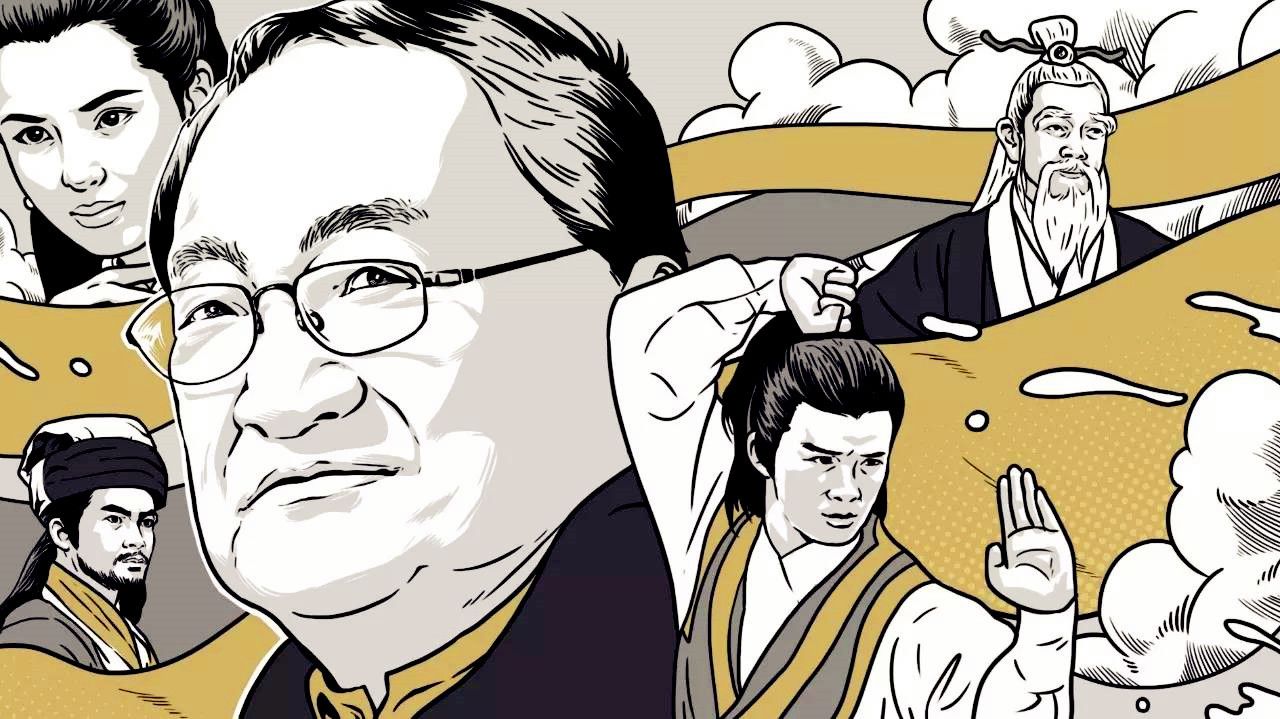
Here, I
am going to attempt to explain the rather complicated concept of Wuxia and
Jianghu (武侠
and 江湖).
武侠 wǔ xiá
江湖 jiānɡ hú
武侠小说 wǔ xiá xiǎo shuō Wuxia novel/fiction
金庸 jīn yōnɡ
This is a bit different from the usual Chinese drama reviews. In that I'm not trying to talk about one specific drama, I'm trying to tackle this rather complicated the concept that even a lot of native Chinese people when they think they know a lot about it.
Don't quite know about that, so if you're coming from a different cultural background and you don't speak the language, it might be even more confusing for you to understand what Wuxiao and Jianghu, and all that is.
So if you have been watching a lot of Chinese dramas, you realize a large proportion of current Chinese dramas are of the period drama genre. And within this genre, a large portion is the Wuxia genre or versions that branch off from this genre, or even if it's a severe political or Romantic period drama, Wuxia is always an element that will show up somewhere within the story.
You rarely see a pure without Wuxia element period drama these days, given that it is depicting a concept and idea and a world that is long gone, and it's not even anything resembles how Chinese people live these days. It's a fascinating cultural phenomenon.
The original meaning of Wuxia
So first, we have to understand the word Wuxia, and then the concept of Jianghu, the character 武 usually refers to martial arts, refers to military warfare. So things that require physical strength and rather bloody and brutal forces. 武 is best understood with its counterpart one, 文 literal meaning is literature or writings or the things that you cultivate and study. It's the culture, it's the part that you don't fight. So 文 and 武 comes together; it describes this set of attributes that is considered to be important. If you are a gentleman, you would love to be 文武双全, which means you can write, you can read, you're very cultured. But then at the same time, you can fight, you are very strong.
So the character 武 refers to that particular set of things, or skills or affairs, so 武侠is generics focusing on people, or characters, or events that happen within the 武 realm, within the military within the fighting within the part that is different from 文.
And 侠 usually refers to a type of person, who is themselves very, very skilled, often in martial arts, but they have some character or morality traits that define them as 侠. For example, they are out there to serve justice when justice is not to be found. They are righteous, they are loyal, and they are courageous.
I wouldn't exactly equal Sir Robin Hood in the Western culture to 侠, but they do share certain similar traits, after explaining this word I have to explain them the concept of Jianghu because they're very very closely related.
What is Jianghu?
Jianghu on the surface means River and lake. Jiang is River. In Chinese, we have two characters either it's called Jiang 江 or He河, depending on actually exactly we are talking about you're either using He or Jiang, that's just a language tradition. For example, the Yangtze River is called Chang Jiang, a long river. But then the Yellow River is called Huang He, Yellow River.
So you are using both characters in this word we pick the Jiang (江) character, the river character, and then Hu (湖) is a lake, so river and lake. Why are these two characters picked to describe a world that basically means it's the counterpart of the existing status political circle of whatever society you're living in. So in ancient China, the court the Emperor, the official system the seat of the political power is the Miaotang (庙堂), the temple, and the whole. And when you go into the river and the lake the Jianghu, you are in the world where it is outside of that political circle.
Jianghu is an ancient concept, as early as Zhuangzi time (庄子369-289 BCE), he's been talking about this concept. It's like the Hermit world that well-educated people, somehow, are not happy with whatever the political power is doing with the world at the time. They would retreat to they would leave the Miaotang, and then they would pursue their freedom, whatever kind of life they want to live in the Jianghu world.
So Jianghu has this innate meaning of freedom, of individualism, of not necessarily anti-government views. But more in the idea of searching personal freedom, political freedom, ideology freedom, and they're not really dealing with all the bureaucracy, that an established power would always have.
The meaning of Wuxia
But an interesting thing is these days when you talk about Jianghu in Chinese period drama, it's not necessarily that Jianghu that I just talked about, which is the another side of the existing political power. It's more talking about the 武侠 world, and that is heavily due to a certain era of literature that popped up in the 1950s in Hong Kong.
Current particular view about the Wuxia world about the Jianghu world really is very very modern and recent boring concept, so what you see in dramas what you think are the ancient Chinese cultural ideal world is actually created within the last say, a little bit over half a century.
In The 1950s, a lot of people coming from mainland China, because of the war that has been going on within the country for so long. They all settle down in Hong Kong, Hong Kong became a very very robust place. It was a difficult time because China has just basically got out of the war, the second world war with Japan. The country was just in pieces there was a civil war and a lot of people were just forced to leave their home. And when they ended up in Hong Kong, it created this particular culture that gave birth to the literary genre that we see today that is so pervasive in Chinese culture, which is called Wuxia.
Wuxia Novels and Dramas, and Jin Yong
Again like I said it can find its origin in older literature, much older, but the type of Wuxia novel/fiction (武侠小说), which I shall show that we are very familiar with these days. All those concepts those particular words language and how the worldview is set up, is really all made up in the 50s Hong Kong.
In the
beginning, there was a writer called Liang Yu-Shen (梁羽生 1926 - 2009),
he is the first person who created the modern Chinese Wuxia fiction genre. But
later Jin Yong (金庸
1924 - 2018) came into the picture, and he became the
definitive the most important writer, who set up an entire genre, that
influenced everyone who basically came after him. He was editor of a very
influential newspaper at the time so he writes a lot of journalism, political
journalism. But at the same time, he would serialize his Wuxia novel in his
newspaper. And those become super popular; eventually, they turn into books,
and I believe there are 14, these novels became the foundation upon which these dramas, got born and then got developed.
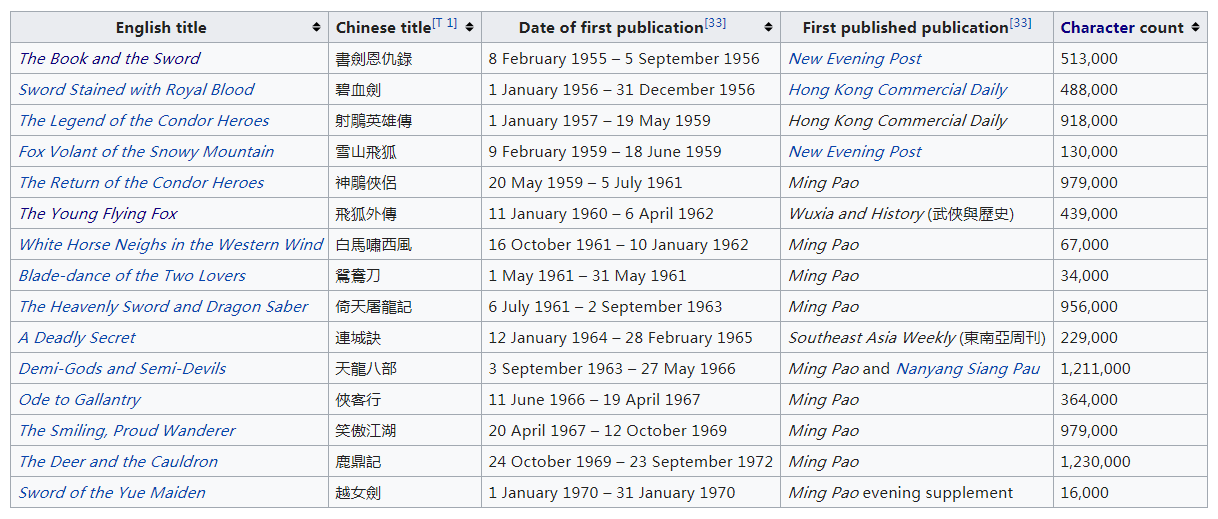
https://en.wikipedia.org/wiki/Jin_Yong
Every
writer who later came after, somehow have to refer back to his work, in terms
of the concept that he builds up what exactly Wuxia is what exactly Jianghu is,
and down to how you use the language to describe certain things and certain
concepts, that are actually not real in our real world.
If you've watched a lot of Wuxia drama, you know people defying gravity, they can fly, they can do crazy things, there's the concept of Qing Gong (轻功), light technique dancing in treetops and hopping of roofs better than monkeys or sparrows. Or the very mysterious concept of Nei Gong (内功), internal strength of power, that really cannot be explained by any physical law existing on this planet. Then there's this world of different fractions sects.
They have their different style fighting they have crazy names for their skills, and somehow there's this alliance within the Wuling. And it has its internal function name system; it has its power structures people fight for their names on the list like you see even in the Nirvana in Fire (琅琊榜).
All those concepts really are created within the Wuxia drama and the 50s in those novels and we got so used to these things, these days, we just thought they have always existed, but that's actually not that true. So in a way Jin Yong single-handedly or he is the most important attributor who created really an idealistic conceptual Ancient Chinese Jianghu world. Where there are people who are extremely skillful who are out there trying to help the weak, trying to define the wrongful rule of whatever political power might be there, trying to save lives, trying to do righteous deeds, trying to serve justice.
And they become so popular so deeply ingrained in our current concept of Chinese culture, that even though such people, such organizations that may never actually have existed in Chinese history. Now we almost accept them as fact, or when we do period dramas whatever story you're trying to tell you almost can never run away from some concepts, that came from his novels or some ideas that are related to the Wuxia world.
For
example, in the Nirvana in Fire (琅琊榜), it really is a
very political story, set in a fictional dynasty that refers to a real period
in Chinese history. But it talks a lot about Jianghu as well in the first one, or
male lead character made Hansu comes from Jianghu. And he is the head
of the Jiangzuo Alliance. All these concepts and ideas, and even language, and how things work have their roots in Wuxia affections that came out of the 1950s Hong Kong.
And in the Nirvana in Fire (琅琊榜), our male characters Xiaopingjing is really always torn between Miaotang and Jianghu, between the political things that he had to deal with because of who he is and what can family he was born into. But then his own desire to go into the Jianghu world, the world where there's freedom, where he could use his super skills to roam country do whatever he likes, and be free. So he says this within the drama a couple of times:
无论我多想当一个逍遥自在的江湖人,我终究不是。
No matter how much I want to be a carefree Jianghu man, I am not.
After 50 ~ 60 years of its creation, the genre is still very strong and super influential in terms of creating the conceptual cultural identity that a lot of Chinese people, wherever they are that they identify with.
I think perhaps the most interesting in this whole thing is that the creation of this genre of literature is really a product of its specific time. At the time when the country just went through a lot of turbulence, at a time when a lot of people weren't assured, as a cultural and historical and ethnic group, what was the future. And because of all the sufferings and difficulties people were living during that period, this ideal ancient version that has China's cultural traits.
But never really existed in Chinese history, but created. And it served this psychological almost need for people to have something, that they want to agree with, as their shared identity and past history. And a lot of those concepts, such as loyalty to your country, your sense of justice, the belief that there is a system outside of the official system. Because of the official system, the court system often is depicted as corrupted and very bad within other Wuxia genres.
So you go out, and you go into the Jianghu and Jianghu’s rules. Jianghu has good people and bad people they fight, but there's always justice, in the that gets served. So it almost serves people's psychological need to believe that such a world could exist and have existed, and there's freedom there's good morale; there is a possibility, and there is hope.
Now they can cling on to and believe in in this fictional world, and somehow it helps them to really live through the difficulty in reality. Then over half a century later, the world is a very different place now, but those things still get passed down to the current generation and even exported to other countries.
These days, in a lot of Chinese creative work whether it's novel whether it's dramas or films we see different versions, or out say the mutations of the Wuxia genre. Such as Xianxia (仙侠), for example, you'd call Journey of the Flower (花千骨), as the Xianxia drama.
Or sometimes mixing with a little bit a western-style fantasy, as you see in Tribes and Empires: Storm of Prophecy (九州·海上牧云记), and there are different degrees and mixture of what type of Wuxia you get to see. But you almost never ever run away completely from it, as long as you're looking at a period drama you are definitely going to find something that's related to the concept of Wuxia.
So this is my attempt to explain it's a rather difficult concept of Wuxia and Jianghu within Chinese literature, a current mindset and the drama and film world. If you've never heard about the things that I talked about or you've thought of them as different things. I hope after this it has helped you clarify some of your confusion, or your questions or your doubt about what precisely Chinese Wuxia is.
And perhaps next time when you watch a Chinese period drama whether it's a pure Wuxia drama or it just contains a snippet of this world, you would have a much better understanding of what they really are, and where they came from.
Thanks for reading, meanwhile happy drama watching.
And If you are interested in Chinese Wuxia novels, here is a free fiction website: https://www.wuxiaworld.com/novels
Responses • 1
0/2000
ID: 322
Matthias
Offline
2 day
Visited
From
Orlando, United States
Send Message
eg 沙发 (sofa) and 网络 (network) are new words, but 沙, 发, 网, 络, are all not new.
There are only 3,500 Chinese characters in daily life, it is very flexible to create new words.