thanks for sharing. I like Tangzhuang the most.
(more)Traditional Chinese Clothing
Original
Chinese Culture
Nov 21 • 53682 read
China's civilization has accumulated a distinctive style of traditional Chinese clothing, like the Cheongsam, Hanfu, and Tangzhuang.
Traditional Chinese Clothing
/fit-in/0x0/img/201911/Traditional-Chinese-Clothing.jpg-384-article-1574298867.jpg)
China has a long history and many ethnic minorities, and the 5,000 years of civilization have accumulated a distinctive style of Chinese clothing. Since ancient times, Chinese customs and culture have spread around the world through the world-famous silk road.
Traditional Chinese clothing has a unique oriental charm. As the embodiment of Chinese culture, it has entered the palace of world culture.
Cheongsam (Qipao, 旗袍)
/fit-in/0x0/img/201911/Traditional-Chinese-Clothing---Cheongsam.jpg-955-article-1574298867.jpg)
The cheongsam, or Qipao, is the classic dress for Chinese women, which combines the elaborate elegance of Chinese tradition with unique elements of style. The high-necked, closed-collar cheongsam features a loose chest, asymmetrical fastening, fitted waist, and side slits. To fans, the cheongsam encapsulates a woman's modesty, softness, and beauty. Designed to show off the natural softness of the female form, it also creates the illusion of long, slender legs.
This close-fitting dress, with a high neck and slits on the sides, comes from China's Manchu Nationality (满族). There is a beautiful legend from the Manchus about the cheongsam.
Legend of the Cheongsam
Legend has it that a young fisherwoman lived by the Jingbo Lake (镜泊湖). She was not only beautiful but also clever and skillful. But when fishing, she often felt hindered by her long and loose-fitting dress. Then an idea struck her; why not make a more practical dress for work? She got down to sewing and produced a long multi-looped-button gown with slits, which enabled her to tuck in the front piece of her dress, thus making her job much easier. As a fisherwoman, she never dreamed that a fortune would befall on her.
The young emperor who ruled China at that time had a dream one night. In the dream, his dead father told him that a lovely fisherwoman in cheongsam by the Jingbo Lake would become his queen. After awakening from his sleep, the emperor sent his men to look for her. Sure enough, there she was! So she became the queen, bringing her cheongsam with her. Manchu women all followed suit, and soon the cheongsam became popular.
Cheongsam Through the Years
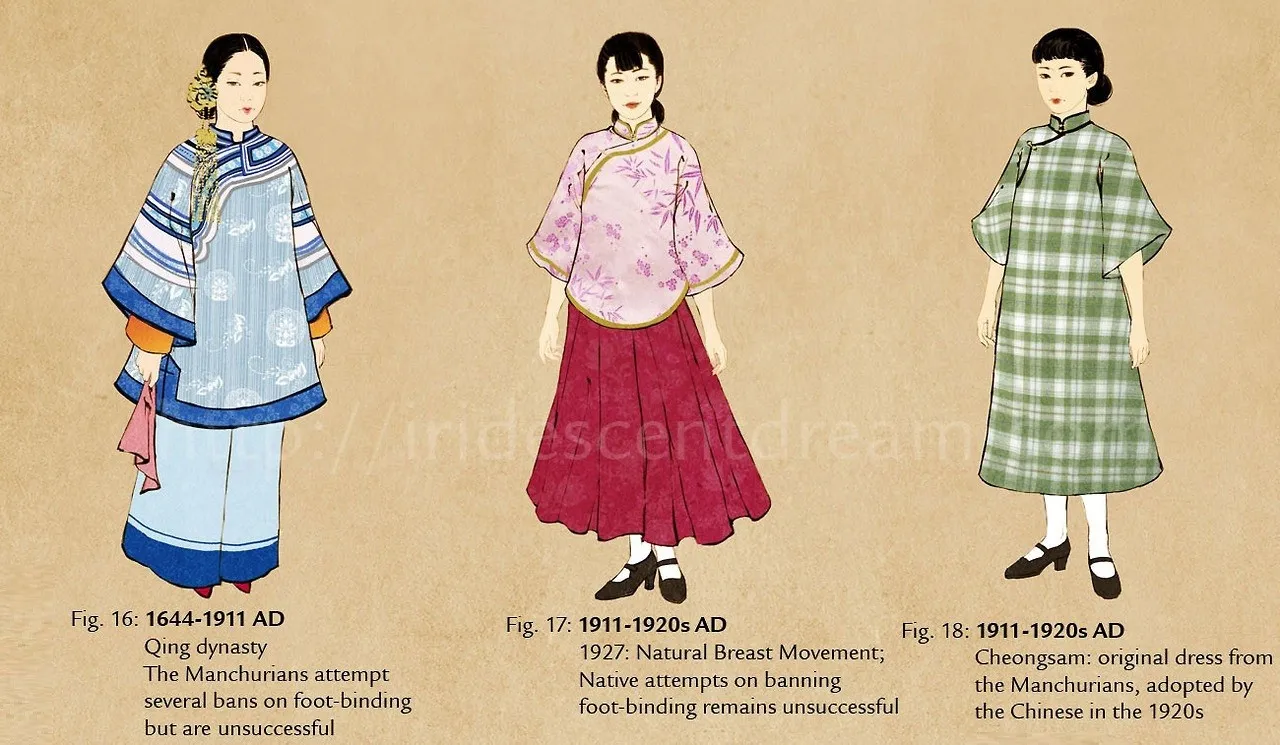
The Cheongsam came from the Manchus who grew out of ancient Nuzhen tribes (女真族). In the early 17th century, Nurhachi (努尔哈赤), a great political and military strategist, unified the various Nuzhen tribes and set up the Eight Banners System (八旗制). Over the years, a collarless, tube-shaped gown was developed, which was worn by both men and women. That is the embryo of the Qipao. The dress is called Qipao in Chinese or translated as “banner gown“, for it came from the people who lived under the Banner System.
The cheongsam became popular among ladies of the royal family in the Qing Dynasty. At that time, cheongsams were fitted loosely and were so long that they would reach the insteps. Usually, they were made of silk, and the whole dress was embroidered, with broad lace trimmed at the collar, sleeves, and edges.
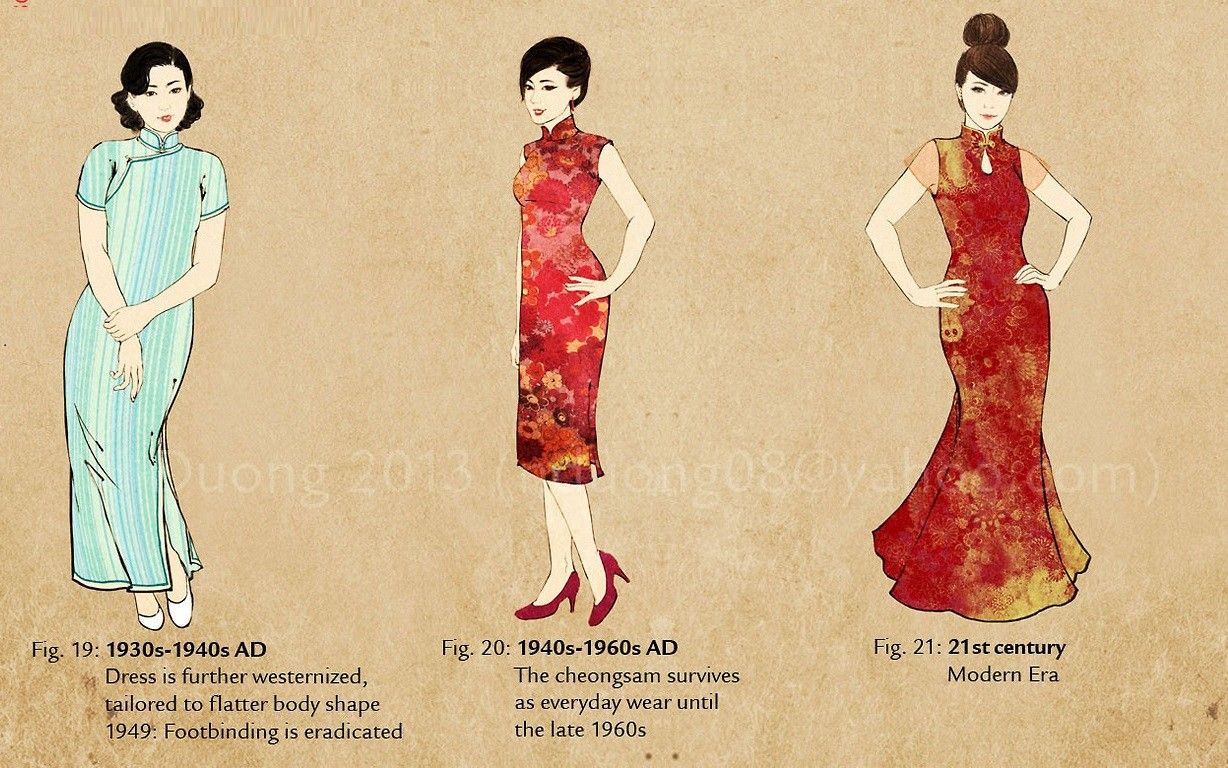
In the 1920s, the cheongsam changed with the influence of Western styles. The cuffs grew narrower and were usually trimmed with thin lace. The length of the dress was shortened as well. This new adaptation allowed the beauty of the female body to be fully displayed.
In the 1930s, wearing a cheongsam became a fashion among women in the whole of China. Various styles existed during this period. Some were short, and some were long, with low, high, or even no collars at all.
Starting from the 1940s, cheongsams became closer-fitting and more practical. In the summer, women wore sleeveless dresses. Cheongsams of this period were seldom adorned with patterns.
The cheongsam didn't become standard female attire until the 1960s. Following Western fashion, the tailors raised the hem, even to above the knee, so that the “long” was no longer long. In the West, during the sexual revolution of the 1960s, the style was deemed something oppressive, like the Victorian bodice.
In Western popular culture, the cheongsam became synonymous with the 1960 movie character Suzie Wong and the sexual objectification of women.
The Cheongsam Goes Mainstream
Today, with its variety of styles, the cheongsam shows its charm in many markets. More and more women in China appreciate its beauty. For instance, when wives of China’s diplomats attend critical social gatherings, the cheongsam is their first choice among dresses. In fact, quite some influential people have suggested that cheongsam should become the national dress for women in China. This shows that the cheongsam remains a vibrant part of Chinese culture.
Wearing a cheongsam nowadays has turned into something of a vogue, both at home and abroad. Due to its elegance and classical looks, the cheongsam becomes a source of inspiration for fashion designers. World-renowned brands like CD (Christian Dior), Versace (Gianni Versace), and Ralph Lauren have all cited some cheongsam elements in their designs. Many foreign women are eager to get themselves a cheongsam should they visit China. Cheongsam is no longer a garment particular to Chinese women but is adding to the vocabulary of beauty for women all over the world.
10 notes on wearing cheongsam
1, Fat person, don't wear too short style; the best to wear a long style,
2, Arms are too thick, do not wear short sleeves, or sleeveless, to wear a sleeve-wrapped body,
3, Thin body, need to wear the short style, thus be able to show your figure more,
4, Short person, wear the short style to appear some slender figure,
5, Older people, choose a bit darker color, and the design is a bit looser appropriately, in order to reflect a woman's dignified showily,
6, Middle-aged people, choose the bright color, and richly decorous fabrics, in order to reflect a woman's gentle and generous,
7, Young people, choose the gorgeous color and lively designs, in order to reflect their youthful vigor,
8, Do not wear heavy makeup when wearing cheongsam, to light makeup, makeup light elegance can show the beauty of cheongsam
9, When wearing a cheongsam, to match the appropriate accessories, as an ornament, such as a handbag, necklace, earrings, or shoes, must match harmony, to highlight the beauty of the cheongsam.
10, Speech and behavior must be gentle, they can reflect a person's cultural accomplishment and aesthetics.
Tangzhuang (Tang Suit, 唐装)
/fit-in/0x0/img/201911/Traditional-Chinese-Clothing---Tangzhuang.jpg-835-article-1574298867.jpg)
The traditional Chinese attire, called Tangzhuang, which originated at the end of the Qing Dynasty (1644 - 1911), has been quite fashionable in recent years.
It is taken for granted that Tangzhuang is a title for clothes of traditional Chinese features. Ironically, during the Tang Dynasty (AD 617 - 907), the trend was Hufu (胡服, Hu is a general term for the northwestern minorities, and Fu means garments). The fact is that being a very prosperous period in Chinese history, the Tang Dynasty (AD 618 - 907) has become a pronoun of China, referring to something with China’s characteristics or tradition, such as “Tangrenjie” or Chinatown.
Qipao and Tangzhuang are popularly regarded as traditional Chinese clothing in popular media worldwide. This is because these were influenced and introduced by the Manchus (萌族人) who ruled China during the Qing Dynasty. As a result, the Manchus introduced their culture and inevitably forcibly established their style of dress displacing the native Han people's clothing of previous generations.
Today, with a high variety of styles, colors, and materials, the Tangzhuang is getting more and more popular among the Chinese people. Wearing traditional attire is in vogue in China since the Asia Pacific Economic Cooperation (APEC) was held in Shanghai in October 2001. At the meeting, all 20 participating leaders wore traditional Chinese jackets in royal blue, scarlet or olive, embroidered with round patterns of peonies – China’s national flower.
In fact, Tangzhuang has been creeping back into fashion in recent years, and the Shanghai summit served as a stimulus to enhance its popularity.
Other social factors that have pushed Tangzhuang into the center of China's fashion include China's successful bid for the 2008 Olympic Games and entry into the World Trade Organization. Also, with the efforts of excellent designers from China and abroad, oriental attire has also become popular overseas.
5 taboos when wearing Tang suit in the wedding
Nowadays, traditional Chinese wedding is more and more popular among young couples. Many people like to get married in the Tang suit. Here you should know the 5 taboos when getting married in a Tang suit:
1, The bride's dress on the wedding day is not allowed to have pockets, because traditionally if the bride wears a gown with pockets, she will take the wealth of her original family with her.
2, The bride's dress should not appear with the fresh flowers, because the fresh flowers are easy to wither. Incorporate the design of the pomegranate flower into the bridal gown, which symbolizes many children and grandchildren.
3, The color of the wedding dress is given priority to more with red, red symbolizes joyous, so the makeup of the bride cannot make light makeup. It can let a person feel dress and makeup look antipathetic otherwise; also the bride looked very pale.
4, Tang suits should not be touched by pregnant women, which is unlucky in traditional marriage customs. The bride should pay more attention to it.
5, If the bride is a second marriage, she can not wear the red Tang suit, while she can choose a color such as pink, or orange Tang suit wedding dress.
Hanfu (Han people clothing, 汉服)
/fit-in/0x0/img/201911/Traditional-Chinese-Clothing---Hanfu-article-1574298867.jpg)
As its name suggests, Hanfu encompasses all types of traditional clothing worn by the Han people ethnic minorities. As such, it has a history as long as the history of the Han people. Hanfu was eliminated by Manchu invaders by force in the 17th century and is not widely regarded in China as a national costume, and public awareness survives to a limited extent through periodic dramas and films.
According to Chinese tradition, Hanfu can be traced back to 4,000 years ago by the Yellow emperor's wife, Leizu, (Yellow emperor: a great sage king of ancient China who legend says ruled in the 27th century BC.)
Leizu used silk to make clothes. Later, the Shang dynasty developed the basic forms of Hanfu, and gradually reached the maturity of the Han dynasty. It is characterized by a complete and finest set of apparel, including clothing, accessories, jewelry, etc., reflecting Chinese traditional culture's rituals. Through thousands of years of development, Hanfu has formed a variety of gorgeous and formal styles. Under the big category, around 15 styles.
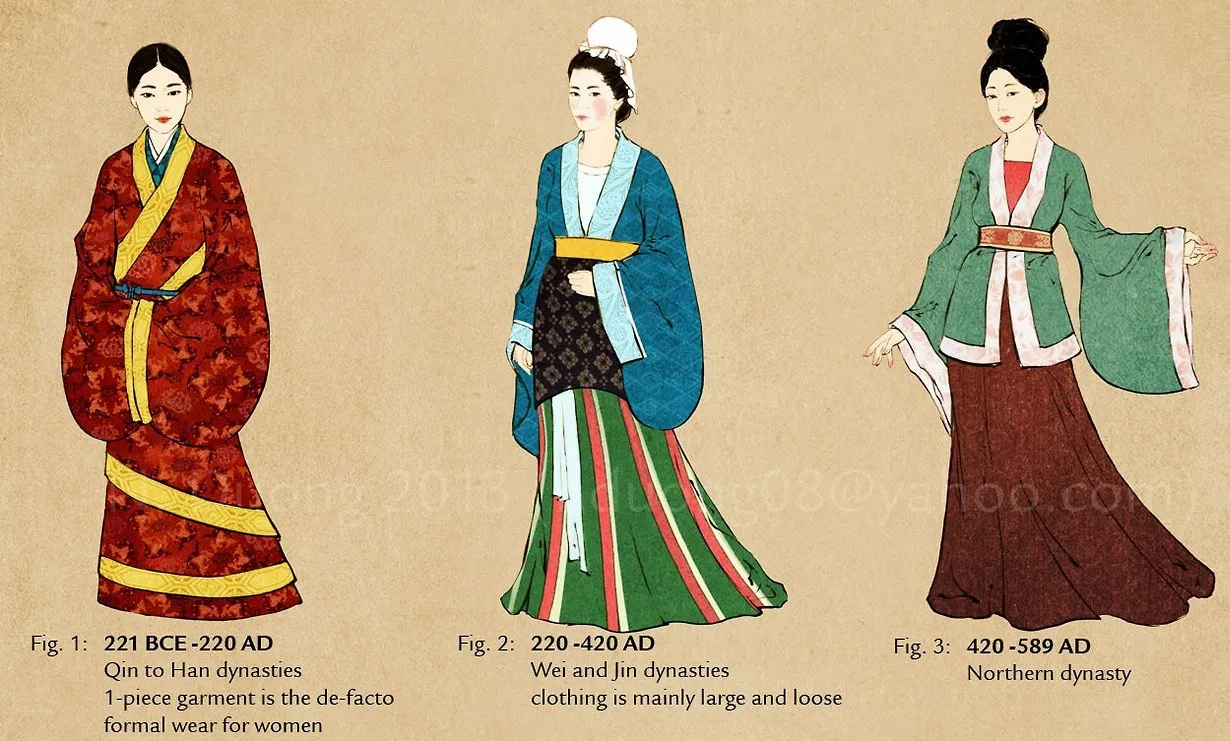
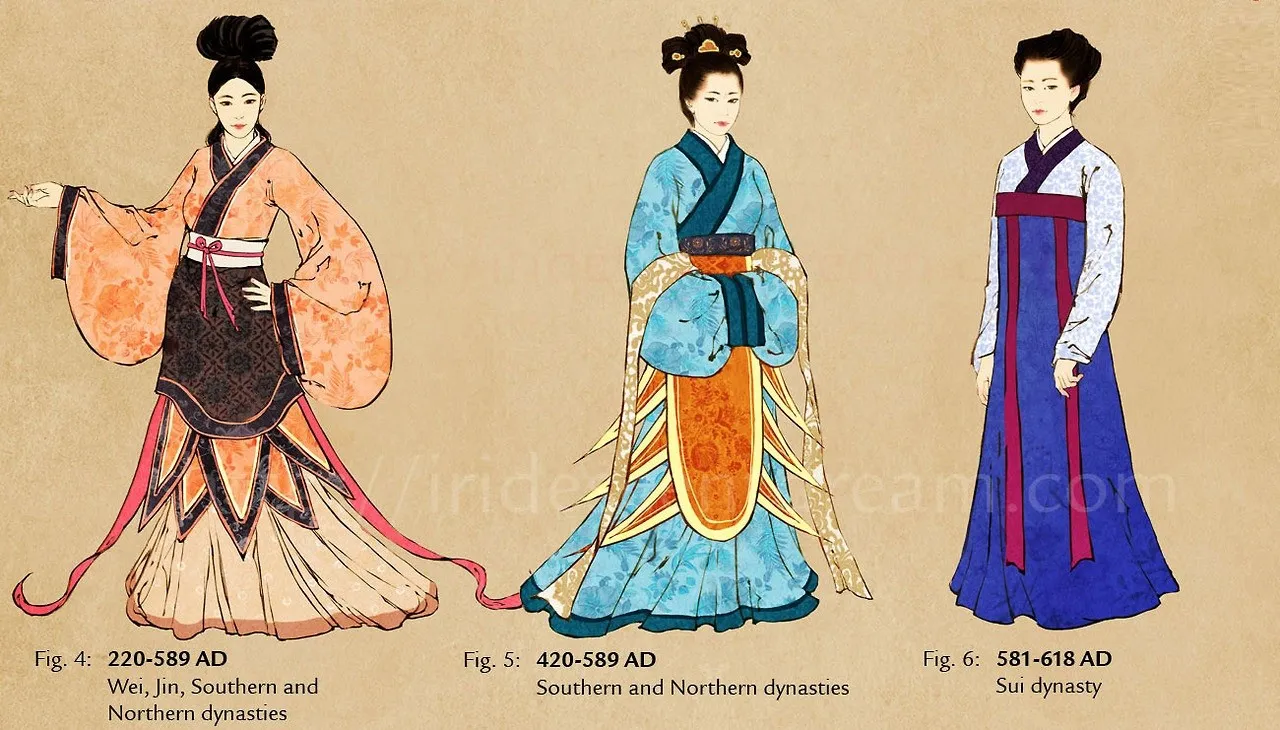
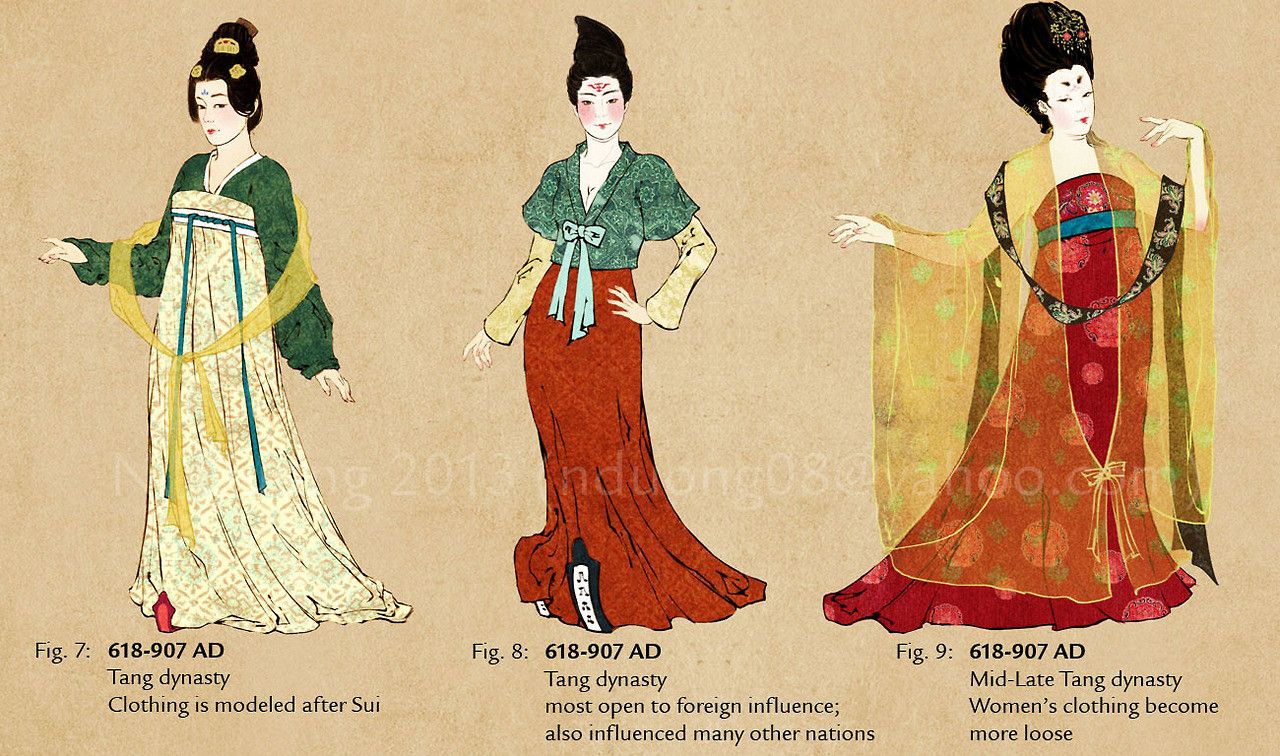
Hanfu has developed throughout different dynasties. Each dynasty had changes in styles a little bit or developed another style of wearing.
The most representative are these four (as a timeline):
- Quju (曲裾), in Han dynasty
- Jiaoling Ruqun (交领襦裙), in Wei and Jin dynasties
- Qixiong Ruqun (齐胸襦裙), in Tang dynasty
- Qiyao Ruqun (齐腰襦裙), in Five dynasties
Ruqun (襦裙): a top garment with a separate lower garment or skirt.
Hanfu is complicated to make and need to takes some time to wear, here is a video guide you on how to wear Qixiong Ruqun.
Hanfu itself has a recorded history of more than 3000 years. It was worn by Han people from the Xia Dynasty (c. 21st century B. C. -16th century B. C.) all the way to the Ming Dynasty (1368 - 1644). The traditional dress of many Asian countries has been influenced by Hanfu, especially those of Japan and Korea.
Han people regarded Hanfu as a significant part of their culture. The wearing of appropriate styles of Hanfu was an essential part of courteous refined behavior. Confucius considered Hanfu a necessary part of Chinese ceremonies and rituals, and many of his quotations contain references to Hanfu.
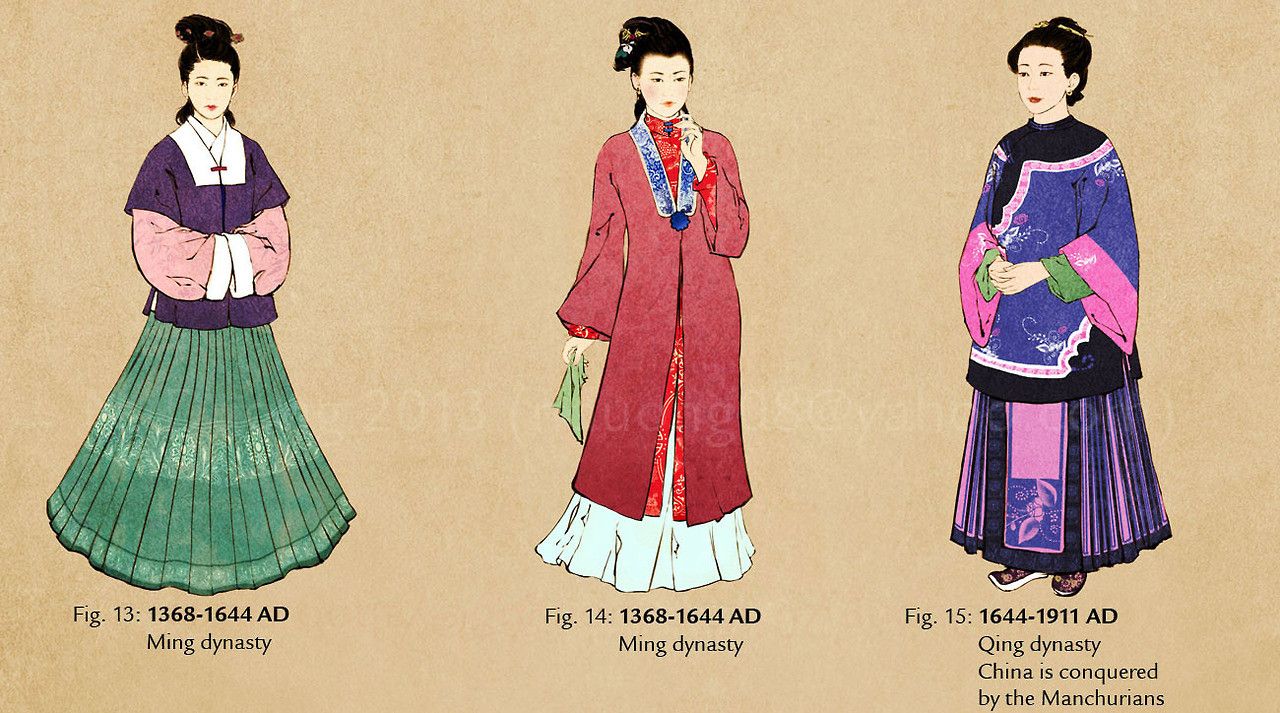
Hanfu disappeared at the beginning of the Qing Dynasty (1644-1911). The Qing Dynasty was founded not by the Han people who form the overwhelming majority of the population of China, but by the Manchus, fishing and hunting people who first rose to prominence in the Northeast. The Manchus foresaw that they would have great difficulty in ruling the Han people, who outnumbered them vastly and had a much more established culture. Soon after the takeover of China, the Manchus began to exercise a policy of subjugating the native Chinese populations to adopt Manchu culture to eliminate unrest at the clear invasion of foreign ethnic minorities.
The ruling Manchus forced the Han men to adopt the Manchu hairstyle (the pigtail) and Manchu-style clothing. Enforcement of the policies was swift and brutal but effective. Hanfu was replaced by Manchu-style clothing, and soon every Chinese male wore a pigtail. However, Ming-era clothing was still permitted for women. As time passed the differences between the slender Manchurian Changpao (长袍) and the wide-sleeve Ming-style clothing narrowed. This resulted in the development of the Ao (祆) dress which distinguished Manchurian style clothing from Ming style.
Mao suit (Zhongshan suit, 中山装)
/fit-in/0x0/img/201911/Traditional-Chinese-Clothing---Mao-suit-article-1574298867.jpg)
The Mao suit is the western name for the style of male attire known as the Sun Zhongshan suit or Zhongshan suit, named after Sun Zhongshan (Sun Yat-sen) who introduced it shortly after the founding of the Republic of China. To the Chinese tradition of changing the style of dress for different dynasties, Sun Yat-sen instructed that a new form of clothing be designed for the new republic. The Western name comes from its popularisation by Mao Zedong.
Incorporating elements of German military dress including a turndown collar and four symmetrically placed pockets and based on a form of attire popular with contemporary Chinese men in Japan and Southeast Asia, the Zhong shan suit was an attempt to cater to “modem” sensibilities without completely adopting Western styles. Instead of the three hidden pockets in Western suits, the Zhongshan suit had four outside pockets to adhere to Chinese concepts of balance and symmetry. Over time, minor stylistic changes developed. The suit originally had seven buttons, later reduced to five.
After Sun Yat-sen's death in 1925, popular mythology assigned a revolutionary and patriotic significance to the Zhongshan suit. The four pockets were said to represent the Four Cardinal Principles cited in the classic Book of Changes. The five center-front buttons were said to represent the five Quan's (branches of government) cited in the constitution of the Republic of China and the three cuff buttons to symbolize Sun Yat-sen’s Three Principles of the People.
In the 1920s, civil servants of the Chinese government were required to wear the Zhongshan suit. After the establishment of the People's Republic of China, the suit became a symbol of proletarian unity and was regularly worn by Communist party cadres until the 1990s when the Western business suit largely replaced it. The Zhongshan or Mao suit remained the standard formal dress for the first and the second generation of PRC leaders such as Deng Xiaoping.
Chinese Knot (中国结)
/fit-in/0x0/img/201911/Traditional-Chinese-Clothing---Chinese-Knot-article-1574298867.jpg)
Chinese Knot is a frequently used clothing accessory of ancient Chinese people.
The Chinese Knot is a type of national handicraft with a long history and profound cultural connotations. It appeared in ancient times, developed in the Tang and Song Dynasty (A. D. 960-1229), and was popularized in Ming and Qing Dynasty (A. D. 1368-1911). The Chinese Knot has now become an elegant and colorful craft, removed from its original practical use.
In 1980, some dedicated connoisseurs collected and arranged the decorative yet practical knots that have been passed down through the centuries in China. After studying the structures of these knots, the devotees set about creating new variations and increasing the decorative value of the knots. These exquisitely symmetrical knots which come in so many forms are as profound as the great cultural heritage of the Chinese people.
The characteristic of the Chinese Knot is that it is purely hand-made, made of a single rope, and named by its specific form and meaning. By combining different clip knots or other auspicious adornments skillfully, a unique auspicious ornament that represents beauty, wisdom, and wishes is formed. For example, “Full of joy,” "Happiness & Longevity,” "Double Happiness", and “Luck and Auspiciousness as one wishes” are Chinese traditional pleasant phrases expressing warmest regards, best wishes, and finest ideal.
In the Chinese language, “knot” has meanings of reunion, friendliness, warmth, marriage, love, etc. Also, “knot” and “luck, Felicity” have the same meaning, so Chinese knots are often used to express some good wishes including happiness, prosperity, love, and no evils.
To fit in with the needs of modem life, Chinese Knot has various products. The two main series are auspicious hanging and knitting clothing adornment. The auspicious hanging includes a large tapestry, a big room hanging, an automobile hanging, etc. Knitting clothing adornment: includes rings, eardrop, hand chains, necklaces, and other woman’s unique decorations.
Today, people are fond of the Chinese Knot for its characteristic form, colorfulness, and profound meaning.
PS: You can find all kinds of traditional Chinese clothing on Amazon by searching.
History of Traditional Chinese Clothing from 221 BC to now
/fit-in/0x0/img/201911/Traditional-Chinese-Clothing-4-article-1574298868.jpg)
Responses • 51
0/2000
XiaoYi
0
•
Reply •
5 day
amazingggggg
0
•
Reply •
Jun 09
I love Tang Dynasty traditional Chinese chlotes😍
0
•
Reply •
May 17
wow
0
•
Reply •
May 16
😍😍😍 wow ...谢谢
0
•
Reply •
May 16
woooaah
0
•
Reply •
Mar 28
很有意思啊
0
•
Reply •
Mar 03
WOW!
0
•
Reply •
Feb 11
so uselful, thankyou
0
•
Reply •
Apr 26
很有意思
0
•
Reply •
Dec 11
More
ID: 322
Matthias
Offline
3 day
Visited
From
Orlando, United States
Send Message