Pinyin Learning Plan
Original
Pinyin
Mar 11 • 1487 read
This Pinyin learning plan is a lecture from an experienced teacher; it includes 4 lessons and 90 minutes per lesson.
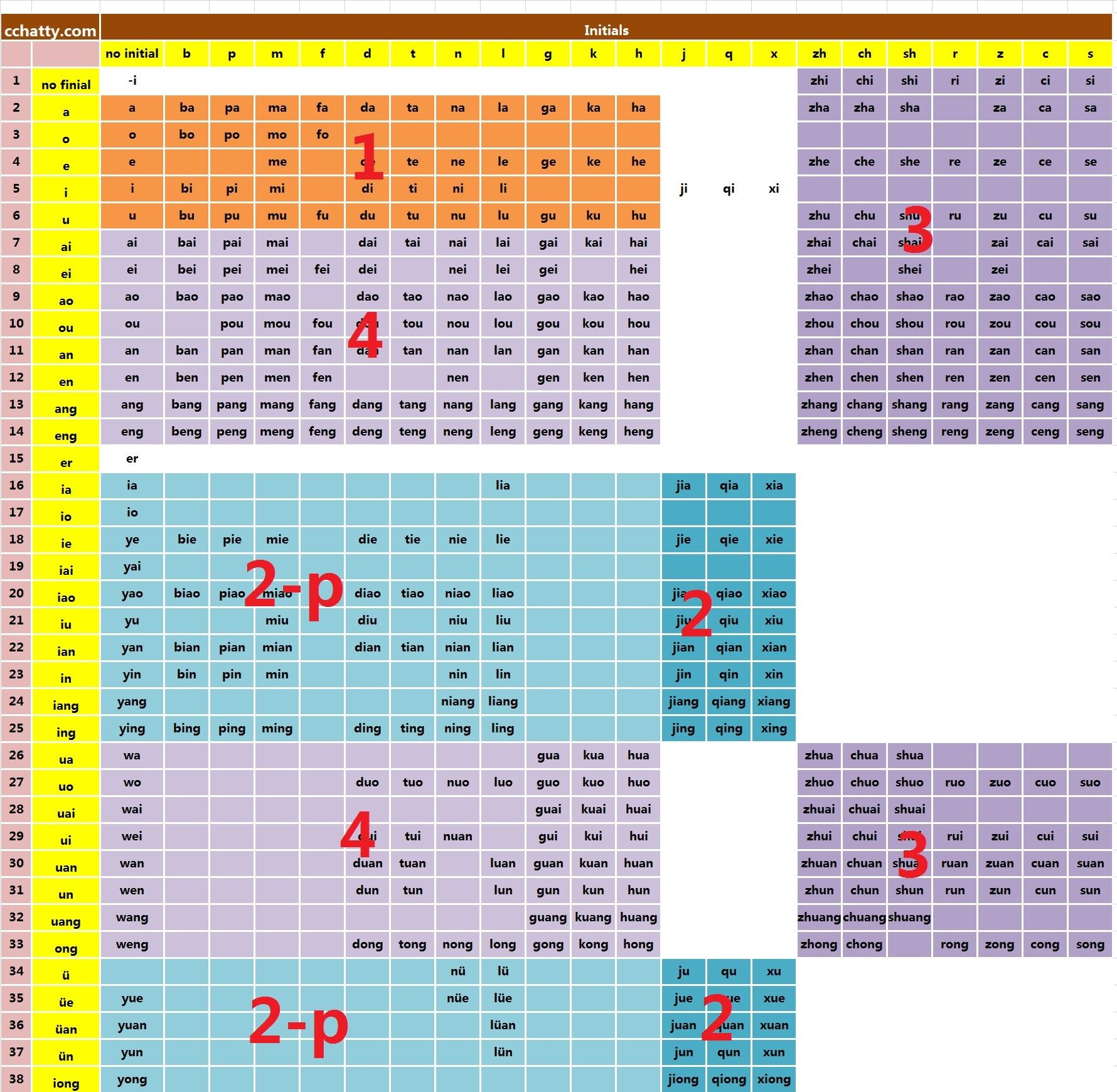
This Pinyin learning plan is a lecture from an experienced teacher; it includes 4 lessons and 120 minutes/2 times per lesson.
During the lesson, the teaching time and practice time should be the same, to ensure that students have more practice opportunities.
And here is not list the text, dialog, new words, but just the Pinyin contents. Learn pinyin is not just learning Pinyin, it needs to learn with the text, sentence, and words, through some dialogue to learn Pinyin.
Before you try to follow this plan, please review the Pinyin brief introduction, so that you can have an overall understanding of what the Pinyin is.
Attached the excel download address (learning plan and printable - google driver): learn Pinyin plan
Lesson one, 11 Initials and 6 Finals, tones and tone changes (Part 1)
learning contents and goals
- familiar with 11 Initials and 6 Finals, understanding the spelling rules
- 4 tones
- Tone position
- Neutral tone
- Tone changes - 3rd tones changes to the 2nd tone
- Tone changes - changes of tones of 不
1, Initials and Finals
A Chinese syllable is usually composed of an initial and final. The former is a consonant that begins the syllable and the latter is the rest of the syllable.
11 Initials
| b | p | m | f |
| d | t | n | l |
| g | k | h |
6 Finals
| a | o | e | i | u | ü |
The spelling rules of Initials and Finals
| a | o | e | i | u | ǖ | |
| b | ba | bo | bi | bu | ||
| p | pa | po | pi | pu | ||
| m | ma | mo | me | mi | mu | |
| f | fa | fo | fu | |||
| d | da | de | di | du | ||
| t | ta | te | ti | tu | ||
| n | na | ne | ni | nu | nǖ | |
| l | la | le | li | lu | lǖ | |
| g | ga | ge | gu | |||
| k | ka | ke | ku | |||
| h | ha | he | hu |
2, Tones and tone position
2.1 4 tones
Tones are changes in the pitch of syllables. In the standard Chinese there are 4 basic tones, represented respectively by the following tone-graphs: the first tone (ā), the second tone (á), the third tone (ǎ), and the fourth tone (à). When a syllable is pronounced in different tones, it has different meanings.
2.2 Tone position
When a syllable contains a single vowel only, the tone-mark is placed above the vowel sound.
When a syllable contains two or more vowels, the tone-mark should be placed above the main vowel (the one pronounced more loudly and clearly). eg. mā, hǎo, zuò.
When a tone-mark is placed above the vowel ī, the dot over it should be omitted, eg. mì, jǐing.
When iu or ui comes, the tone-mark should be placed above the terminal vowel, eg. liú, guǐ.
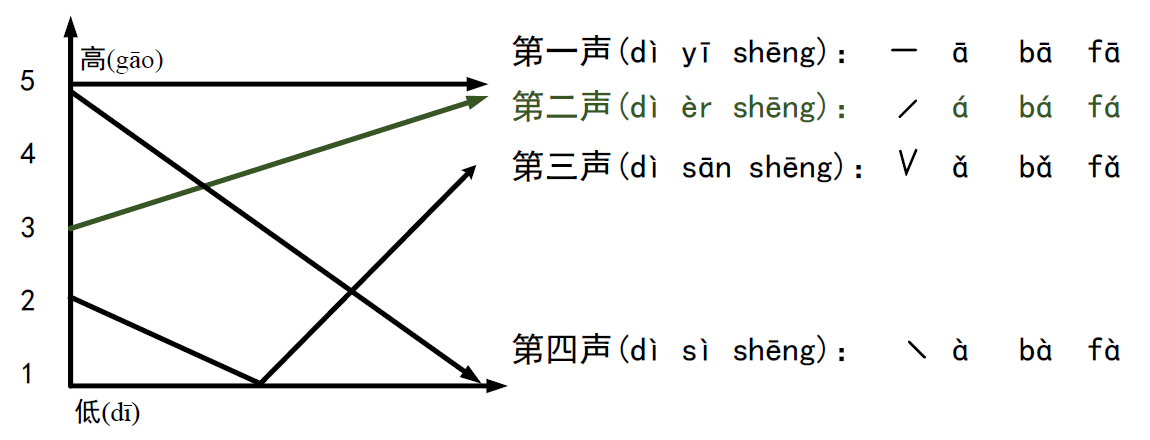
| 55 | the first tone | ā, bā, fā, mā | māma 妈妈 (mother) |
| 35 | the second tone | á, bá, fá, yé | yéye 爷爷 (grandfather) |
| 214 | the third tone | ǎ, bǎ, fǎ, nǎi | nǎinai 奶奶 (grandmother) |
| 51 | the fourth tone | à, bà, fà, bà | bàba 爸爸 (father) |
2.3 Tone exercise - repeat after the teacher
- first tone: 一、三、七、八、天、只、山、咖啡、今天
- second tone: 十、来、白、瓶、爷、门、元、明天
- third tone: 五、九、好、你、我
- fourth tone: 二、四、六、去、坐、号、大、上、下
3, Neutral tone
In standard Chinese pronunciation, there are a number of syllables that lose their original tones and are pronounced soft and short. This is known as the neutral tone which is identified by the absence of a tone make, eg. xièxie, bǘ kèqi.
repeat after the teacher
| mā ma 妈妈 (mother) | jiē jie 姐姐 (elder sister) |
| bà ba 爸爸 (father) | mèi mei 妹妹 (younger sister) |
| gē ge 哥哥 (elder brother) | ài ren 爱人 (lover, sweetheart, spouse) |
| dì di 弟弟 (younger brother) | hái zi 孩子 (child) |
| hǎo de 好的 (ok, yes, fine) | wǒ de 我的 (my, mine) |
4, Tone changes
A third tone, when immediately followed by another third tone, should be pronounced in the second tone, eg. nǐ hǎo --> ní hǎo (你好).
Repeat after the teacher
| 你好 | 很好 | 左拐 |
| 可以 | 五百 | 九百 |
Dialog:
A:你好! (Nǐ hǎo!)
B:你好!(nǐ hǎo!)
A:你早!(Nǐ zǎo!)
B:你早!(Nǐ zǎo!)
A:你好吗?(Nǐ hǎo ma?)
B:我很好,你好吗?(Wǒ hěn hǎo, nǐ hǎo ma?)
A:我也很好。(Wǒ yě hěn hǎo.)
A third tone, when followed by a first, second or fourth tone, or by the majority of the neutral tones, usually becomes a half third tone, that is, the tone that only falls but does not rise, eg. nǐmen --> nǐmen (你们).
| the third tone + first tone --> | a half third tone + first tone |
| the third tone + second tone --> | a half third tone + second tone |
| the third tone + fourth tone --> | a half third tone + fourth tone |
| the third tone + neutral tone --> | a half third tone + neutral tone |
wǒ chī --> 我吃
wǒ lāi --> 我来
wǒ qù --> 我去
wǒ ma --> 我吗?
A:你来吗?(Nǐ lái ma?)
B:我来。(Wǒ lái.)
A:你去吗?(Nǐ qù ma?)
B:我去。(Wǒ qù.)
Changes of tones of 不, 不 is pronounced in the second tone when it precedes another fourth tone or a neutral tone that is originally a fourth tone, eg. bù kèqi --> bú kèqi (不客气). But it is pronounced in the fourth tone when it precedes a first, second or third tone.
Repeat after the teacher:
| bǔ kǎo | hě hǎo | nǐ lái | hěn lèi |
| dǎ dǎo | fěn bǐ | měi lì | hǎi wài |
| měi hǎo | wǚ dǎo | hěn hēi | nǎ ge |
Lesson two, 3 Initials and 13 Finals, and their spelling (Par 2 and 2-p)
learning contents and goals
- familiar with new 13 initials and 3 finals
- spelling rules of ǖ
- spelling rules of i
- spelling rules of iou
- spelling rules of j, q, x and ǖ
1, Initials and Finals
3 Initials
| j | q | x |
13 Finals
| ia | ie | ||
| iao | iou (iu) | ||
| ian | iang | ||
| in | ing | iong | |
| ǖ | ǖe | ǖan | ǖn |
Spelling
| j | q | x | |
| ia | jia | qia | xia |
| ie | jie | qie | xie |
| iao | jiao | qiao | xian |
| iou (iu) | jiu | qiu | xiu |
| ian | jian | qian | xian |
| iang | jiang | qiang | xiang |
| in | jin | qin | xin |
| ing | jing | qing | |
| iong | jiong | qiong | xiong |
| ǖ | ju | qu | xu |
| ǖe | jue | que | xue |
| ǖan | juan | quan | xuan |
| ǘn | jun | qun | xun |
2, Spelling rules
Spelling rules of ǖ
When ǖ forms a syllable by itself or occurs at the beginning of a syllable, it is written with the two dots of ǖ dropped, eg. ǖ --> yu, ǖan --> yuan, ǖe --> yue, ǖn --> yun.
Spelling rules of i
When i forms a syllable by itself, it is written as yi, when i occurs at the beginning of a syllable, it should be written as y, eg. i --> yi, ian -->yan
Spelling rules of iou
The compound final iou is written as iu and the tone-mark is placed above the last element, eg. jiǚ(九). When it forms a syllable by itself, it is written as you and the tone-mark is placed above o, eg. yōu(优).
Spelling rules of j, q, x and ǖ
When j, q, x are put before ǖ or a final beginning with ǖ, the two dots in ǖ are dropped, eg. jǜ(句), xué(学).
3, Do practice follow the textbook
- j, q, x and 13 Finals in lesson 2
- 11 Initials in lesson 1 and 13 Finals in lesson 2
- Initial discrimination, eg, jia -- qia, qiu -- jiu
- Final discrimination, eg quan -- qian, xie -- xue
Leeson three, 7 Initials and 16 Finals, and their spelling (Part 3)
learning contents and goals
- familiar with new 7 initials and 16 finals
- spelling rules of u
- spelling rules of uei and uen
- changes of tones of 一
1, Initials and Finals
7 initials
| zh | ch | sh | r |
| z | c | s |
16 finals
| ai | ei | ao | ou | an | en | ang | eng | ong |
| ua | uo | uai | uei (ui) | uan | uen (un) | uang |
spellings
| zh | ch | sh | r | z | c | s | |
| ai | zhai | chai | shai | zai | cai | sai | |
| ei | zhei | shei | zei | ||||
| ao | zhao | chao | shao | rao | zao | cao | sao |
| ou | zhou | chou | shou | rou | zou | cou | sou |
| an | zhan | chan | shan | ran | zan | can | san |
| en | zhen | chen | shen | ren | zen | cen | sen |
| ang | zhang | chang | shang | rang | zang | cang | sang |
| eng | zheng | cheng | sheng | reng | zeng | ceng | seng |
| ong | zhong | chong | rong | zong | cong | song | |
| ua | zhua | zhua | zhua | rua | |||
| uo | zhuo | zhuo | zhuo | ruo | zuo | cuo | suo |
| uai | zhuai | zhuai | zhuai | ||||
| uei (ui) | zhui | chui | zhui | rui | zui | cui | sui |
| uan | zhuan | chuan | zhuan | ruan | zuan | cuan | suan |
| uen (un) | zhun | chun | zhun | run | zun | cun | sun |
| uang | zhuang | chuang | zhuang |
2, Spelling rules
Spelling rules of u
When u forms a syllable by itself, it should be written as wu, when u occurs at the beginning of a syllable, it is written as w, eg. u-->wu, uan-->wan
Spelling rules of uei and uen
uei and uen, when preceded by an initial, are written as ui and un respectively, eg. huí (回), zhǚn (准).
Changes of tones of 一
The word 一 is normally pronounced in the first tone, eg. yī(一).
When 一 is followed by a syllable in the fourth tone, or by a syllable in the neutral tone transformed from the fourth tone, it is pronounced in the second tone, eg. yí kuài(一块), yí ge (一个).
When 一 is followed by a syllable in the first, the second of the third tone, it is pronounced in the fourth tone, eg. yì fē(一分), yì píng(一瓶), yì bě(一本).
3, zh -- z, sh -- s, ch -- c, r
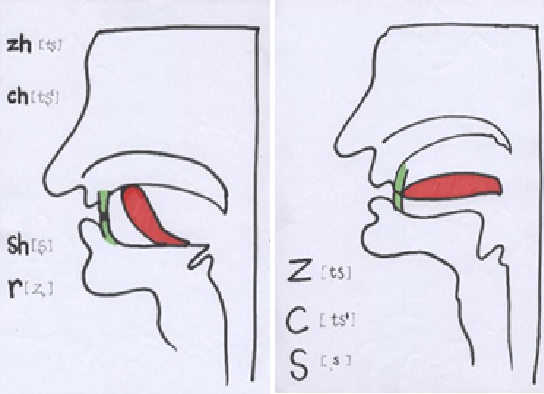
Notice where your tongue is.
4, Do practice follow the textbook
- 7 initials and 16 finals in lesson 3
- initial discrimination, eg, zu -- su, sui -- cui
- final discrimination, eg, su -- suo, wen -- weng
- discrimination of, zh -- z, sh -- s, ch -- c
- changes of tones of 一
Lesson four, practice - the left and overall (part 4, and all)
learning contents and goals
- left spelling of 16 initials and 11 finals (part 4)
- er, ueng (weng)
- dividing mark
- retroflex final
- Pinyin review and further learning
1, Spelling fo 16 Initials and 12 Finals
| b | p | m | f | d | t | n | l | g | k | h | |
| ai | bai | pai | mai | dai | tai | nai | lai | gai | kai | hai | |
| ei | bei | pei | mei | fei | dei | nei | lei | gei | hei | ||
| ao | bao | pao | mao | dao | tao | nao | lao | gao | kao | hao | |
| ou | pou | mou | fou | dou | tou | nou | lou | gou | kou | hou | |
| an | ban | pan | man | fan | dan | tan | nan | lan | gan | kan | han |
| en | ben | pen | men | fen | nen | gen | ken | hen | |||
| ang | bang | pang | mang | fang | dang | tang | nang | lang | gang | kang | hang |
| eng | beng | peng | meng | feng | deng | teng | neng | leng | geng | keng | heng |
| ua | gua | kua | hua | ||||||||
| uo | duo | tuo | nuo | luo | guo | kuo | huo | ||||
| uai | guai | kuai | huai | ||||||||
| uan | duan | tuan | luan | guan | kuan | huan | |||||
| un | dun | tun | lun | gun | kun | hun | |||||
| uang | guang | kuang | huang | ||||||||
| ong | dong | tong | nong | long | gong | kong | long |
2, Dividing mark and Retroflex final
Dividing mark
When a syllable beginning with a, o, e, follows syllable in such an ambiguous way that the division of the two syllables could be confused, it is essential to put a dividing mark ' in between, eg, Tiān'ānmén(天安门).
Retroflex final
The final er is usually attached to another final to form a retroflex final and when thus used, it is no longer an independent syllable. A retroflex final is represented by the letter r added to the final, eg, wánr(玩儿), huār(花儿).
3, Overall practice with the full picture
- discrimination
- tones
- listen
- readout
4, Suggestion on the next learning
Learning Pinyin and correcting pronunciation is a long process, and along with the whole process of learning Chinese. Most people, no matter the elementary level or advanced levels, have issues with pronunciation.
Also, the language is for communication, even if some pronunciation issues will not affect our expression of meaning and ideas. So, don't be discouraged, but keep trying.
At the same time, we say practice makes perfect(熟能生巧), we have to listen and speak more, let's find a Chinese native and talk with him/her, and talking and talking.
Responses • 0
0/2000
ID: 322
Matthias
Offline
1 day
Visited
From
Orlando, United States
Send Message