Facial Make-ups in Beijing Opera
Original
Chinese Opera
Mar 03 • 1470 read
Facial make-ups are not only a symbol of Chinese operas but also a symbol of Chinese culture with distinctive national characteristics.
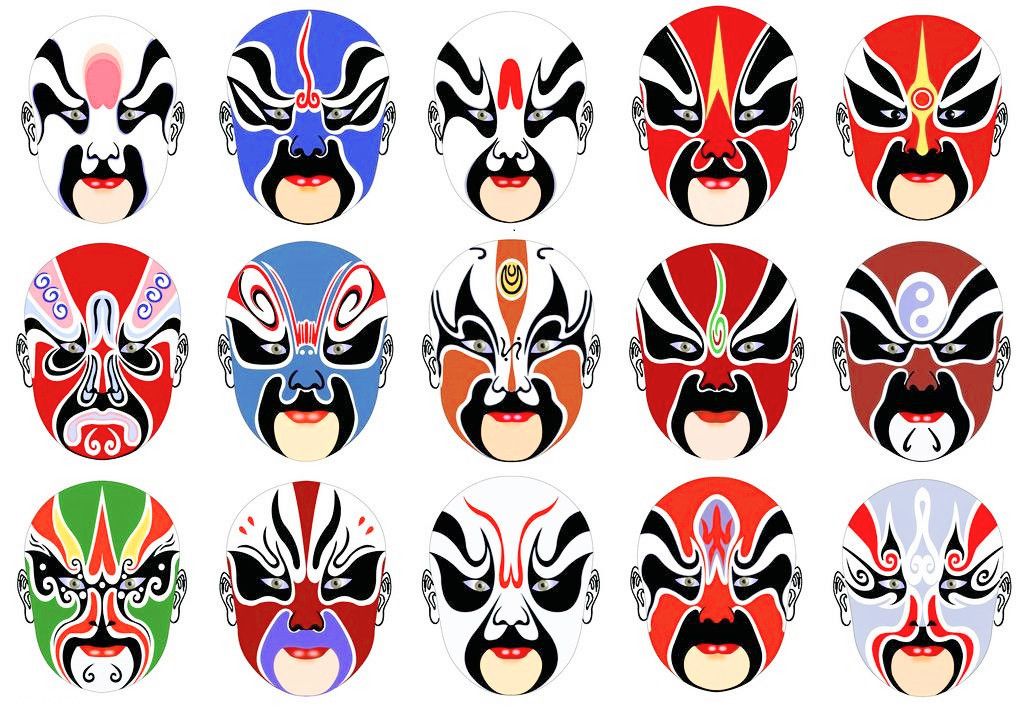
Speaking of Beijing Opera, foreign friends would first probably think of those colorful facial make-ups, and might be curious: Should Beijing Opera be something like the western masquerade ball? At such a ball, people can resume their original look right after they take off their masks. On the opera stage, however, people paint colors with various patterns directly on their faces. Since masks would hinder the performers to demonstrate the facial expressions on the stage, the artists delineate make-ups directly on their faces.
Facial make-ups are not only a symbol of Chinese operas but also a symbol of Chinese culture with distinctive national characteristics. The facial make-ups of Beijing Opera originated from life and in turn reflect life in an exaggerated manner. Containing strong symbolic significance, the facial make-ups indicates age, look, personality, character, status, professions, and others. Since the colors and designs of the facial make-ups convey specific meaning, they are famed as the Picture of the Soul.
The painted facial patterns of Beijing Opera usually include Full Face. Three-Tile Face, Cross-Shaped Face, Six-tenths Face, Fragmented Face. Twisted Face, Gold-Ingot Shaped Face, Buddhist-and-Taoist Monk Face, Ghost-and-Immortal Face, Animal-Shaped Face, Eunuch Face, and Clown Face, etc. The colors (primary color) and designs of the facial patterns also symbolize the personality of characters in the play. Foreign friends, who would like to understand the painted facial patterns at first glance, have to know the composition of different facial make-ups and the connotations represented by the colors and patterns.
The Colors of Beijing Opera Facial Make-ups
Red is used to portray a loyal, valiant and righteous character, such as the well-known general Guan Yu from the State of Shu-Han in the Three-Kingdom Period, who was brave and loyal all his lifetime and unyielding to evil.
Black is used to reflecting a role with unyielding integrity and reckless bravery, such as the fair and upright official Bao Zheng in the North Song Dynasty, who left himself an excellent reputation for generations to admire. Bao Zheng is very good at trying the cases as if he is the blue sky and the bright moon, and his the forehead is painted with a crescent moon indicating that he could hear the case of this world during the day time and try the case of the nether world during the night time. He is famed as "Justice Bao.”
White is used to indicate an insidious character, such as King Wei Wu, the treacherous paranoid Cao Cao, who killed a great many innocent people.
Yellow is mostly used to depict a savage personality, such as Dian Wei, the general under Cao Cao in the late years of the East Han Dynasty, who risked his life several times in harsh battles.
Blue and Green mostly represent the brave, courageous, rough, and fierce character, such as General Ma Wu, the Greenwood Rebel Army leader in the East Han Dynasty, who was sturdy and robust all his life.
Pink is used for the aged and weak characters, such as Lian Po, the aged general of the State Zhao.
Purple usually represents the brave and resolute character, such as Zhuan Zhu, the cold-blooded envoy, who assassinated Liao (Emperor of Wu) in the Spring and Autumn Period.
Gold and
Silver mostly reflect immortals and ghosts, such as "Erlang Shen"
Yang Jian and Great Ox King in the Beijing Opera of Journey to the West. However, the
rule to use the color of facial make-ups bears some exceptions and is somewhat
flexible. For instance, in the Beijing Opera Famen
Temple, the eunuch Liu Jin wears red make-up, which does not represent
bravery or loyalty, but his pampered life and arrogance.
Composition of Facial Make-ups in Beijing Opera
1. Full Face (整脸)
Full
Face refers to a pattern to paint a single color as the main color on the face
and delicately outline the eyebrows, mouth, nose and facial textures. For
instance, Guan Yu has a painted red full face with black eyebrows; Bao Zheng
has painted black full face with white eyebrows: and Cao Cao has painted white
full face with black eyebrows.
2. Three-Tile Face (三块瓦脸)
Three-tile face refers to a pattern to outline, on the basis of the full face, the eye socket and nasal fossa to make the face look like three tiles, or the Chinese character "品", also called "Three Dimples".
For instance, Ma Su, the general of the Kingdom of Shu-Han in the Beijing Opera of Loss of Jieting, adopted the painted facial a pattern of the white three-tile face, where he talked exaggeratedly and failed to defend the strategically important fortress of Jie Ting for the Shu-Han Kingdom, thus he was eventually executed by Prime Minister Zhuge Liang.
The forehead of Jiang Wei is painted with a Taiji diagram showing that he is good at using the method of ancient fortune-telling and apperceiving the tule of natural operation.
Also, in the Beijing Opera of Iron Cage Hill, the well-known General Jiang Wei Shu-Han Kingdom, who painted red three-tile face, swore to be loyal to Prime Minister Zhuge Liang and remained so even after Zhuge Liang passed away.
In the Beijing Opera Zhuangyuan Seal, Chang Yuchun, the distinguished general of the Red Scarf Army in the late Beijing Opera, was bold, brave and battle wise, so the purple three-tile face is applied.
The fragmentary three-tile face is based on the three-tile face by adding lines and colors to multiply delineate the lines of the eyebrow socket, eye socket, and nasal fossa.
Don Erdun, the son of Dou Zhizhong who was the subordinate of the rebel leader Li Zicheng in the late Yuan Dynasty. The eyebrow of Dou Erdun is painted with a hook pattern indicating that he pacifies the good people and drives out the rascal and is skillful at using the tiger-head twin hook weapon.
3. Cross-Shaped Face (十字门脸)
Cross-shaped face is painted on the basis of the three-tile face by drawing a straight black a line from the nose tip all the way up to the top of the forehead and connecting
both eye sockets with a straight line, thus forming a painted cross shape on
the face.
4. 六分脸
Six-Tenths Face
Six-tenths face is painted by applying the same color on the forehead column and the face below the eye, which makes the color on the forehead other than the forehead column take up 40% of the full face, and the color below the eye takes up 60% of the full face, creating a proportion of 4:6, thus it is called six-tenths face.
This
facial pattern is mostly used for seniors, such as in the opera of The Meeting of
Heroes, Huang Gai, a senior general of East Wu State in the Three
Kingdoms helped General Zhou Yu in East Wu State to trick Cao Cao with
"Ruse of Self-injury" - thus this idiom: Zhou Yu hitting Huang Gai -
one would like to hit, and the other would want to accept the hit. In the end,
they pretended to surrender and burnt the camp of Cao Cao's army, resulting in
defeating Cao's Army and laying down the structure of the tripartite balance of
the three kingdoms Wu-Shu-Wei. This was the famous "Battle of the Red
Cliffs” in Ming Dynasty.
5. Fragmented Face (碎脸)
Fragmented face evolved from the fragmented three-tile face, which omitted the main color in both cheeks and focused on the change of auxiliary color,is much more colorful than the fragmented three-tile face. It has diversified composition patterns, various types of colors, and complicated and fragmented lines.
For
example, in the Chinese history Golden Beach, Yang Qilang the seventh son of the
Yang family is heroic, valiant, and good at fighting in the battle between the
two armies of the Northern Song State and the State of Liao (a small state in
the north of the Northern Song State).
6. Twisted Face (歪脸)
Twisted
face is a facial make-up with asymmetric composition and colors, giving people
a sense of deflection and used to depict characters with special facial
features. For example, in the Beijing Opera Interrogating Li Qi, Li Qi’s face
is outlined to be twisted so as to portray that he is badly beaten.
Patterns of Facial Make-ups in Beijing Opera
In the facial make-up patterns of Beijing Opera, the patterns, just like the colors, also convey the characters' fates, personalities, specialties, use of weapons, or legends of the characters, etc.
For example, Xiang Yu, the rebel leader in the late Beijing Opera, who was absolutely valiant in the history, but ultimately defeated by Liu Bang, was a quite tragic figure so his face pattern is delineated as a crying face.
In the Qin Dynasty Zhongkui Marries off His Sister, Zhongkui's forehead is painted red. It is said that Zhongkui used to be a Jinshi in the Beijing Opera, and became ugly after he mistakenly entered the den of monsters when he came to Beijing to attend the exam so that he failed in the Tang Dynasty exam. He was so enraged that he knocked himself to death at the Houzai door and Emperor Yu Huang conferred him with the title of the God of Subduing Demons. Hence, his face is painted red showing that his head is bleeding.
1. Buddhist Monk's Face (僧脸)
The Buddhist Monk's face is generally outlined with bean eyes, fragmented nasal fossa, and a fragmented mouth as well as a red Buddhist relics bead on the forehead indicating that he is converted to Buddhism.
The
colors of this pattern are classified into white, red, yellow and blue, etc., of
which white is more common. For example, in ancient Chinese novel Outlaws of the Marsh, the monk Lu Zhishen is clear-cut
on what to love and what to hate, do boldly what is righteous, rescue the
desperately poor and help those who are in difficulty, and abhor evils as
deadly foes.
2. Taoist Monk's face (道士脸)
The
Taoist monk's face is drawn in the forehead with a Taiji diagram or Bagua
symbols showing his Taoist identity, such as Li Tieguai in the imperial palace The Beijing Opera
Crossing the Sea, which tells a story of eight Taoist immortals in
their own way to cross the sea.
3. Clown Face (丑角脸)
The
clown face which features a white patch in the center of the character's face with
such shapes as bean curd, peach, jujube flower, kidney, or chrysanthemum, etc.,
for example, Tang Qin in the Eight Immortals Examining the Head and Assnssiminng Tang, who
longs for the concubine of his benefactor Mo Huaigu and framed his benefactor.
4. Pictographic Face (象形脸)
Pictographic
face is picturized with the whole bird or beast or it's characteristic part on
the face, usually used for the fairy tale drama. The composition and color of
this makeup is based on the image characteristics of each elf and genie
without any fixed pattern, but emphasizes being expressive, so that the audience can understand at the first glance what kind of immortal or genie is.
The most representative character is Sun Wukong making havoc in heaven in the
Beijing Opera Journey to the West.
5. Eunuch Face (太监脸)
The eunuch face is used to exaggerate those eunuchs who usurp power and persecute people. The sharp eyebrow means the treacherousness, kitchen-knife shaped Orbita means cruelly oppressing and exploiting the common people, and the downward mouth indicates his cruel and vicious character. It is red or white. For example,in the Beijing Opera Femen Temple. Liu Jin the eunuch in the Ming Dynasty is painted with a circle on his forehead indicating that he is castrated and is a Buddhist, and the fat grains on his forehead and at his both cheeks depicting the expression of the idle rich who lives comfortably.
In
short, the make-ups of Beijing Opera are diversified so that they can fully
express the character's distinctive personality, even for the same character,
different ways are applied to delineate the make-up in different plays. For
example, in the Beijing Opera Havoc in Heaven,
the Monkey makes havoc in the heavenly palace and the Jade Emperor
confines the Monkey in the Bagua furnace used by Taishang Laojun to practice
the ever-young alchemy pill. Before the
Monkey is put into the furnace, his eyes are painted in pink. However, his eyes are painted in gold when the Monkey escapes from the furnace, symbolizing that his eyes have been refined into the piercing eyes.
The make-up of Beijing Opera is an art, which shall not only vividly manifest each character's personality, but also present to the audience with a sense of beauty, so the make-up painting is a piece of very deep knowledge. Although there is a spectral pattern to sketch the character in Beijing Opera, each the actor creates the make-up with a vivid effect according to his own face as well as his understanding of the character, therefore, to paint the facial make-up is also one of the difficult arts of Beijing Opera.
Dear foreign friends, are you now interested in the colorful make-ups of Beijing Opera? In addition to the Beijing Opera stage where we can see the make-ups, we can also see the make-ups of Beijing Opera everywhere in our real lives, such as in Chinese embroidery, paper-cut, decorative painting, stamps, T-shirts, which take Beijing Opera as the subject matter. The Beijing Opera art has penetrated into every corner of the world. The world-famous tenor Pavarotti once asked the Beijing Opera actor to draw the make-up of Xiang Yu the King of West Chu on his face. If you are also interested and have the chance to watch Beijing Opera performances, you may go to the backstage to have a look at how the actors draw the make-ups. If you are in high mood just like Pavarotti, you might as well ask the Beijing Opera actor to paint a make-up on your face!
Responses • 0
0/2000
ID: 322
Matthias
Offline
3 day
Visited
From
Orlando, United States
Send Message