Chinese new year 2020
Original
Chinese Festival
Dec 18 • 379 read
In 2020 the Chinese New Year falls on 25 January 2020, beginning a year of the Rat. The China public holidays start from January 24 until January 30, 2020.
Chinese New Year, which is also known as ‘Spring Festival’ or ‘Lunar New Year’ is China's most important festival and most significant holiday period. In 2020 the Chinese New Year falls on 25 January 2020, beginning a year of the Rat. The China public holidays start from January 24 till January 30, 2020. The Chinese New Year celebrations last for a week, and there is decoration, lots of food, family reunion dinners, gift-giving, and visiting with family and friends.
Important dates
Every year Chinese New Year falls on a different date, but it falls from January 21 to February 20. In 2019 the Chinese New Year was on February 5, while in 2020 it will fall on January 25. Chinese New Year is vital in popular Chinese astrology, and for Chinese people, years starts at Chinese New Year, instead of January one. The year 2020 is the year of Rat which will begin on January 25th, while 2021 will be the year of Ox which will start on February 12th. Below are some of the important dates during the 2020 period of the Chinese New Year.
Solar Date Lunar Date Title
January 17th December 23rd Little Year
January 24th December 30th New Year's Eve
January 25th January 1st Spring Festival
February 8th January 15th Lantern Festival
Chinese New Year - celebrations
The main Chinese New Year celebrations include putting up decoration, eating reunion dinner with family, fireworks, and giving red envelopes and other gifts. These four celebrations are discussed below in detail. In Chinese cities, from New Year’s Day, traditional performances can be seen, such as lion dances, dragon dances, and imperial performances like an emperor wedding. A variety of traditional Chinese products are on offer, and rarely seen Chinese snacks. City and temple fairs are the places to go for this.
Chinese New Year - family time
Chinese New Year is the time for families to get together. Most of the younger generations of the family pursue their education or career in big cities like Shanghai, Beijing or Guangzhou. But no matter wherever they are, their family expects them to be home to celebrate the New Year with families. Also, the New Year holiday could be a chance for them to meet their parents and relatives. Chinese people have a custom of staying up late on Chinese New Year to welcome the New Year's arrival. After the family reunion dinner, families often sit together to watch the Spring Festival Gala; one of the most-watched TV shows in China. Also, most of the people send red envelopes through Wechat. It is an important tradition to made dumplings on Chinese New Year eve because it is believed that the dumpling shape represent ancient Chinese ingots, so it is believed that the more dumplings you eat during Chinese New Year, the more money and the more significant fortune you could earn in the coming year. Also, many other dishes such as fish, Nian Gao on the table symbolize good fortune, luck, and wealth.
Chinese New Year - decoration
Every street, house, and building where Spring Festival is celebrated is decorated with a bright and loud red color. The primary color for the festival is red because the red color is believed to be an auspicious color. The Chinese people, in general, love the red color as it represents good fortune and happiness. People hand red Chinese lanterns in streets, red couplets are pasted on doors, and official buildings such as banks are decorated with red New Year pictures depicting images of prosperity. A month before of Chinese New Year people start decorating public places, while the home decoration is usually done on Chinese New Year’s Eve. In 2020 the Chinese New Year will be a year of the Rat; hence, most of the decorations related to rats will be commonly seen. There are various gods includes in Chinese folk religion, but one type is Door Gods. During Chinese New Year paintings of these gods are pasted onto the main door of the home. Also, people decorate by hanging up some words such as with the word fu, which symbolizes good fortune and happiness. These words often are written on a red square piece of paper, and then people past on doors, walls or windows.
Chinese New Year - firecrackers
During the Chinese New Year period, it is a necessary custom to set off firecrackers and fireworks. With firecrackers, the Chinese New Year celebrations would not be complete. Traditionally, firecrackers were initially used to scare away evil spirits. According to the Chinese legend, a monster known as Nian would come out to eat villagers and destroy their homes on New Year’s Eve. The villagers found that burning dry bamboo to produce an explosive sound scared away the Nian. Since then, it has become a tradition at Chinese New Year. Today, lighting firecrackers and fireworks are a major tradition to celebrate the coming of the New Year, and also a way to improve the festive atmosphere. Before the reunion dinner on New Year, many families light firecrackers to invite ancestors to celebrate the festival together, and that adds a jubilant atmosphere to the festival. Also, it is customary to set off fireworks at midnight to scare away evil spirits and celebrate the coming New Year.
Chinese New Year - red envelope
During Spring Festival Chinese people exchange money that called red envelope, or red pocket. It is also known as ‘lucky money’ or ‘New Year’s money’. By giving money to the kids, elders hope to pass on a year of blessing and good fortune. The younger generation gives another version to their elders as a blessing of longevity and a show of gratitude. Also, married couples give red envelopes to unmarried friends to transfer luck. In Chinese rural areas, the tradition of New Year gifts giving is still in practice; however, the new generation prefers to receive red envelopes. That is why red envelopes are the most popular gifts during the New Year. The envelopes are considered to bring fortune and good luck because they are red. Traditionally only employers give red envelopes to working adults.
2020 Chinese New Year - day by day guide
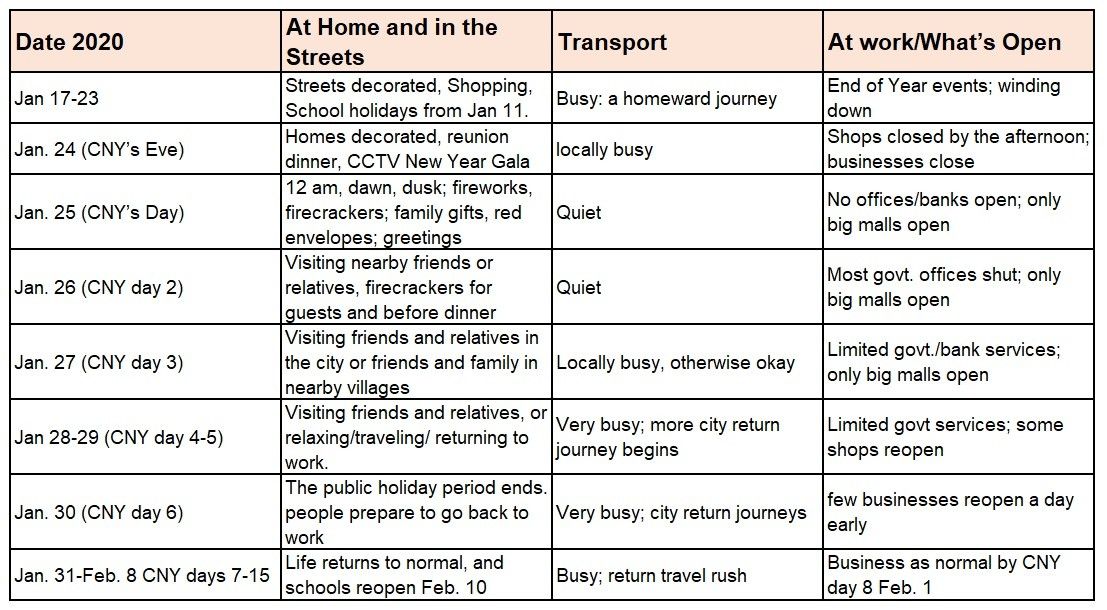
Public institutions and businesses in China take seven days of New Year holidays. However, public transport, large malls, tourist attractions, restaurants, and hotels will open as usual, or even stay open longer. Also, see when transport will be busy and when local customs are due to happen.
Chinese New Year - taboos
Traditionally, Chinese people believe that the year beginning affects the whole year, so the Chinese Spring Festival is a season of superstitions and taboos. Chinese New Year involves somber ceremonies to wish for a good harvest, and also some strict rules and restrictions. All words with negative meaning such as sick, death, poor, pain, and more are forbidden. Before the New Year, there is a day of cleaning, and that is about to sweep away the bad luck. But during the New Year celebration, it is forbidden to sweep or clean. Throwing out garbage or cleaning is believed to sweep away good luck. Scissors and sharp objects are forbidden to use because it is believed that it will cut the stream of wealth and success. That is why most of the hair salons are closed during the holidays. Asking debt repayment is a taboo until the fifth day, it is thought that it brings bad luck. It is forbidden to give New Year blessings to someone who is ill and still in bed; otherwise, he/she will be bed-ridden for the entire year. It is suggested that to avoid fight and crying, and issues should be solved peacefully. This is all about to ensure a smooth path in the New Year. Giving gifts with unlucky words, colors, numbers or meaning is considered unlucky, and it should be avoided.
Responses • 0
0/2000
ID: 322
Matthias
Offline
2 day
Visited
From
Orlando, United States
Send Message