Beijing Opera Props
Original
Chinese Opera
Mar 05 • 2239 read
In Beijing Opera, many scenes will be reflected through the actor's recitative and body movements; this is the virtuality and fiction of Beijing Opera props.
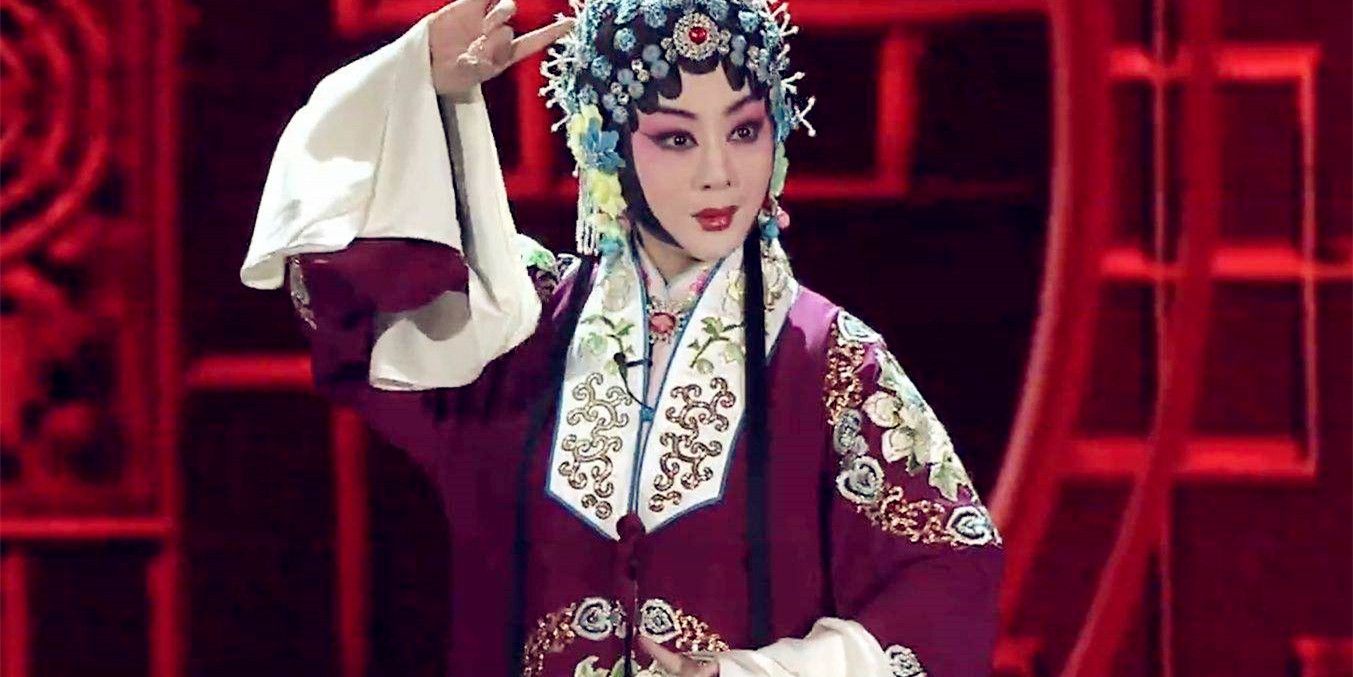
The realistic western drama moves the original life to the stage. In order to show the realistic life, some western drama director even drag the tall and strong horse onto the stage, or with a thick rope pull a ship to sail on the stage where the paddle is made into a hollow, inside filled with water, and we can hear the sound of water when the ship is paddled. However, we often see such scenes on the Chinese opera stage: as the curtain slowly opens, the stage is absolutely empty.
The character walks a few steps to the rhythm of the gong and drum, holds a horsewhip, and looks up and says: "This is the premier's mansion." Then he raises his leg to do a posture to get down from the horse, then does an action to hitch the horses and lays the whip on the floor, and facing to the side curtain on the right side of the stage does an action to knock the door and says: "Open the door!" This series of movements mean that a horseman arrives at the Premier’s mansion to see the Premier.
By here, the foreign friends have been confused and ask: "Where is the horse and where is the door? And where is the luxurious residence of the Premier? Isn't the stage empty?" In this scene, the whip refers to the horse. The whip is made from rattan with the handle painted gold, wound with thin threads, and hung up red, yellow, white, black, pink, and other color silk tassels. Generally speaking, red means the red mane horse, yellow refers to the horse with yellow hairs and white dots, white refers to the white dragon horse, black refers to the Wu Zhui horse, and pink refers to the pink horse. The actor stands on the left leg, slightly strides the right leg. and lifts the whip, demonstrating the gesture of mounting the horse: dances by waving a whip, indicating gallop of the horse; holds the whip without dancing, demonstrating leading the horse. There is no door or residence on the empty stage, which will be reflected through the actor's recitative and body movements.
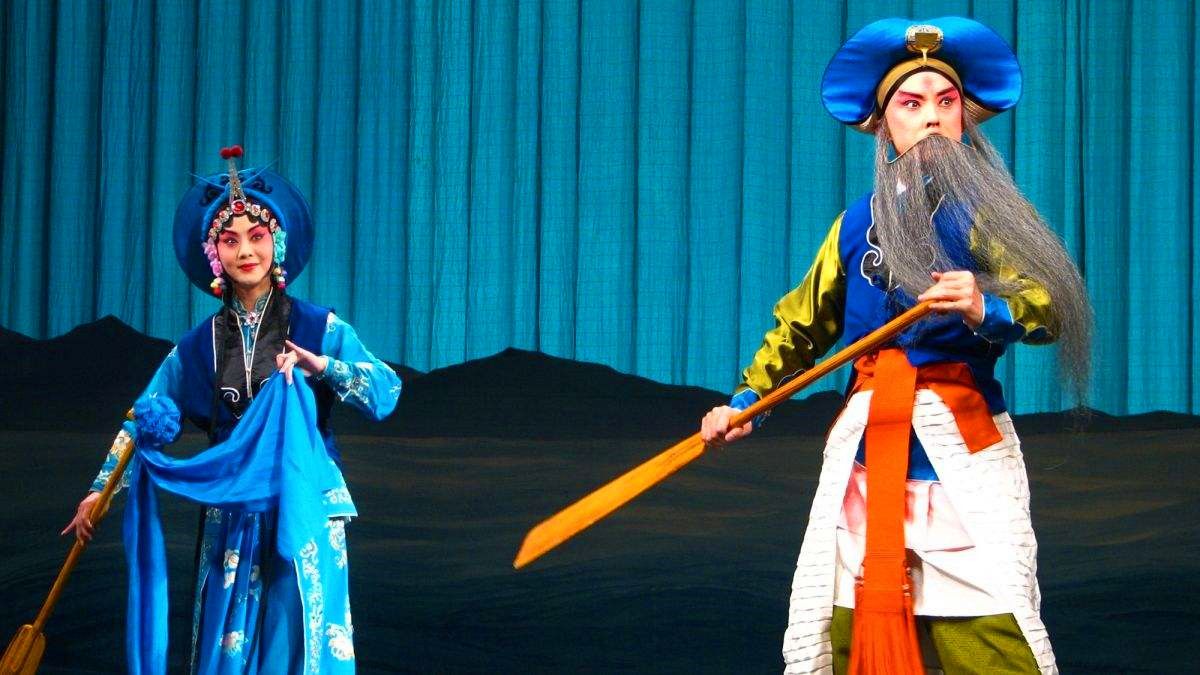
When we watch the Beijing Opera Fisherman’s Revenge (打渔杀家) again, there will be a scene in which Xiao En and his daughter are fishing. At the back of the curtain, Xiao Guiying sings: Scull the boat to go down the stream", and then Xiao En shouts out: "Go sailing!" The orchestra plays the sound of water by beating the gong and drums, and the father and his daughter come out, each holding a wooden paddle,in front Xiao En steering the helm and at rear Guiying sculling the oar with a colorful painting. The two take a pose one high and the other low, sculling the oar and sailing the boat, one in front and the other at the rear, one on the left and the other on the right to run around the stage, demonstrating that the fishing boat bumps along the rough.
This is a manifestation of sailing the boat, but there is neither a ship nor water on the stage. In the play, the wooden paddle refers to a ship and the stage performance completely relies on the actor to give people a sense of sailing in the boat. All these have to appeal to the audience's imagination by imagining that there is on the stage a horse, a door, the premier's residence, and a boat, as people often say that on the Beijing Opera stage, there is nothing, but there can be anything.
If there is no true window or stairs on the stage, the actor has to perform the acts of opening the door, closing the door, opening the window, and going upstairs and downstairs, giving people a sense that there are doors, windows, and stairs. If you want to show the march and battle, the four extras on the stage, who act as the soldiers and military servants, also known as walk-on (龙套) parts, represent a powerful army. The four extras lift up the banners, some armor-clad generals stand on both sides, and the commanding marshal holds the command flag sitting at the center. When the marshal shouts out: Go forward", the gongs and drums sound, Suona band also begins to play, and the generals and soldiers go around the marshal for one lag; and when the music ends and the marshal orders again: "Line up,” it suggests that the army has arrived at the battlefield. No matter how magnificent the scenes are. Beijing Opera can create such an atmosphere by using only over 10 persons, and in a few minutes, as it is so-called "Three or five steps may walk across the world, and six or seven people can be a mighty army." This is the virtuality and fiction of Beijing Opera props. In contract with solid, virtual refers to things that do not exist, and fiction is imitation.
Xun Huisheng. one of the Four Great Dans of Beijing Opera said that the virtuality is an activity by which an actor on the stage does not rely on physical objects, but uses gestures and acts to depict and imitate the life. Just because the Chinese opera is virtual, the audiences can maximize their imagination, and along with the actors’ performance, imagine the stage as the scene in the play. The stage is limited, but the human imagination is infinite.
On an ordinary stage, you can fully imagine il is the boudoir, bridal chamber, an imperial court, government office, temple, teahouse, pagoda, solitude, mountain and river, lake and sea, or heaven and hell. Different locations, environments, and times can be converted through the actors' performance and music change. Even within a drama, the stage can change to different scenarios, for example, in the Beijing Opera Havoc in Heaven, the stage atmosphere changes, with the Monkey's somersault cloud, into the temple for a moment, into a battlefield for a while, and then into the Mountain of Flowers and Fruits. It is absolutely amazing.
In the Beijing Opera Picking up the Bracelet, there is a very famous excerpt, which is about Sun Yujiao's feeding chickens on the stage. Sun Yujiao drives the chicken out to feed on the stage, but there are no real chickens on the stage. Through her acts of driving and feeding the chickens, the audience feels that there is really a flock of chickens on the stage.
Accidentally the chaff blown by the wind gets into Sun Yujiao's eyes, and she rubs her eyes with a handkerchief. She looks at the chickens snatching the food, and by counting, finds out that one chicken is missing. She looks for the chicken everywhere inside and outside of the house and finally finds it hiding under the table.
When the famous Chinese opera actor Yu Lianquan played this scene, the audience can clearly distinguish whether the chickens on the stage were chick biddies or old chickens, how much they were, and which one was the naughtiest. By using the virtual characteristics of the Chinese drama stage, and completely relying on his superb acting, Yu Lianquan won high praises of foreign audiences and obtained international awards.
Although the Beijing Opera stage is virtual, there are some real props, like knives, swords, flags, whips, paddles, stoves, the Four Treasures of Study, the weapons in actors' hands, etc. The actor can create, with these props and through the performances, different virtual scenes, and it is a void and solid combination or false and true co-existence. Among the physical properties on the Beijing Opera stage, the most common props are a table and two chairs, i.e., a table and two chairs set on the stage together with the decorative silk fabrics covering the table and chairs, and they are all visible objects, which can, however, create different virtual scenes.
Generally speaking, we call the universal one-table and two-chair a symbol of the indoor space, which may be a study room, the imperial court, a hall used for interrogating the criminals, a luxury residence, or a general's tent, or may also, be a noisy tavern. The difference is that if it is a refined study room, the silk fabrics put on the table and chairs are light blue, and the embroidery patterns are a few strands of orchids; if it is a palace, the patterns of the silk fabrics are the embroidered flying dragons; if it is in a military tent, the color and patterns of the silk fabrics need to be more magnificent and enthusiastic; and if it is in a noisy place such as a pub. the silk fabrics need to be bright and gaudy. When we change the color and patterns of the silk fabrics covered on the table and chairs according to different environments, a table and two chairs represent totally different scenes.
Besides, to change the way to place the table and chairs can also achieve the same purpose. For example, to put the chairs behind the table is to demonstrate a solemn occasion when the emperor holds the court, the general deals with the military affairs or an official holds the court trial; to put the chairs in front of the table is to manifest the common people's home life; to place the chairs on either side of the table are to illustrate a situation when a guest arrives, the master invites the guest to sit on the left chair while the master sits on the right chair to show respect to the guest because of the Chinese people regard the left as respect.
Moreover, the table and chairs can represent a lot of things respectively. A table is sometimes a bed to sleep, and sometimes a tool to climb up and look far. It can also be a bridge, tower, mountain, slope, and terrace, and can even be the clouds at the foot of the Monkey King. The chairs are not only the sitting tool but also the weapon used by the characters in the play to fight each other. In short, a table and two chairs become a symbol of the art of Beijing Opera, and its impressionistic characteristic is adequate enough to release the endless passionate imagination of the audience.
Finally, the foreign friends who want to see a Beijing Opera performance also have to know the rule on how to pull the curtain. In the past, the Beijing Opera stage did not have the big curtain, and the audience could see the entire stage: today, the most outside of the Beijing Opera stage is a large velvet curtain, which is used to hide the stage before the performance. Sometimes during the performance, another curtain may be pulled up, known as the “the second curtain,” which is used to shelter some preparation work behind the scene such as displaying the table and chairs, and the actors' changing their dresses, while sometimes actors may play in front at the same time, thus making the Beijing Opera performance is more compact.
As Beijing Opera does not take the act system but the breakout system, once the curtain opens, it means the start of the whole play. Each time the second curtain closes, it means the end of a scene. While the curtain of the western drama stage opens each time, it means the start of an act. Once this act ends, the curtain will slowly close down, or the whole hall turns dark. In a Beijing Opera play, there are at least 10 scenes or more than twenty or thirty scenes, so the second curtain opens and closes frequently. The second curtain looks gossamer and charming.
Dear foreign friends, do you now understand the rules of Beijing Opera performances? Simply put, after the curtain opens and before the actor appears on the stage, the stage itself does not mean any time and place until a character in the play appears. Through the character’s recitative and singing together with the audiences' imaginations, the audiences will know whether, in this play, the stage is his study room or somewhere else.
So, the Beijing Opera performance takes place on the empty stage, and relies on the actors' virtual action together with the audiences' imagination to complete, which requires high diathesis of both the actors and the audiences. The void-solid combination of props in Beijing Opera creates the varieties of unlimited space, both the limited stage space and the audiences' infinite fantasy space. Compared with the realistic western drama, the Beijing Opera stage clearly reflects the reserved oriental character.
Responses • 0
0/2000
ID: 322
Matthias
Offline
1 day
Visited
From
Orlando, United States
Send Message