4 Skills of a Beijing Opera performer
Original
Chinese Opera
Mar 18 • 4364 read
From The Phoenix Returns to Its Nest (a classic play of Beijing Opera), know the 4 necessary skills of Beijing opera performance - Singing, Recitative, Acting, and Acrobatic Fighting. (唱念做打)
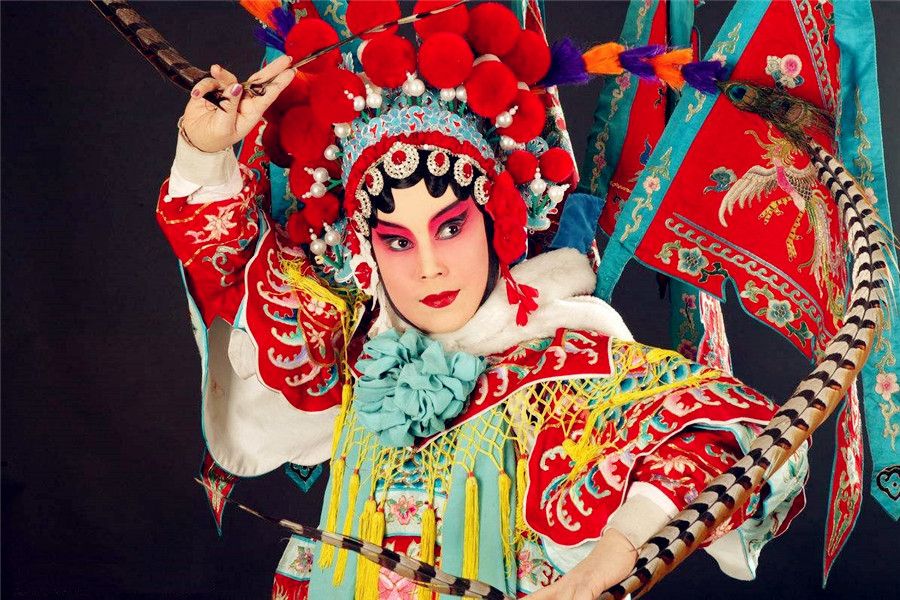
When strolling in the Chinese royal garden, or feel free to watch a Chinese cultural shirt or a Chinese paper-cutting, the foreign friends often see a pattern with the phoenix picture. Like the dragon, the phoenix is the mythical animal in the Chinese ancient legends as the symbol of good luck and happiness. In so many Beijing Opera repertoires, there is a play not only from a beautiful legend, but also related to the phoenix in the Chinese ancient myths, and that's The Phoenix Returns to Its Nest, the representative repertoire of Mei Lanfang.
This is a light comedy full of wit and humor. The Phoenix Returns to Its Nest euphemistically expresses, by describing a sad and happy love story in the years of the late Ming Dynasty of China, people's love towards truth, goodness, and beauty. This play has complete types of role, basically embracing all sorts of performance styles such as singing, recitative, acting, and acrobatic fighting (四功). It can be used as a classical repertoire for foreign friends to understand Beijing Opera.
As the name implies. The Phoenix Returns to Its Nest means letting the phoenix go back to its original nest, symbolizing that the pretty girl has got her to wish to marry a longing man. The play is a story that took place in the late Ming Period. Cheng Pu. Shilang of the Ministry of Defense (equivalent to today's deputy Defense Minister), had two daughters. One was born by his concubine and named Xue'e, who was very pretty and smart and beloved by Cheng Pu; the other was born by his wife and named Xue Yan, who was ugly and loved to eat and play every day. Xue Yan was the elder sister, and Xue'e was the younger sister.
One day. Cheng Pu met the old friend's son Mu Juyi who was handsome and graceful and wanted to choose him as Xue'e's husband, but his wife wanted to marry Xue Yan to Mu Juyi. When Cheng Pu celebrated his birthday. Mu Juyi came to offer birthday felicitations and tarried in the study room of the Cheng's family. At nightfall, his wife sent Xue Yan to feign Xue'e to meet with Mu Juyi secretly in the study room. Mu Juyi found that Xue Yan was very ugly, mistakenly conceived that Cheng Pu cheated on the marriage, and fled overnight. Just then. Mu Juyi was appointed by the government and left home for his position.
At that time, a royal descendant Zhu Huanran who coveted Xue'e for some time noticed Mu Juyi's leave and took the opportunity to feign Mu Juyi go to Cheng's home to marry Xue’e. Cheng Pu's wife took it for gospel truth, and let Xue Yan feign Xue’e to get married. In the bridal chamber, the two found out that both were impostors. Though they regretted, they could not tell about their sufferings. The two ugly finally matched a pair. Soon after that, the insurrection arose, and Cheng Pu's wife went to the Zhu's home for refuge. While Xue'e refused to go because of Zhu Huanran’s previous misconduct. Cheng Pu squashed the insurgence, and took Xue'e to the army, while Mu Juyi happened to join the army there. Cheng Pu talked about the marriage again, but Mu Juyi resolutely turned down. Cheng Pu realized that Mu Juyi misunderstood Xue'e, and insisted on the marriage. In the bridal chamber. Mu Juyi saw the real beautiful Xue’e and was overjoyed, however, at this time, Xue'e felt wronged for Mu Juyi's previous refusal. Mu Juyi apologized repeatedly and furnished the full explanations. The young couple of a perfect match finally got married.
1, Singing 唱
The western drama is usually based on dialogues, while Beijing Opera gives people a deep impression that the actors keep on singing, and the audience seems to be never tired at the actors' singing. It’s true that singing is the major means of Chinese opera performance. Singing can not only express the character’s emotion and express the character's thoughts but also unfold the story and put forward the narration. Just because Beijing Opera incisively expresses the character’s emotion through a large number of songs,the Chinese traditional opera is regarded as the lyric drama. On the other hand, as it narrates meanwhile expressing emotions, and often employs singing to deduce the story and advance the plot, the Chinese traditional opera is regarded as a main narrative language system.
Different operas have different characteristics of singing. Beijing Opera has such main arias as Erhuang, Xipi, and Gao Bozi and the different aria has a different expressive effect. For example, Erhuang is relatively flat, stable, deep and smooth, and it is suitable for embodying such moods as meditation, sadness, grief, and lament, so it is mostly used for the tragedy. Xipi tune is lively, bold, powerful and sprightly, suitable for expressing cheerful, resolute, grievous moods. Each role type of Gao Bozi can sing, freely pause the musical sentence, and does not have many constrains on the format, suitable for expressing passionate, grievous feelings. Different arias together with beautiful lyrics make Beijing Opera exotically charming.
Let's
look at a section of lyrics sung by Guimen Dan Cheng Xue'e who wants to look
for her father in the army:
I should have gone with my mother to the capital to seek refuge, but I walk randomly. It’s shameful as I am especially reluctant to see my elder sister’s husband. I hate Zhu Qiansui for his misconduct. That day he cheated me, but he happened to walk into the trap set by my mother. If I go to see him again today, will he let me go? My mother shall not be one-sided, and I want to explain something. It is said that the daughter's chasteness is of utmost importance. If someone does not care for his face, he is useless to live m the world. The robber started to rebel only for the property and money. Once the robber gets the property and money, he may not necessarily harm the person and create a feud. If I do not encounter distress, I will unite with my parents; if I do encounter a distress,my father surely will make an inquiry. Now that my wish has been fulfilled and I have a pure and clean body,so I am very happy even if I shall die. I know that I must watch out the trap, so I come to the army to explain before my father.
According to the lyrics, we can see the development of the plot, which twists and turns ups and downs. Xue'e should have gone with her mother to seek refuge in Zhu Huanran's home, but because of his misconduct, she didn't want to go even if she has to die, so she chose to go to the army to find her father to explain what. Not only that, but we also can, through the lyrics of "I walk randomly, and it is very shameful”, “the daughter's chasteness is of utmost importance. If someone does not care for his face, he is useless to live in the world", and " I have a pure and clean body, so I am very happy even if I shall die", see Cheng Xue'e's chaste nature. She would rather die to keep her body chaste and from being sullied by Zhu Huanran. Meanwhile, we can also feel the social moral standards from her lyrics, as a woman can not walk around away from home, and should try to avoid contact with the misdemeanant. Mei Lanfang sang these lyrics in a sprightly and mellow manner with unique characteristics and fully displayed the pure and immaculate traits of an honest young ancient Chinese girl.
Xue Yan in The Phoenix Returns to Its Nest is treated as a clown Caidan role. Cheng Xueyan looks ugly, does not like study, likes to shoot from her lips, and behaves indecently, but she has a passion same with that of an ordinary person to seek the beautiful love and happy life. So before others, she will deliberately show her reserved manner of a maiden and identity of an official's daughter,and at the same time, she also has a certain wisdom to face unexpected change, and is able to size up the situation and do things fit. Cheng Xueyan’s main scenes include 1, appearing on the stage, 2, in the study, and 3, in the ugly bridal chamber. Of which, the most exciting part focus on the two scenes appearing on the stage and in the ugly bridal chamber, adding the comic effect for the whole play. The civilian clowns in the play are not like other types of a role requiring stylized performance and restrain, and their singing can be very flexible and may also imitate, according to the scene and the plot, the arias of other types of the role of Sheng, Dan, Jing. For example. Cheng Xueyan's singing in the ugly bridal chamber "Tonight you should fold the quilt and make the bed with me" can use the whimpering and plaintive sound to dispose of the tone, in order to achieve the comic effect.
Let's have a look at a section of lyrics murmured by Cheng Xueyan to herself when she received her mother's orders, and peeped at Mu Juyi in the study room:
日前领了严亲命,
I just
took my mother’s strict order
命奴家在帘内偷覷郎君,
to peep at the youngster behind the curtain.
只见他美容颜神清骨俊,
I sec
that he is very handsome and good-looking,
实可叹衣褴褛家道清贫,
But he
wears shabby clothes and comes from a poor family.
倘若是苦用功力图上进,
If he
studies hard and aspires progress,
也能够功名就平步青云。
He may
win a high position and have a meteoric rise.
According to the lyrics, we can generally figure out Cheng Xueyan's inner minds. She most likely thinks whether Mu Juyi's family situation can match her. After she sees that Mu Juyi comes from a poor family, she thinks again that if he can bear hardships and work hard to aspire progress, one day he might rapidly go up. Comparing Cheng Xueyan and Cheng Xue’e's lyrics, we can clearly see the totally different characters of the two protagonists: Xueyan cares about the family condition and future of the would-be husband, but does not care about her own behavior, while Xue'e focuses her attention on her own quality: Xueyan's acts are coy and wretched, but Xue'e's behavior is natural and graceful: Xueyan's language is rustic and shallow, but Xue'e's language is gentle and elegant. Through such totally different librettos, the characteristics of different types of roles in Beijing Opera suddenly leap out before the audience.
Beijing
Opera artists usually pay special attention to singing. In different themes of
the play and indifferent arias, they are particular about choosing what kind
of aria and achieving what effect, when the character shall sing and what to
sing and how to sing. The enduring famous section like this is the first-rate
works thoroughly tempered by artists of several generations. The fans are the
same, and they are so familiar with many Beijing Opera famous sections so that
whenever the actors sing the section they are familiar with, they often narrow
their eyes, wag their heads, carefully taste with the pace, and go into an
intoxicated state. So, "people used to go to the theatre" is not
called "to watch the opera", but it is called "to listen to the
opera”. You can see that singing in the Chinese traditional opera is of great artistic charm.
2, recitative 念
In Chinese traditional opera, the speech delivered by the character on the stage is called recitative or speaking. Recitative is actually a musical speaking, which plays a very important role in the opera performance, and can also be used to develop the story, display the temperament of the character, and express thoughts and feelings of characters. There is a saying in the drama circle that recitative is worth one thousand jins (jin is a Chinese measurement, and one jin is equal to 0.5kg) and singing is worth 0.4 jin. It is adequate enough to show which one is more important in opera performance. While the westerners often think that such opera with singing and recitative is very strange.
In 1735. the Orphan of Zhao translated by French Majose (Joseph de Premare. 1666 - 1735) omitted all the lyrics used to sing. The translator presumably thought that singing and recitative should not be so entangled together, because in Europe there were no recitatives at all in a lot of singing plays, nor was there singing in the recitative plays. This was not only a misunderstanding by westerners towards the Chinese traditional opera due to different cultural traditions, but also reflected the characteristics of recitative an artistic means in the Chinese opera different from others.
Recitative Beijing Opera includes dialogue, monologue, interruption, and narration, etc. Dialogue is the speech between the characters in the play, and basically belongs to the prose style, but also has a very strong rhyme and rhythm. A monologue is used by the character to account for his inner heart activity or to introduce himself, similar to large sections of a monologue by Hamlet in Shakespeare's works. Interruption refers to interrupted words between the lyrics and generally, is not too much. Beijing Opera recitative is divided into two main categories according to phonology: one is the rhythmic recitative, which speaks literary words with Huguang accent and Zhongzhou rhyme, and Xiao Sheng, Lao Sheng. Lao Dan. Qing Yi. and Hualian speak rhythmic recitatives to display a serious, solemn expression; the other is called Beijing dialogue based on the Beijing dialect and close to the colloquial language, mainly used by Hua Dan, Cai Dan, clown, eunuchs, to demonstrate lively, humorous contents and emotions.
Rhythmic recitative of Beijing Opera is full of charm and melodic rhythm. The rhythmic
recitative in the opera The Phoenix Returns to Its Nest is not only beautiful
in form but also is easy to understand. To narrate an event by the rhythmic
recitative can not only achieve a clean and clear effect but also reflect
the character's disposition, emotion, and thought. For example, Guimen Dan Xue’e's
rhythmic recitative "a person shall not cheat, or it will result in harm
to himself' not only clearly displays the character's inner perception, but
also inspires and enlightens people, and transfers the education information.
And her another rhythmic recitative "that day, Zhu Qiansui came to frame
me. but did not succeed. Today, if I go to his home, how could he let me not be
sullied. Better not to" shows her inner peace, and also her resolute and
supple-outside and strong-inside character. Recitative is especially important
to the civilian clown. In most repertoires, most of the recitatives spoken by
the clown are the Beijing dialect dialogues and their styles are close to daily
life and colloquial language. In the play, when the mother rebuke Xue Yan's
behavior is not as good as her sister. Xue Yan recipes that: "Oh, you said
my sister looks good. Of course, my sister was brought up by the 2nd mother,
and I was raised by you. Well, look at
such an appearance of yourself, and raise me like this. Am I sorry to you,
ah!?" According to the recitative style, Xue’e's recitative is elegant and
Xueyan's recitative is vulgar, and the theatre effect is very obvious. Xue'e’s
elegant words all show her solemn, virtuous qualities, and Xueyan's vulgar
language also reflects her vulgar, shallow traits.
3, Acting 做
Perfect combination of recitative and singing in Beijing Opera together with corresponding actions makes the performance of Beijing Opera gorgeously aesthetic. These actions are called acting, also called acting skills, which are important means of opera performances, including such dancing performance skills as posture, facial expressions, gestures, etc. The acting skills in Beijing Opera are of dancing effect, and each action and gesture are full of rhythm; body movements such as sitting, lying, or walking, whipping a horse, brandishing a sword, drinking, casting the sleeves and stroking the beard are all stylized dancing performance, so it is said that there is no action without dance in Beijing Opera. While the acting in Beijing Opera is in the pursuit of beauty all the time, that is one major factor by which Beijing Opera has prospered all the years and attracted a large number of audiences.
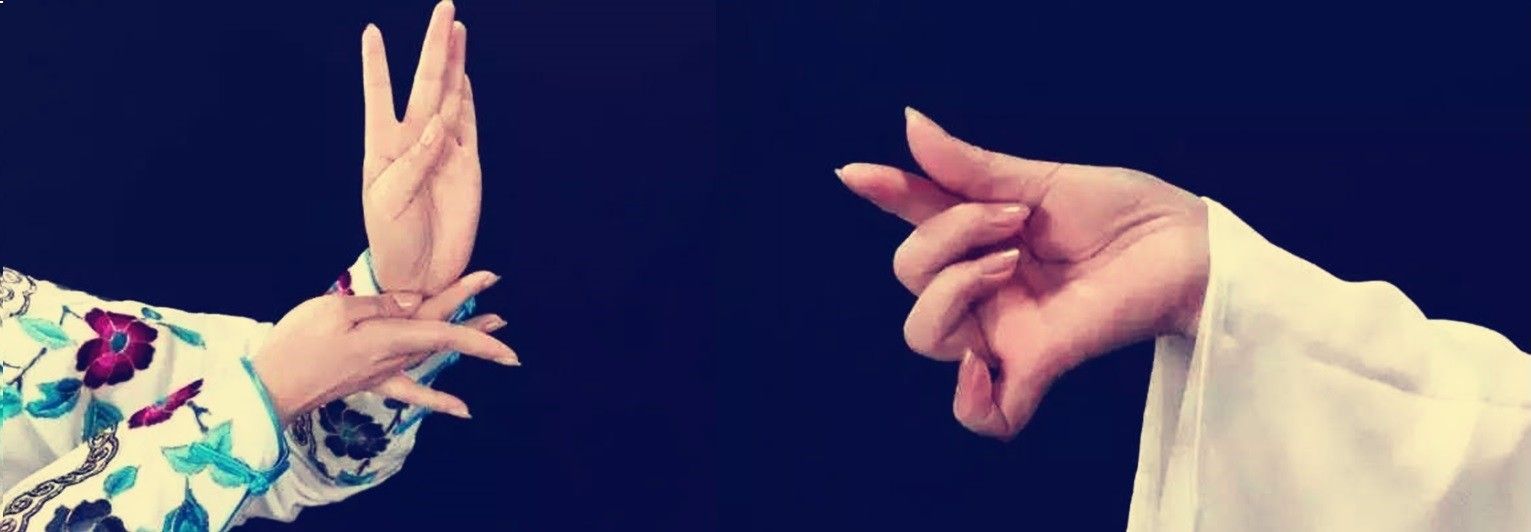
In the performance, the Beijing Opera actors' hand (gestures 手), eye (vision 眼), body (postures 身), rule (technical methods and specifications 法), and gait (stage steps 步), namely the five rules (五法) we often say, should follow the stylized norms, and even the gesture and action need particular attention. Each type of role has its own requirement, for examples, Wu Sheng shall put together his five fingers, Hualian shall separate his five fingers, Lao Sheng's fingers shall be separate and slightly curve, and Xiao Sheng shall press his thumb on the palm. Different fingerings convey different meanings. "Angry finger" refers to anger, and "shocking finger” refers to shock. Dan mostly uses the "orchid finger", and Mei Lanfang uses over thirty kinds of gestures to express various mentalities of the roles.
In addition, there is also the water-sleeve skill, to display various moods of the character by jittering or shaking the water-sleeves. Rapid downward Hinging the sleeves mean anger and refusal; lifting the sleeve to cover the head means panic or sorrow; waving the sleeves to draw circles or swinging the sleeves refers to excitement or anxiety.
In The Phoenix Returns to Its Nest' the character should, at Cheng Xueyan's first appearance on the stage and exit after the first appearance, poise Qing Yi’s posture to walk-up and down, demonstrating that although she looks ugly and behaves indecently, she is on earth the daughter of an official, and also a descent of a notable family. For another example, when she and Mu Juyi meet in the study room, her body movements shall from time to time show her vulgar and stupid actions in huge contrast with her appearance of a daughter of a notable family, to create a great comic effect.
In an
excerpt In the Ugly Bridal Chamber of the play, the Xuezi Chou character Zhu Huanran
is immensely proud to call his friends out to celebrate his wedding, but his
friends speak with witty recitatives: "As to today’s wedding, each has
her/his own mind. The two small clowns are really a pair of painted hammers.
You don't have to mind her ugly, and she shall not care about your shadiness.
On the wedding night, no one shall be blamed..." At this time, Zhu Huanran
takes off the veil and is stunned at the fact that the bride is the ugly
Xueyan instead of the beautiful Xue'e, and sings: "I see that the woman is
terribly ugly, with a big mouth, yellow teeth, and upturned nostrils. Her hands
are like steel drills, and under her skirt exposes the two-chi (chi is a
Chinese measurement and one chi is equal to 33.3 centimeters) 'lotus feet’. I
must have met the ghost. I am trembling with terror, where does the demon come
from to entangle me?” The two clowns now suddenly realize that they have done a
seemingly clever thing which turns out to be a foolish one instead. Although
they regret very much, since they have been into the bridal chamber and what's
done can not be undone, they have to acknowledge the marriage of an ugly
couple. Singing, recitative, and acting are combined in this part, and it
renders the comic effect through exaggerated performance. One can not help
but be uproarious.
4, Acrobatic Fighting 打
Dear foreign friends, have you ever seen the acrobatic fighting performed by Beijing Opera actors on the stage? And watched them wave the dazzling diversified weapons and fight and wrestle with each other on the stage? This is acrobatic fighting in the Chinese opera. The acrobatic fighting in Beijing Opera is different from that in the reality of life and is also different from the martial arts in martial arts films, but it is grappling with a strong dancing effect. The two most common types of martial arts in Beijing Opera are somersault wrestling and fighting with a broadsword, spear, sword, and halberd. The martial arts play is usually intense and nervous, but sometimes also can bring the audience laughter. The difference between the fighting in Beijing Opera and that in other operas lies in the stylized performance of the martial arts, actions with dance effect, highly romanticized performance, being more difficult in performance and stronger expressiveness. For example, the pair fighting between the rallies of the two armies has a fixed form, and different weapons are applied according to the situation whether the battle is intensified or be well-matched in strength. The general at the stage comer uses the weapon to push aside the enemy's broadsword and spear on both sides, and the enemy goes down in parades, called taking off the boots in reverse; the victorious general will go down triumphantly, called proudly exit. However, no matter how fierce the fight and wrestling are on the stage, it will not appear in Beijing Opera scenes that are badly mutilated and too horrible to look at, because the martial arts in Beijing Opera are a rhythmic dance with a strong romantic color.
Formerly in The Phoenix Returns to Its Nest, there was a segment of the play in which a bandit insurrection arose. Cheng Pu suppressed the insurrection and Mu Juyi also joined the army, because the whole play stresses the sorrow and joy, separation and union of the love between the man and woman, so this fighting a segment of the play is omitted. In short, the singing, recitative, acting and acrobatic fighting are not completely separated, but perfectly mingled together. Although the singing, recitative, acting, and acrobatic fighting in every scene are not identically proportionate, but alt are arranged properly, converged naturally and mingled together, forming a comprehensive performing art in which singing goes with the sound, dancing goes with the move, and singing goes with dancing. By precisely applying the traditional performing practices of Beijing Opera, it vividly depicts the characters in the play The Phoenix Returns to Its Nest. Although it is a traditional drama in ancient costumes, it is by no means crudely made, and indeed the social background can be mingled to depict the characters in the play. Although it describes a marriage story about the royal kinsman, its contents focus on the love among the folk people, embodying the ordinary people's longing for the beautiful love and sound marriage, and pursuing the honest truth.
Responses • 0
0/2000
ID: 322
Matthias
Offline
1 day
Visited
From
Orlando, United States
Send Message